PLD Space, an international space transportation company, is advancing towards the final validation of its reusable MIURA 5 orbital launcher, developed in a record time of just two years. This unprecedented global achievement confirms the company’s industrial maturity and its ability to provide Spain and Europe with a new sovereign access to space. The development of MIURA 5 builds on the experience gained from the MIURA 1 program and is based on a vertically integrated industrial model and a “test and learn” philosophy, where every test is an opportunity for improvement.
“Reliability is built by testing. Every component, engine, and system undergoes an exhaustive validation process before flying. That’s how you move fast — but safely,” said Raúl Torres, CEO and Co-founder of PLD Space.
MIURA 5 is currently in the qualification and validation phase of all its subsystems engines, structures, avionics, GNC, separation systems, and fairing after completing the engineering stage and initial development test campaigns. PLD Space is advancing in all development phases in parallel. In design, it has closed the Critical Design Review (CDR) of the launch system, a final technical review that indicates the rocket design is ready to proceed to final tests and the actual flight of MIURA 5. Additionally, the company completed the first phase of the Flight Safety Validation process with CNES, a key step for operations at the Guiana Space Centre (CSG) in Kourou.
The company is in the semi-serial production phase of all its subsystems. In structures, it has produced eight complete tanks to date for both the first and second stages. In propulsion, it has completed the manufacture of the first full units of TEPREL-C, the most powerful private rocket engine in Europe (190 kN), doubling the power of competitors in its range, as well as TEPREL-Vac for the second stage. This achieves an industrial maturity level that will allow the company to produce one engine every 14 days by the end of 2025.
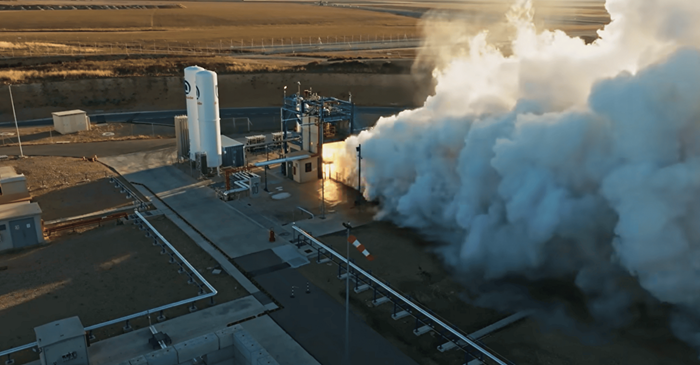
Regarding testing, in addition to validating critical TEPREL-C hardware — such as turbopumps and gas generators — PLD Space is successfully conducting hot-fire tests of fully integrated engines as part of its qualification campaign. “The results from the TEPREL-CVac hot-fire tests we have conducted so far demonstrate the strength of the engine development know-how we have built internally over more than a decade,” said Raúl Torres.
Beyond engine testing, the company has carried out pressure, compression, and cryogenic tests on all MIURA 5 tanks, as well as fairing deployment and stage separation tests. In the launch phase, civil works for the MIURA 5 Launch Complex at CSG Kourou are progressing, positioning PLD Space as the first private company to start building its launch base in the ELM-Diamant area. In parallel, the company is manufacturing the launch pad in Spain, as well as the containers that will transport the rocket by ship to Kourou.
The company aims to have the first fully integrated MIURA 5 launcher ready before the end of 2025 to begin demonstration flights in 2026. The commercial phase has already started, with several launch slots reserved. The success of MIURA 5 positions PLD Space as a European benchmark and Spain as a key player in shaping the future of space transportation. The company is driving the creation of a critical global capability, where access to space will be as decisive for industrial development as the Internet was for the digital era.
With over €170 million in funding and a top-tier network of technological partners, PLD Space is leading the industrialization of the European aerospace sector, contributing to Europe’s strategic autonomy in space. The company’s supply chain currently includes 397 key partners, mainly based in Spain and across Europe. Between 2024 and the first half of 2025, total investment in the MIURA 5 supplier network exceeded €50 million. PLD Space’s growth is driven by a young, highly qualified international team. In 2025, the workforce grew by 40%, surpassing 400 employees, and is expected to reach 420 by year-end.
“This is the team that made it possible to develop an orbital rocket in half the time of our international competitors,” said Ezequiel Sánchez, Executive President of PLD Space. “We are proving that we have what it takes to lead the next generation of space transportation — and that the future of innovation will be built in space.” PLD Space currently operates more than 180,000 m² of proprietary infrastructure, including Europe’s largest private rocket test center in Teruel (Spain), which has recently expanded with four new test benches, and the upcoming Launch Complex in Kourou (French Guiana), from where MIURA 5 will perform its first missions in 2026.