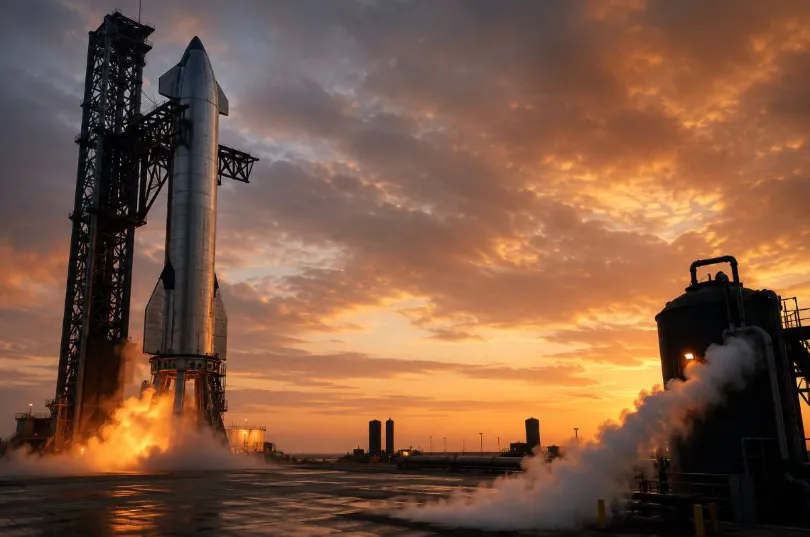
The launch team at Starbase, Texas, north of the US-Mexico border, aimed to lift off at 5:45 pm local time. The countdown had proceeded smoothly through the day, including the loading of more than 11.5 million pounds of liquid methane and liquid oxygen into the two-stage rocket, which stands more than 400 feet tall. The abort came as the countdown clock reached zero during the booster’s ignition sequence.
Elon Musk, SpaceX’s founder and CEO, wrote on X that some of the engines did not start, triggering the automatic abort, and that the company was offloading propellant with a next attempt hoped for in a few days. Later Thursday, Musk said ground teams would replace two of the Raptor engines on the Super Heavy booster and that the most probable launch timing was early next week. SpaceX did not state how many engines failed, but a graphic on the company’s live stream indicated four of the 33 never ignited.
The Super Heavy booster carries 33 methane-fueled Raptor engines, each capable of more than half a million pounds of thrust, which ignite in a staggered sequence after activation of the pad’s water-cooled flame diverter. The engines flying on this vehicle are SpaceX’s third-generation Raptor 3 design. Flight 13 is the second launch to use the Raptor 3 on the upgraded Starship Version 3, which debuted on a mostly successful test flight in May. On that mission the pad startup sequence went off without a hitch, though the Raptor 3s experienced in-flight issues.
Goals for Flight 13 include testing corrective actions from Flight 12. SpaceX said that at stage separation in May, slight differences in engine startup on the ship caused the booster’s directional flip to be off by roughly 90 degrees, and the startup sequence was modified to be more robust to timing variability. Some of the booster’s engines also failed to reignite during the landing burn in May, preventing a controlled splashdown, and one of the six Raptor engines on the upper stage shut down prematurely, forcing SpaceX to skip an in-space reignition attempt. The company wants to demonstrate a controlled booster splashdown and an in-space Raptor relight on Flight 13.
A successful flight would help clear the way for SpaceX to move to an orbital flight, a step toward using Starship for Starlink satellite launches and orbital refueling tests. That progression would move Starship closer to readiness for flights to the Moon in support of NASA’s Artemis lunar lander program.
SpaceX officials did not immediately announce when they plan to try again. Musk indicated the most probable launch timing is early next week, following the replacement of two Raptor engines on the Super Heavy booster.