
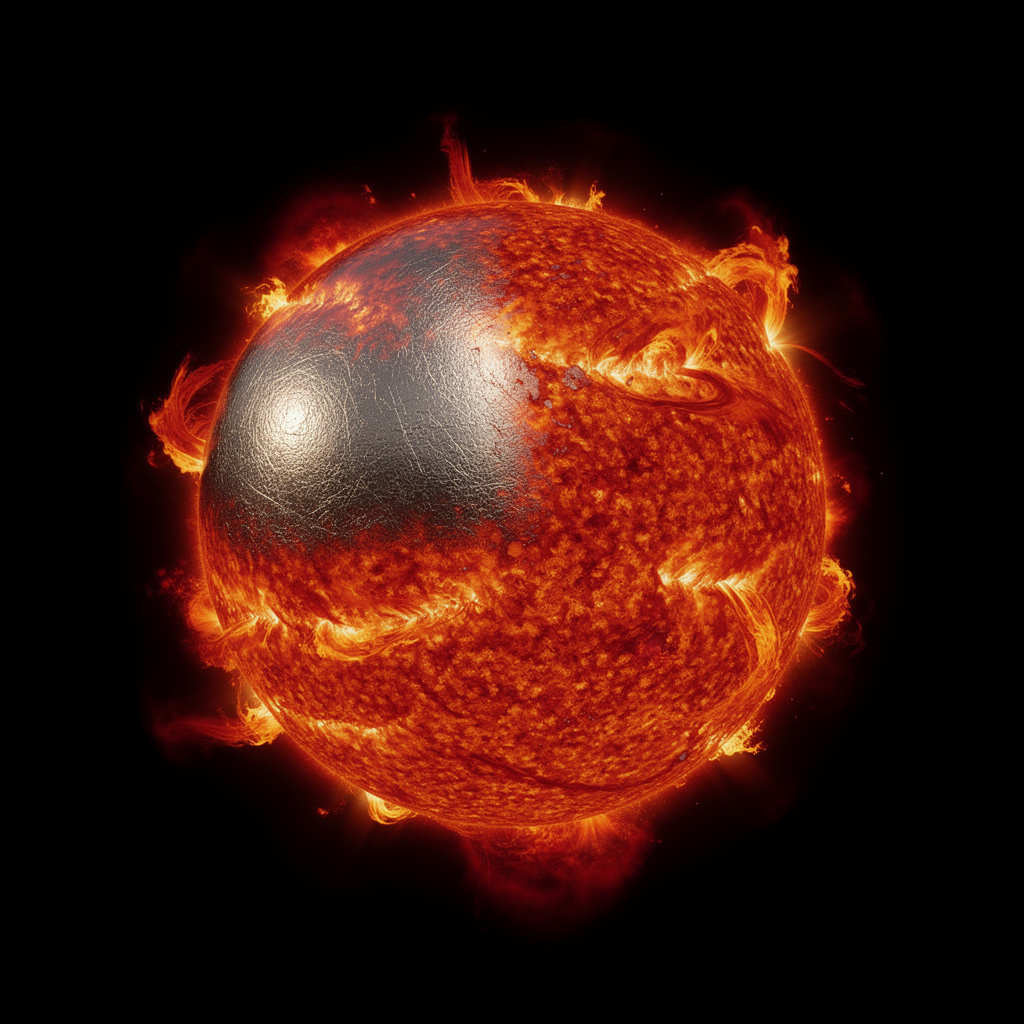
The Sun is made almost entirely of hydrogen and helium, with heavier elements such as carbon, iron, and silver accounting for only 1.5 percent of its mass. Despite these small quantities, these elements are valuable to astronomers because they preserve clues about the chemical development of the cosmos. Earlier estimates of the Sun’s silver content relied on simplified models of its atmosphere, which the new work replaced with a more advanced approach.
The research was carried out by Sema Caliskan during her PhD studies at the Department of Physics and Astronomy at Uppsala University. To measure the Sun’s silver content, the team studied sunlight through spectroscopy, in which atoms in the solar atmosphere absorb light at particular wavelengths, leaving dark spectral lines that act as an elemental fingerprint. Scientists compare these patterns with atmospheric models to calculate how much of an element is present.
The team combined a dynamic model of the Sun’s outer layers with improved atomic physics calculations, allowing a more accurate description of how silver atoms interact with light and surrounding particles. Unlike earlier methods, the new calculations account for non-equilibrium effects, in which the light itself affects the same silver atoms responsible for producing the absorption lines. The result was a silver estimate 55 percent higher than before.
The revised figure addresses a problem that had been difficult to explain. Previous measurements suggested the Sun contained significantly less silver than chemically primitive meteorites, even though the Sun and those meteorites formed from the same cloud of gas and dust about 4.6 billion years ago. With the new calculation, the Sun’s silver abundance is now much more consistent with the amount found in these ancient meteorites.
Caliskan said the updated knowledge of the Sun’s composition matters for understanding other stars, planets, and cosmic material, because the Sun is one of astronomy’s key reference points. Heavy elements are created inside stars and during stellar explosions before being incorporated into new stars and planets, and measuring their abundance helps scientists trace the chemical evolution of the Milky Way. The findings may also improve understanding of how silver and other heavy elements form before becoming part of later generations of stars and planets.
The researchers now plan to apply the same method to other stars. By studying the light of stars of different types and ages, Caliskan said, the team hopes to understand where silver is formed in the universe and how it has been distributed throughout the Milky Way over time. The calculations were performed with Tetralith, a Swedish supercomputer at the National Supercomputer Center at Linköping University, and mark the first time this approach has been applied to silver in the Sun.