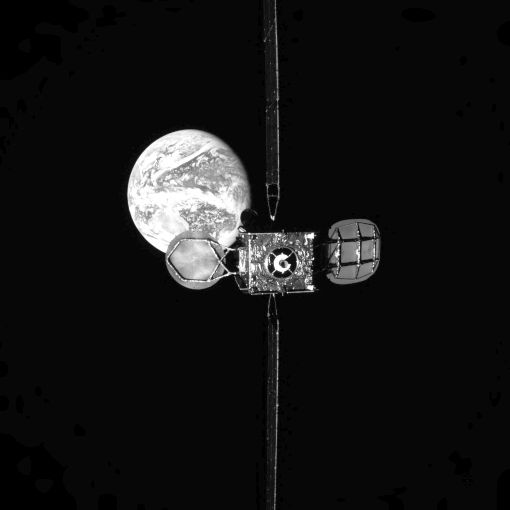
For decades, satellites have largely been treated as disposable assets: once their fuel runs out, spacecraft worth hundreds of millions of dollars can reach retirement even while their hardware remains operational. In 2020, a “space tug” demonstrated a different approach. In-orbit servicing is now beginning to turn satellite ownership into long-term asset management—and its development could prove crucial to the future of orbital data centers.
1. When a Healthy Satellite Runs Out of Fuel
Geostationary satellites can reach the end of their working lives for a frustrating reason: their hardware still works, but their propellant is nearly exhausted. Solar radiation pressure and gravitational disturbances continually affect their orbits, requiring regular station-keeping maneuvers.
Without sufficient propellant, a satellite that cost $300 million–$500 million can lose its ability to maintain its assigned position, even if its transponders, antennas and solar arrays remain functional. For many conventional GEO satellites, a nominal 15-year design life reflects the propellant budget as much as the durability of the hardware.
This gap between remaining technical capability and available fuel created the opening for commercial satellite servicing.
The milestone came in February 2020, when MEV-1 docked with Intelsat 901. Developed by Northrop Grumman’s SpaceLogistics, the Mission Extension Vehicle attached itself to the satellite, launched in 2001, and took over propulsion and attitude control. Rather than transferring fuel, it effectively became an external propulsion system.
The result was five additional years of service. Intelsat 901 retired in 2025 after nearly 24 years in orbit, compared with its original 15-year design life. In April 2025, MEV-1 separated from the satellite in a GEO graveyard orbit—the first undocking between two commercial spacecraft in that orbital region.
Satellite life extension had completed a full commercial service cycle: docking, sustained operations, retirement and departure for another assignment.
2. From Demonstration to Repeat Business
A convincing commercial market requires more than a successful debut. It needs customers willing to purchase further services. Satellite life extension is beginning to build that record.
MEV’s design contains an important commercial insight: it docks using an engine nozzle already present on compatible client satellites. The customer does not need to have installed a dedicated servicing interface before launch.
That expands the addressable market beyond future spacecraft designed for servicing to a substantial installed fleet already in orbit.
3. A Market Developing at Different Speeds
In-orbit servicing encompasses several distinct businesses. Taking over a satellite’s propulsion, transferring fuel and removing debris involve different technical requirements—and very different levels of commercial maturity.
Market forecasts suggest considerable growth, although estimates vary with the services included. One projection puts the overall on-orbit services market at approximately $3.2 billion in 2026, rising to $6.9 billion by 2034. Refueling is also expected to expand substantially as compatible spacecraft and delivery infrastructure become available.
The commercial pattern is becoming clearer: services that preserve an identifiable revenue-generating asset have the clearest path to payment.
4. Why Orbital Data Centers Need Servicing
Extending Platform Life
Battery degradation can constrain the useful life of computing satellites, particularly those undergoing frequent charge-discharge cycles. If future spacecraft are designed for battery replacement, servicing could extend their operating lives—provided their other subsystems remain healthy and the economics justify the mission.
That would allow operators to manage selected components as replaceable equipment, rather than retire an entire platform when one critical subsystem reaches its limit.
Creating an Upgrade Path
GPU generations can advance on roughly two-year cycles, while satellite platforms may remain in orbit for a decade or longer. Replaceable computing modules could help orbital data centers keep pace with that development.
MRV’s ability to install propulsion pods illustrates the broader potential of robotic module installation. Replacing computing hardware would require additional capabilities, including serviceable electrical, data and thermal interfaces. It remains a future engineering objective rather than an established commercial service.
Strengthening the Investment Case
The inability to repair or upgrade expensive hardware is a significant concern for investors assessing orbital computing. Reliable servicing could reduce some of that risk and improve confidence in projected asset lifetimes.
The financing benefit would depend on demonstrated reliability, available servicing capacity and costs. It cannot be assumed simply because a servicing vehicle exists.
For long-lived space infrastructure, maintainability could become a central design requirement, influencing architecture, procurement and operating economics from the outset.
5. The Commercial Limits Still Matter
Life extension has paying commercial customers, but that success does not mean every servicing activity has an equally mature market.
Active debris removal remains largely supported by government and institutional buyers. ESA’s original ClearSpace-1 service contract was worth approximately €86 million. The mission subsequently changed its target after the original object was affected by a collision, and ESA now lists a planned launch in 2029.
Disposal contracts are emerging, including public-sector purchases of end-of-life satellite removal services. However, removing legacy debris still lacks the broad, recurring private-sector demand seen in established satellite operations.
The fundamental economic test also remains unchanged: the cost of servicing must be justified by the value it preserves. For inexpensive constellation satellites, replacement can be more economical than dispatching another spacecraft to recover or repair them.
The market is therefore advancing unevenly: life extension is leading, refueling is moving toward operational demonstrations, and large-scale debris removal still needs durable funding mechanisms involving public procurement, regulation or insurance.
From Spacecraft Ownership to Asset Management
In the six years between MEV-1’s historic docking and the launch of MRV with its robotic arms and propulsion pods, the industry’s central question has shifted from whether servicing is possible to when it makes financial sense.
As maintenance and upgrade options develop, space assets can increasingly be managed over their operating lives rather than treated as equipment that must eventually be discarded.
That shift also makes early mission planning more important: payload performance, platform lifetime and upgrade requirements need to be considered together. STARPATH GLOBAL combines in-house software capabilities with access to China’s established satellite, payload and AIT supply chain to help international teams match application needs with suitable mission resources. Teams exploring a custom satellite or onboard processing capability can explore the options with STARPATH GLOBAL, starting with their intended application, operating lifetime and budget.