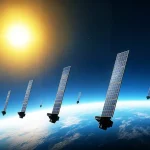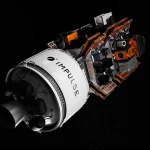
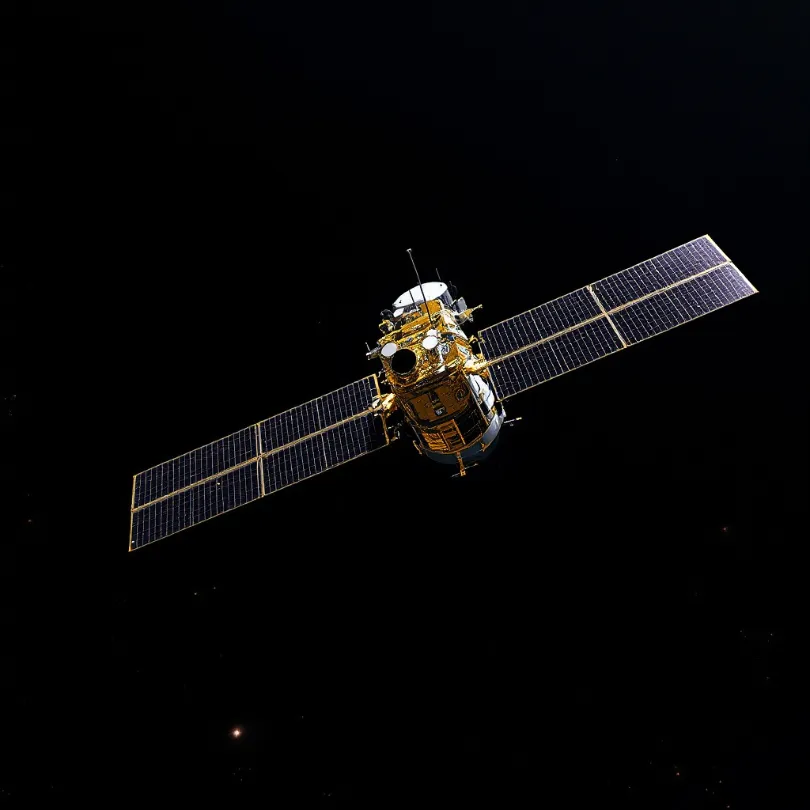
The experiment, called NAVI-Orbital, was conducted aboard Loft Orbital’s YAM-9 satellite and achieved its first successful in-orbit demonstration on April 16, 2026. According to the researchers, it represents the first reported demonstration of a vision-language model performing autonomous multimodal inference entirely aboard an orbiting spacecraft. Rather than simply capturing images and transmitting them to Earth for analysis, YAM-9 was able to run Google’s Gemma 3 model directly onboard. The AI classified newly captured Earth imagery, generated written descriptions of what appeared in each scene and could respond to follow-up questions from operators using natural language.
The model used for the demonstration was Gemma 3 4B, a roughly four-billion-parameter open-weights vision-language model developed by Google. NASA deployed a compressed 4-bit version requiring only about 8 GB of memory. Remarkably, the model did not require specialized modifications or fine-tuning for YAM-9’s imaging instrument before operating in orbit. The AI ran on an NVIDIA Jetson AGX Orin, a compact computing platform commonly used for robotics and edge AI applications. That distinction is important because NAVI-Orbital did not rely on a terrestrial data center to perform the inference. The image was captured in space, processed by the GPU aboard the spacecraft and interpreted by Gemma while still in orbit.
NASA’s system goes beyond simply putting an AI model on a satellite. NAVI-Orbital uses an agentic software architecture in which a LangGraph-based system coordinates different functions, including image detection and dialogue with operators. Instead of engineers having to translate a request into a rigid series of spacecraft commands, an operator can give the system instructions in ordinary language.
Juan M. Delfa, technical group lead at NASA and one of the researchers behind NAVI-Orbital, described that capability as a significant departure from traditional spacecraft operations. Scientists can effectively write a prompt and send it to the spacecraft, rather than relying exclusively on highly structured command sequences prepared through an operations team. The experiment also addresses one of the fundamental bottlenecks of Earth-observation satellites: bandwidth.
Modern imaging satellites can generate enormous quantities of data, but their ability to transmit that information to Earth is constrained by available bandwidth and limited ground-station contact windows. Traditionally, a spacecraft collects imagery, stores it and waits for an opportunity to downlink the data. Only after the data reaches Earth can researchers determine whether it contains something useful.
Onboard AI potentially reverses that process.
A future satellite could be asked to locate wildfires, flooding, ships, damaged infrastructure or other features of interest and analyze imagery as it is collected. Instead of transmitting every image, the spacecraft could identify relevant observations and send back descriptions, alerts or selected imagery. The NAVI-Orbital researchers refer to this concept as “semantic compression,” effectively transmitting the useful information contained in a dataset rather than automatically transmitting the entire dataset.
The researchers tested the system extensively before sending it to orbit. On the 7,960-image AID Earth-observation benchmark, NAVI-Orbital achieved 88.16% accuracy. It was subsequently validated on representative spacecraft hardware before being tested against newly captured and previously unseen imagery aboard YAM-9.
The significance extends beyond Earth observation. If increasingly capable foundation models can operate on relatively compact, low-power spacecraft computers, satellites could eventually become substantially more autonomous. Rather than functioning primarily as remote sensors controlled from Earth, spacecraft could interpret observations, prioritize data and potentially make operational decisions locally.
That capability becomes particularly valuable farther from Earth, where communications latency makes constant human supervision increasingly difficult. Mars spacecraft, lunar infrastructure and deep-space probes could potentially use similar systems to interpret their surroundings and respond to unexpected situations without waiting for instructions from Earth.
For now, however, NASA’s demonstration is considerably narrower than a fully autonomous spacecraft. Gemma is analyzing imagery and responding to prompts rather than independently commanding the satellite or controlling its flight. Still, the experiment demonstrates that a modern foundation model can run locally on satellite-class hardware and perform useful inference against real data collected in orbit.
Loft Orbital says its spacecraft already support hyperspectral, multispectral, radio-frequency and thermal sensors alongside onboard computing resources, creating the possibility of applying similar AI systems to several types of orbital data. The result points toward a different architecture for Earth observation: satellites that do not merely collect data for computers on Earth to understand, but increasingly carry the computers capable of understanding that data with them.