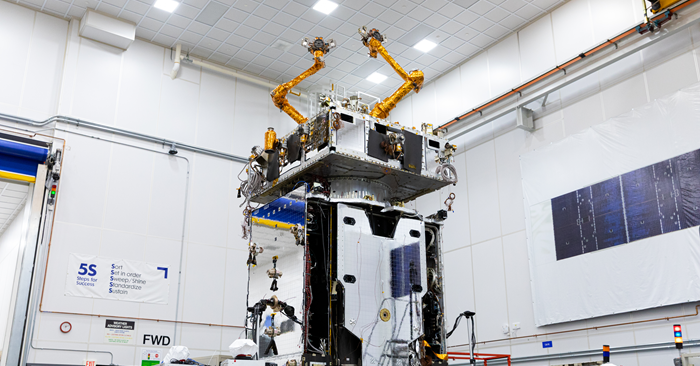
Northrop Grumman Corporation’s SpaceLogistics LLC has integrated a robotics payload onto its Mission Robotic Vehicle (MRV) spacecraft bus, achieving another milestone for its MRV and the Defense Advanced Research Projects Agency’s Robotic Servicing of Geosynchronous Satellites (RSGS) program. The sophisticated robotics of the MRV builds on the company’s proven satellite servicing technology.
Integrating the U.S. Naval Research Laboratory’s robotics payload onto MRV brings SpaceLogistics closer to delivering the first commercial spacecraft with robotic servicing capabilities for commercial and government satellites in geosynchronous Earth orbit. Next, it will go through environmental testing to validate its performance in space.
“Innovative. Flexible. Adaptable. That is how we see the future of on-orbit servicing, and it is why we are the leading industry advocate for a model of future satellite operations that increases value for our customers,” said Rob Hauge, president, SpaceLogistics. “With advanced robotics technology and our proven experience in satellite servicing, we are delivering the next generation of in-space sustainment technologies.”
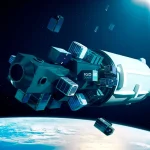
Northrop Grumman’s SpaceLogistics division is at the forefront of developing on-orbit satellite servicing technologies to extend the lifespan and functionality of satellites. Their flagship products include the Mission Extension Vehicle (MEV) and the Mission Extension Pod (MEP), which are pioneering tools in robotic servicing. These systems enable in-orbit life extension by docking with aging satellites, providing propulsion and attitude control. Key milestones include multiple successful dockings, launch collaborations with SpaceX, and partnerships with satellite operators like Intelsat and Optus. Northrop Grumman has also been selected by DARPA as a commercial partner for future robotic servicing missions, marking continued leadership in this domain.
Northrop Grumman’s space robotic servicing system, led by its Mission Extension Vehicles (MEVs) and Mission Extension Pods (MEPs), plays a critical role in modern space applications by enabling on-orbit servicing of satellites. This capability enhances the sustainability and cost-efficiency of space operations, reduces space debris by keeping assets functional longer, and provides satellite operators with greater flexibility and resilience in managing their orbital infrastructure, benefits that are increasingly vital as space becomes more congested and strategically important.