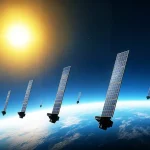
MOSCOW/KYIV, Aug. 13, 2026 — Russia is accelerating the deployment of Rassvet, a domestically developed low-Earth-orbit broadband constellation intended to reduce the country’s dependence on foreign satellite communications. Recent launches and orbital observations suggest that the project has moved beyond experimental testing, although its present capabilities remain far short of SpaceX’s Starlink network.
The system is being developed by Bureau 1440, a privately operated Russian aerospace company affiliated with ICS Holding. Bureau 1440 describes Rassvet as a future global broadband network using satellites connected by optical inter-satellite links.
Major General Vadym Skibitskyi, deputy head of Ukraine’s military intelligence agency, said in an interview reported on Aug. 10 that Russia was deploying the network “much faster than originally planned.” He said 16 Rassvet satellites were already operating and cited Russian targets of 292 spacecraft by 2027 and 924 by 2035. He also said Ukrainian officials had begun discussing possible countermeasures.
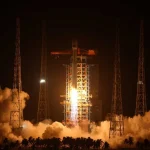
The figure of 16 requires qualification. Public launch records indicate that Russia launched a first batch of 16 production-model Rassvet-3 satellites from the Plesetsk Cosmodrome on March 23, followed by another 16-spacecraft batch on July 19. One satellite from the first batch subsequently failed to raise its orbit and re-entered the atmosphere in June. The cumulative number launched in the two production batches is therefore 32, while the number considered operational depends on whether spacecraft still raising their orbits are included.

Engineers and flight controllers monitor Rassvet satellite telemetry, orbital paths, and network data.
Intermittent coverage over Ukraine
Rassvet does not yet offer continuous service over Ukraine. Orbital analysis published by the Ukrainian defense outlet Militarnyi on July 31 found that the first production batch was creating at least two usable communication windows per day, each lasting roughly one to one-and-a-half hours.
The satellites pass within view of Ukraine more frequently, but only some passes place them high enough above the horizon to support a potentially stable connection. The second group launched in July was still maneuvering toward its intended orbital configuration and could add further coverage once deployment is completed.
These observations show that Rassvet has achieved meaningful regional visibility, but they do not by themselves prove that Russian military units are already using an operational broadband service. Public information about user terminals, gateways, network capacity and field deployment remains limited.
Nor is Rassvet currently comparable in scale with Starlink, which operates thousands of active satellites. Building a few hours of daily coverage over selected latitudes is substantially easier than delivering uninterrupted, high-capacity service to large numbers of users.
Technical progress—and important caveats
Bureau 1440 says its planned service will provide user-terminal data rates of up to 1 gigabit per second and latency below 70 milliseconds. Its spacecraft are designed to use domestically developed laser terminals for inter-satellite communication, reducing the number of ground gateways required to route traffic over long distances.
The company previously reported experimental optical-link tests at 10 gigabits per second. That figure refers to communications between test satellites, however, and should not be confused with the speed available to an individual ground user.
Likewise, the advertised 1Gbps speed and sub-70ms latency are design or service targets rather than independently verified performance levels for the present production constellation. Claims that current spacecraft maintain end-to-end latency below 60 milliseconds or offer 30% more bandwidth than earlier models could not be confirmed from reliable public documentation.
Bureau 1440’s use of near-polar orbits is particularly relevant to Russia. Such an architecture could eventually serve Siberia, the Far East, Arctic transport routes and remote industrial sites that are costly to connect by fiber or conventional mobile networks.
The company lists aviation, rail transport, shipping, mining, geological exploration, telecommunications backhaul, education, healthcare and emergency services among its intended markets. It has also announced cooperation with major Russian transport and telecommunications companies.
Military potential remains largely prospective
Rassvet is formally presented as a commercial broadband system, but a sovereign low-orbit network would have clear dual-use value.
If equipped with suitable terminals, Russian forces could potentially use it for resilient command links, reconnaissance-data transmission and communications with mobile or unmanned platforms. Ukrainian analysts have suggested that future terminals might be installed on long-range Geran-family drones or unmanned surface vessels.
These scenarios are technically plausible, but they remain assessments rather than confirmed operational deployments. No reliable public evidence currently demonstrates that Geran-4 or Geran-5 drones are carrying working Rassvet terminals, or that the network is already guiding Russian weapons.
A mature constellation could nevertheless reduce Russia’s reliance on foreign services. Russian forces had previously obtained unauthorized Starlink terminals, but Ukraine worked with SpaceX to restrict devices that were not registered on approved Ukrainian lists, according to Skibitskyi and Reuters.
Russia is simultaneously developing electronic-warfare capabilities intended to interfere with satellite-supported Ukrainian operations. Reuters reported in July that Russian jammers had been deployed near military facilities and other protected sites, including systems capable of disrupting some Starlink connections. Such interference appears localized and variable, rather than evidence that Russia can disable the entire network.
An ambitious timetable
Bureau 1440 has moved from two three-satellite experimental missions, launched in 2023 and 2024, to batches of much larger production spacecraft. This is a substantial industrial step.
Russian planning documents and public statements have nevertheless given different constellation targets over time, including approximately 250, 288 or 292 satellites for initial service and more than 900 by 2035. The latest figure cited by Ukrainian intelligence is 292 satellites in 2027 and 924 by 2035.
Reaching the near-term target would require a sharp increase in launch frequency, satellite manufacturing and ground-terminal production. Two batches of 16 satellites demonstrate progress, but they do not establish that Russia can sustain the launch cadence needed to place nearly 300 spacecraft in orbit by the end of 2027.
The project also has substantial state backing. Public reports cite approximately 102 billion rubles in planned federal support under Russia’s Data Economy program, alongside hundreds of billions of rubles in expected private investment. The exact financing schedule and proportion already disbursed are not fully transparent.
Rassvet should therefore be regarded as a credible and strategically important emerging system—not yet a Russian equivalent of Starlink in operational scale. Its near-term significance lies in intermittent regional connectivity, technology development and the creation of an independent communications infrastructure. Its longer-term military and commercial impact will depend on whether Bureau 1440 can convert early launches and laboratory performance into mass production, reliable user terminals and continuous service.