SpaceX is now targeting its first attempt to catch a returning Starship upper stage with the launch tower “chopstick” arms within the next few months, a shift from earlier expectations that the milestone could occur on the vehicle’s next flight.
The updated timeline came from CEO Elon Musk, who said the company’s first Starship tower-catch attempt is likely still several months away. The change follows weeks of growing anticipation surrounding Flight 14, which had previously been discussed as a potential candidate for the historic recovery test. The upper stage recovery remains dependent on regulatory approvals and SpaceX’s assessment of flight readiness.
The planned maneuver represents one of the most technically ambitious objectives in the Starship program. While SpaceX has already demonstrated multiple successful catches of the Super Heavy booster using the launch tower at Starbase, Texas, no Starship upper stage has ever been recovered directly by the tower. Achieving that capability is considered a critical step toward the company’s long-term goal of creating a fully and rapidly reusable launch system.
From Ocean Splashdowns to Precision Tower Recovery
The Starship program has advanced significantly over the past two years, progressing from destructive test flights to increasingly controlled recoveries.
A major breakthrough occurred during Starship Flight 13 on July 24, 2026, when the upper-stage vehicle known as Ship 40 survived atmospheric reentry and executed an intact splashdown in the Indian Ocean. The vehicle was later recovered near Australia’s Christmas Island after a complex maritime operation lasting more than three weeks.
The successful recovery provided SpaceX engineers with something they had never possessed before: a flown Starship upper stage available for detailed post-flight inspection. Engineers can now directly examine thermal protection tiles, structural components, propulsion systems, and aerodynamic surfaces after exposure to orbital flight and reentry conditions.
That mission represented a crucial precursor to any future tower catch attempt. Recovering the vehicle intact allows SpaceX to validate models, identify damage mechanisms, and refine landing guidance systems before attempting a far more demanding return to Starbase.
The company has long followed an incremental testing philosophy summarized internally as “Fly, Learn, Repeat.” Rather than attempting all capabilities simultaneously, SpaceX typically introduces new objectives one at a time as confidence increases.
The Engineering Challenge of Catching Starship
Catching a Starship upper stage is considerably more difficult than recovering the Super Heavy booster.
The booster returns shortly after launch and follows a relatively predictable ballistic trajectory. SpaceX has already demonstrated several successful booster catches using the launch tower’s giant mechanical arms, commonly known as “Mechazilla.”
The upper stage presents a different challenge altogether.
After reaching orbit, Starship must survive orbital velocities exceeding 27,000 kilometers per hour before reentering Earth’s atmosphere. During descent, the vehicle experiences extreme heating generated by atmospheric friction. Thousands of heat-shield tiles protect the stainless-steel structure from temperatures that can exceed 1,400 degrees Celsius in critical regions.
Following reentry, Starship performs a controlled aerodynamic descent using large flaps to maneuver through the atmosphere. It then transitions into a vertical orientation for landing, reigniting Raptor engines before touching down—or, eventually, being caught by the launch tower.
To successfully execute a tower catch, the vehicle must arrive within an extraordinarily small positional tolerance. Even minor deviations could result in a collision with the tower or require an abort to a safer landing profile.
The operation effectively combines the challenges of orbital reentry, precision rocket landing, and real-time robotic capture into a single sequence lasting only seconds.
Why Reusability Matters to SpaceX’s Business Model
The importance of Starship recovery extends well beyond engineering prestige.
SpaceX’s entire long-term strategy depends on transforming orbital launch economics through rapid reuse. Falcon 9 demonstrated the financial benefits of recovering first-stage boosters, but Starship aims to extend that concept to the entire launch vehicle.
Today, even reusable rockets typically expend upper stages. Starship is designed to eliminate that limitation.
If both Super Heavy and Starship can be recovered, inspected, refueled, and relaunched rapidly, SpaceX believes launch costs could decline dramatically while flight rates increase by orders of magnitude.
That capability is essential for several future business cases:
* Deployment of larger generations of Starlink satellites.
* Construction of orbital infrastructure.
* In-space propellant transfer operations.
* Lunar missions under NASA’s Artemis program.
* Future Mars transportation systems.
* Large-scale deployment of orbital computing and communications assets.
Musk has repeatedly stated that Starship must eventually support airline-like operations, with vehicles flying frequently rather than being treated as disposable hardware.
Flight 14 Remains a Key Test Mission
Although the first tower catch may now occur later than previously expected, the next Starship flight remains highly significant.
Earlier plans outlined Flight 14 as a mission that could deploy upgraded Starlink satellites while continuing validation of Starship Version 3 hardware. The flight is expected to further demonstrate orbital operations and reentry performance while building confidence in vehicle recovery systems.
SpaceX has also been working toward operational deployment of Starlink V3 satellites, which are expected to offer substantially greater capacity than previous generations. Starship’s enormous payload capability is central to that expansion strategy because many of the larger satellites cannot be efficiently launched on Falcon 9.
As a result, Starship’s development timeline directly influences not only exploration programs but also one of SpaceX’s most important revenue-generating businesses.
Lessons From Earlier Milestones
The path toward a Starship catch has been years in the making.
When SpaceX first unveiled the concept of using giant launch-tower arms to recover rockets, many industry observers viewed the idea as excessively risky. Traditional launch systems typically rely on landing legs or expendable stages.
SpaceX instead pursued a more aggressive approach. By eliminating landing legs, the company can reduce vehicle mass and increase payload performance. The tradeoff is the need for extremely precise landings.
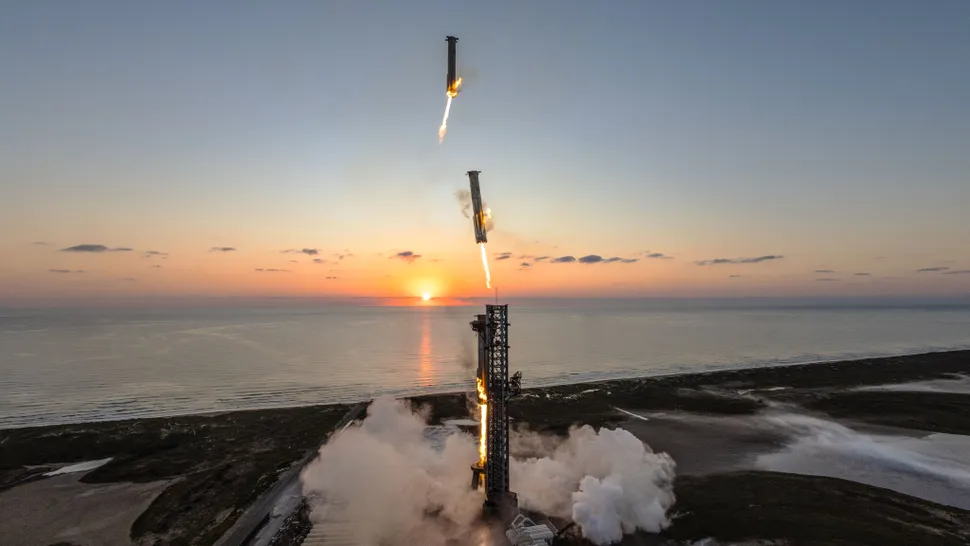
That gamble paid off in October 2024 when Super Heavy Booster 12 became the first rocket stage ever caught by launch-tower arms during Starship Flight 5. The achievement demonstrated that the concept was viable and established a new approach to rocket recovery.
Subsequent catches further validated the architecture and shifted attention toward the more difficult objective of recovering the orbital-stage vehicle.
The company’s development history suggests that apparent delays often reflect efforts to increase mission success probability rather than signs of program stagnation.
Implications for NASA and Artemis
NASA is closely watching every Starship milestone because the vehicle plays a central role in the Artemis lunar exploration program.
SpaceX’s Human Landing System variant of Starship was selected to transport astronauts from lunar orbit to the Moon’s surface. That architecture depends on capabilities that SpaceX is still developing, including orbital refueling and large-scale vehicle reuse.
A successful Starship recovery would strengthen confidence in the overall transportation system required for future lunar missions.
While a tower catch is not strictly required for Artemis, it would demonstrate a level of operational maturity that could reduce costs and increase flight cadence. Both factors are important because lunar missions may require numerous supporting launches to position propellant and hardware in orbit before crewed operations begin.
NASA therefore has a strong interest in seeing Starship evolve from an experimental test vehicle into a routinely reusable transportation system.
Competition in the Global Heavy-Lift Market
SpaceX currently holds a substantial lead in reusable heavy-lift launch technology, but competitors are advancing their own programs.
Blue Origin is developing New Glenn, a partially reusable heavy-lift rocket designed to compete for commercial, civil, and national security missions. However, New Glenn currently focuses on recovering only its first stage.
China is pursuing multiple reusable launch initiatives through both state-owned and commercial organizations. Several Chinese companies are testing vertical-takeoff, vertical-landing technologies inspired in part by Falcon 9’s success. Meanwhile, Chinese national space planners have outlined future super-heavy-lift architectures intended to support lunar exploration and deep-space missions.
Europe is also exploring reusable launch concepts, though most remain at earlier stages of development compared with SpaceX.
No competitor has yet demonstrated an operational equivalent of Starship’s planned fully reusable architecture. A successful upper-stage tower catch would therefore widen SpaceX’s technological lead and provide another proof point for its unconventional recovery strategy.
The Road Toward Fully Reusable Orbital Flight
The significance of the upcoming catch attempt extends beyond a single test objective.
For decades, the space industry has pursued full reusability as a way to dramatically lower launch costs. While reusable boosters have become increasingly common, a fully reusable orbital-class launch system remains elusive.
Starship is arguably the most ambitious effort yet to solve that challenge.
The recovery of Ship 40 demonstrated that Starship can survive orbital flight and return largely intact. The next major step is proving that the vehicle can return accurately enough for direct capture at the launch site.
If SpaceX succeeds, the company will move closer to a transportation model in which both stages can be rapidly turned around for subsequent missions. That capability would underpin future plans ranging from Starlink expansion and commercial space infrastructure to lunar logistics and eventual Mars expeditions.
For now, SpaceX appears willing to wait several more months before attempting the maneuver. Given the complexity of catching a 50-meter-tall spacecraft returning from orbit, additional caution may ultimately improve the odds that one of the most anticipated milestones in modern rocketry succeeds on its first attempt.
Conclusion
Elon Musk’s updated timeline indicates that SpaceX’s first Starship tower catch is no longer expected immediately, but the objective remains firmly on the company’s roadmap. The delay follows the historic recovery of Ship 40 after Flight 13 and reflects SpaceX’s incremental approach to developing full reusability.
When the attempt finally occurs, it will represent far more than a dramatic landing demonstration. A successful catch would validate a key element of SpaceX’s vision for rapidly reusable space transportation and bring the Starship program closer to supporting high-frequency launches, large-scale satellite deployment, lunar exploration, and eventually human missions to Mars.
Top image: Composite photo showing the Super Heavy booster of SpaceX’s Starship megarocket coming in for a landing on the launch mount during the vehicle’s fifth-ever test flight on Oct. 13, 2024. (Image credit: SpaceX via X)