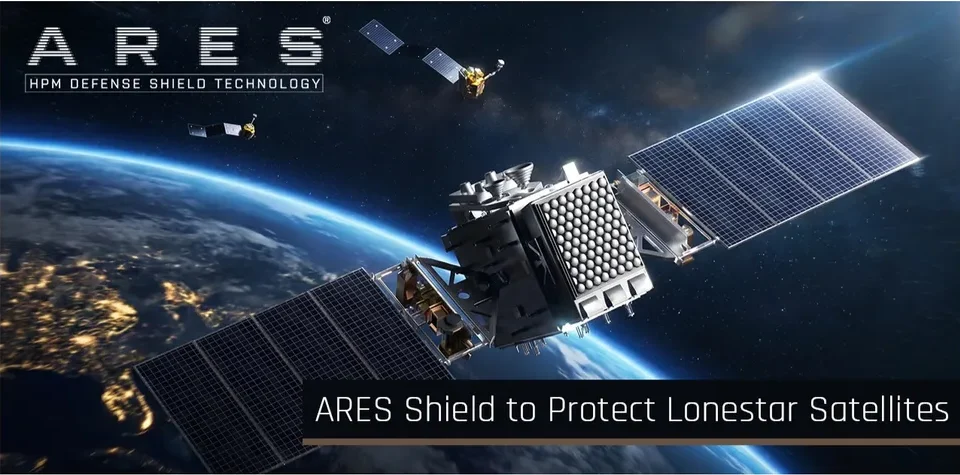
Florida-based Lonestar Data Holdings has selected Polish space security startup Ares Shield to provide protective systems for satellites supporting the company’s emerging orbital data storage infrastructure, marking one of the first publicly disclosed commercial agreements focused specifically on active satellite protection for space-based data centers.
Under the agreement, Ares Shield will initially equip three Lonestar spacecraft with protection modules. The contract has a potential value of up to $6 million if additional satellites in Lonestar’s future constellation adopt the technology.
According to information released about the program, Ares Shield’s system combines onboard sensors, artificial-intelligence-based threat analysis, and a high-power microwave capability designed to identify and respond to potential threats in orbit. The company says the module can detect and classify objects approaching a protected spacecraft, including so-called inspector satellites that maneuver near other spacecraft for observation or servicing purposes.
The award reflects a broader shift in the commercial space sector. As satellites increasingly support critical infrastructure, governments and commercial operators alike are becoming more concerned about space domain awareness, cyber resilience, and the possibility of intentional interference.
While satellite operators have traditionally relied on tracking data from government networks and commercial space situational awareness providers, the industry is beginning to explore onboard defensive capabilities that can operate autonomously when communications delays or operational constraints limit ground intervention.
The contract is strategically significant because Lonestar is not building a conventional communications or Earth observation constellation. The company is developing space-based data storage services designed to provide highly resilient and sovereign data protection for government and regulated-industry customers.
Lonestar’s concept centers on storing critical digital assets in orbit, creating a geographically and politically isolated backup environment that remains accessible even during terrestrial disasters, infrastructure failures, or cyberattacks. The company states that its next mission is scheduled for launch in April 2027 and that it is actively marketing storage capacity to government and enterprise customers.
For such a business model, physical satellite security becomes particularly important. Unlike traditional Earth observation satellites, orbital data vaults could eventually become repositories for government records, financial information, healthcare data, and other high-value digital assets. The loss or compromise of those spacecraft could have consequences extending well beyond the space sector.
Integrating defensive payloads onto commercial satellites introduces several engineering challenges.
Additional sensors, processing hardware, and microwave systems can affect spacecraft mass, power budgets, thermal management requirements, and electromagnetic compatibility. Satellite manufacturers typically must perform extensive environmental testing—including vibration, thermal vacuum, and EMC verification—to ensure that new payloads do not interfere with core spacecraft systems.
As commercial operators seek greater autonomy in orbit, spacecraft architectures may increasingly incorporate dedicated security subsystems alongside traditional avionics, communications, and payload functions. For satellite manufacturers, that trend could create a new category of hosted payloads focused on protection and resilience rather than mission operations.
The agreement also illustrates how artificial intelligence is moving deeper into spacecraft operations. Autonomous threat detection and classification could reduce operator workload while allowing faster responses to rapidly developing proximity events.
The Lonestar-Ares Shield agreement emerges amid growing global investment in protected space architectures.
Military organizations, including the U.S. Space Force, are increasingly funding resilient satellite networks, distributed constellations, and space-domain-awareness capabilities intended to operate in contested environments. Recent U.S. defense programs have emphasized proliferated constellations, secure communications, and persistent monitoring as key elements of future space infrastructure.
Commercial operators are beginning to face similar concerns. The expansion of in-orbit servicing, rendezvous technologies, and dual-use spacecraft has increased attention on proximity operations and the need for reliable identification of nearby objects.
While active satellite protection remains a niche market today, the emergence of specialized providers such as Ares Shield suggests that space security could become a distinct commercial segment as operators place increasingly valuable assets in orbit.
For Lonestar, the contract represents more than a security upgrade. It is an early indication that companies building space-based digital infrastructure are starting to treat satellite protection as a core requirement rather than an optional capability.