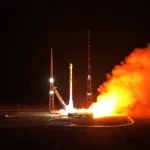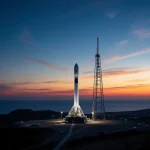
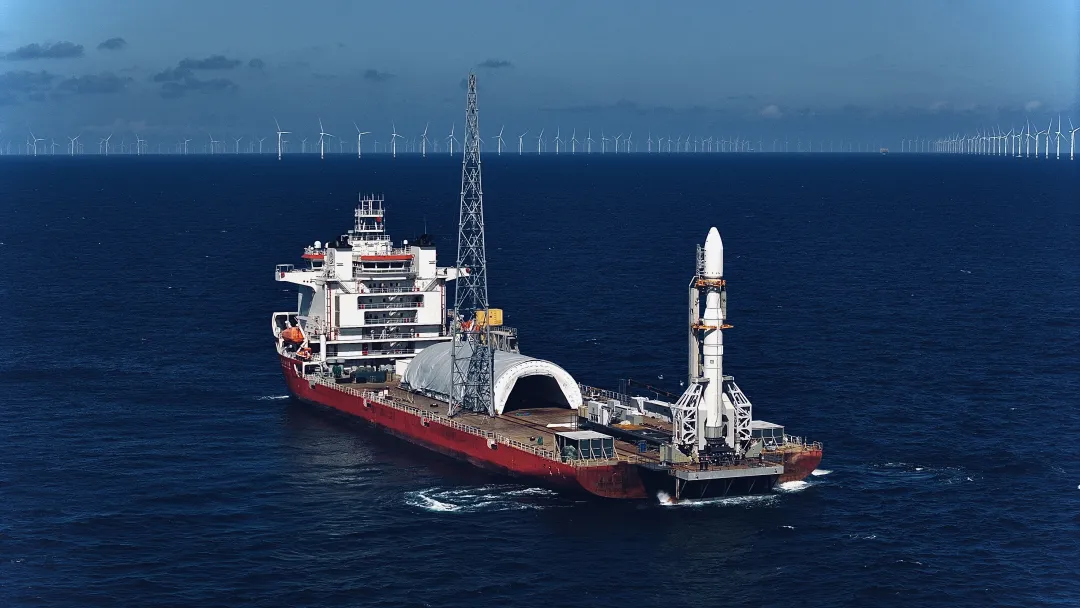
Chinese commercial space company CAS Space has completed a full mission rehearsal for the first sea launch of its Kinetica-1 solid-fuel rocket, bringing the maiden maritime launch closer to execution and validating the ground support architecture required to operate the vehicle from a moving offshore platform.
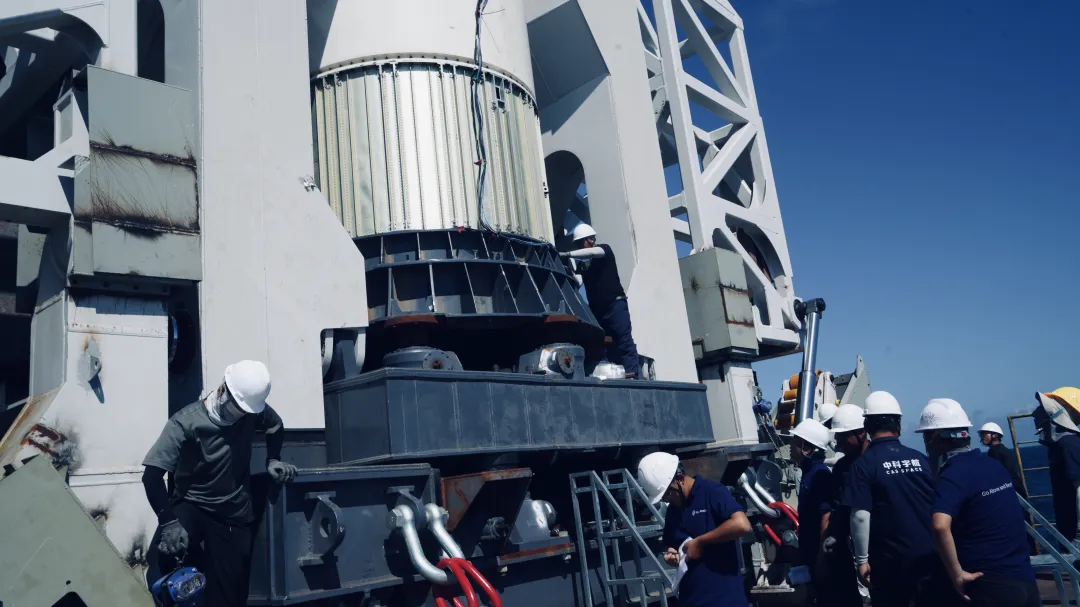
The Aug. 25 rehearsal simulated the launch-day sequence from transportation and platform operations through rocket erection and pre-launch preparation. More than 10 tests were conducted, including launch-tower erection, dynamic-platform self-alignment and operation of an anti-tip system. CAS Space said the exercise completed an end-to-end validation of its launch support system and connected the operational chain from land-to-sea transportation to offshore launch.
A launch system designed around rapid offshore turnaround
One of the central elements of the rehearsal was CAS Space’s highly integrated offshore launch tower, which the company describes as the world’s first integrated launch tower in the 100-ton-class solid-rocket category. Rather than separating rocket transportation, erection and launch-interface equipment into multiple systems, the architecture is designed to perform those functions as an integrated unit.
CAS Space said the tower can raise and return the rocket to its horizontal position in about 120 seconds. The company also says the shortest complete cycle from transportation to launch can be reduced to 48 hours.
That operating concept is particularly relevant to commercial constellation missions. Offshore launch sites can provide greater flexibility in launch azimuth and downrange safety compared with fixed land-based facilities, but they also introduce additional logistics and marine-weather constraints. Reducing the number of separate pieces of ground equipment and shortening the setup sequence can therefore have a direct effect on launch cadence and operating cost.
The approach is also consistent with the broader evolution of Kinetica-1 from an experimental vehicle into a higher-frequency commercial launch platform. CAS Space has increasingly emphasized standardized production, multi-satellite rideshare and rapid-response launch services for small and medium satellite missions.
Protecting a solid rocket in a marine environment
Moving launch operations offshore creates another engineering challenge: the marine environment is significantly more demanding for exposed hardware than a conventional inland launch site. Salt-laden air can accelerate corrosion of metallic structures, electrical interfaces and other exposed equipment, while humidity and condensation can complicate the protection of sensitive systems.
To address those conditions, CAS Space has introduced an inflatable membrane mobile environmental-control building for offshore operations. The company says the structure provides improved sealing and thermal insulation compared with conventional steel-frame facilities, while reducing weight by more than two-thirds. It also claims an approximately 80% reduction in overall cost and says the facility can be transported, installed and commissioned at a remote location within 48 hours.
From an engineering perspective, the significance of such a facility extends beyond simple weather protection. A controlled environment can reduce the exposure of rocket and ground-support equipment to salt spray and humidity during the relatively long period between marine transportation and launch. For a launch system intended to operate from different offshore locations, portability also becomes part of the system’s logistics architecture rather than merely a facility feature.
Keeping the rocket aligned on a moving platform
The most distinctive technical problem in an offshore launch is the launch platform itself. Unlike a fixed launch pad, a marine platform is continuously affected by vessel motion and environmental forces. Pitch, roll and yaw can change the launch system’s reference attitude, making precise pre-launch alignment more difficult.
CAS Space said its dynamic-platform self-alignment technology uses a proprietary high-precision alignment algorithm and flight-control software. The system can complete initial attitude alignment in as little as 30 minutes, according to the company.
The technical objective is straightforward: establish a sufficiently accurate reference frame despite the platform’s movement before the rocket enters its final launch configuration. This becomes particularly important for solid-fuel launchers, whose propulsion systems cannot simply be throttled or restarted in flight to compensate for every departure from the intended trajectory. Accurate initial alignment and robust guidance, navigation and control therefore form an important part of the overall launch-margin strategy.
A passive-release anti-tip system adds another safety layer
CAS Space has also developed a new anti-tip mechanism for the rocket. The system uses what the company describes as a passive-release architecture and is designed to rapidly move away from the vehicle’s flight path after release.
The design is intended to reduce dependence on an active release command at the critical moment of liftoff. In principle, reducing the number of functions that must execute correctly at the instant of launch can improve fault tolerance, although the actual reliability benefit will ultimately depend on qualification testing and operational experience.
Together with the alignment system, the anti-tip mechanism illustrates how an offshore launch system requires much more than simply placing an existing rocket on a ship. The launch platform, environmental protection, alignment, restraint and release mechanisms all have to be engineered as an integrated system.
Kinetica-1 enters the maritime phase after 15 flights
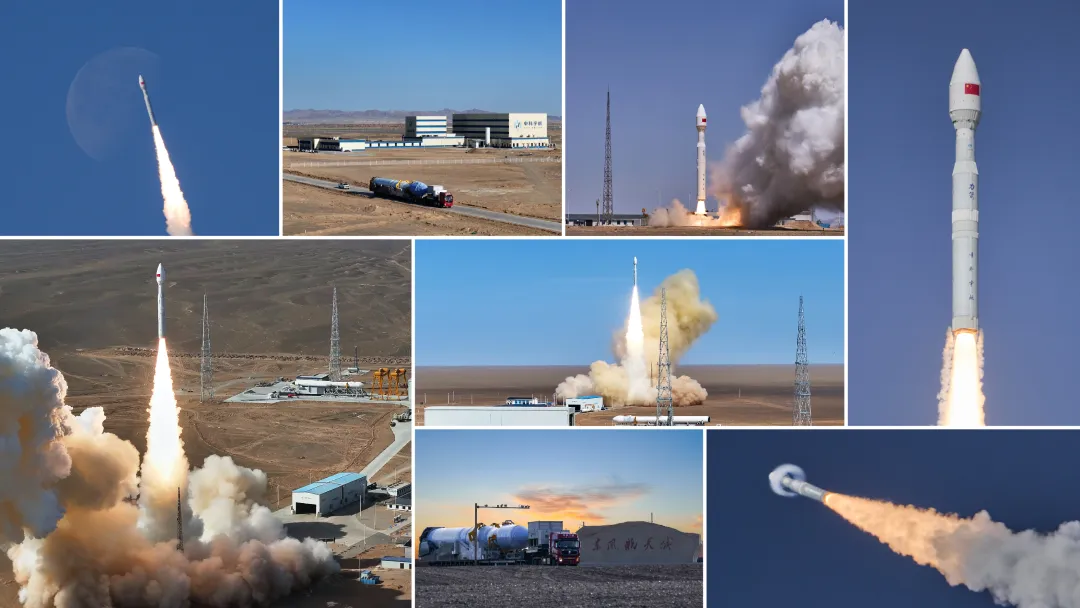
The upcoming mission will be Kinetica-1’s first sea launch and is planned to carry three satellites from waters near Guangdong. The mission will extend the rocket’s operating envelope from established land-based launch operations to a mobile maritime launch environment.
Kinetica-1 has completed 15 flights to date. As of its most recent mission, the rocket had delivered 110 satellites to orbit with a combined payload mass exceeding 16 metric tons. Its July 24 flight, Kinetica-1 Y15, successfully deployed five satellites and marked the 15th flight of the vehicle.
That flight history provides a useful foundation for the sea-launch campaign. The rocket is not being introduced to a new operating environment at the same time as it undergoes an initial flight-proving campaign; instead, the new challenge is primarily the integration of an established launch vehicle with a different launch infrastructure and operating environment.
Why the sea-launch capability matters for constellation operators
The commercial value of the demonstration will depend less on the novelty of launching from the sea than on whether the system can turn that flexibility into repeatable launch services.
For low-Earth-orbit constellation operators, launch demand is increasingly characterized by batches of satellites, replenishment missions and schedule-sensitive deployment. A mobile launch platform can potentially provide access to launch trajectories that are difficult to accommodate from fixed sites and can offer an additional option when land-based launch capacity is constrained.
CAS Space’s current operating model combines high-rate rocket production with both land and sea launch options. The company has positioned Kinetica-1 as a vehicle for ton-class, cost-sensitive small-satellite missions, while its broader launch-service portfolio includes dedicated and rideshare missions. The July mission, for example, carried five satellites for five customers, illustrating the type of multi-customer utilization that can help spread launch costs across a constellation or small-satellite campaign.
The immediate milestone is therefore the first offshore flight, but the more important commercial test will come afterward: whether the integrated launch system can maintain the claimed 48-hour transportation-to-launch cycle under real operational conditions, repeatedly deploy payloads with the required accuracy, and preserve the reliability demonstrated by Kinetica-1’s land-based flight record.
If those elements can be demonstrated, the sea-launch system could give CAS Space another tool for responding to the growing demand for frequent constellation deployment and replenishment, while providing a practical bridge between established land launch operations and more flexible maritime launch architectures.