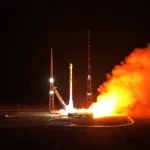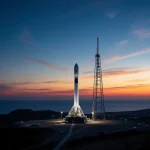
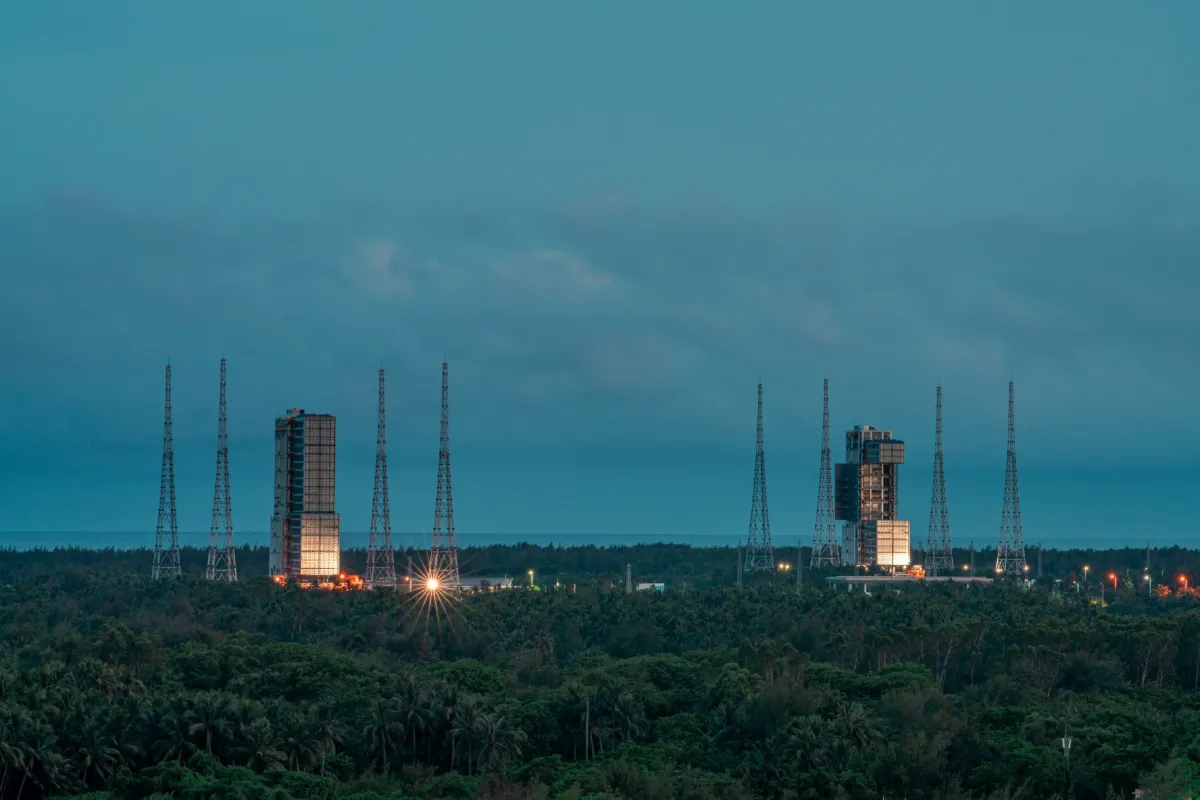
The global launch industry is entering a new phase, one defined less by whether rockets can reach orbit and more by how quickly launch capacity can scale.
Firefly Aerospace CEO Jason Kim recently pointed to a widening imbalance between the number of satellites waiting to fly and the amount of launch capacity available to carry them. Even with SpaceX maintaining an extraordinary launch cadence, commercial and government customers continue to seek more dedicated, flexible and responsive access to orbit. For China, where commercial launch companies and large satellite constellations are expanding at the same time, that shift could create a much bigger industrial opportunity than simply building more rockets.
It could also elevate Hainan from a launch site into the center of a broader commercial space ecosystem.
As China pushes toward higher launch frequencies, the industry will need far more than additional launch vehicles. It will need engine factories, test stands, satellite assembly lines, cryogenic propellant infrastructure, recovery systems, refurbishment facilities, tracking networks and faster ground operations. Much of that infrastructure works best when it is clustered around a high-cadence coastal spaceport.
That is what makes Hainan especially important.
The island’s value is not limited to latitude or launch azimuths. Its coastal geography, access to ports, room for downrange operations and growing commercial launch infrastructure give it the potential to anchor an integrated space transportation hub — one where rockets are assembled, satellites are integrated, vehicles are launched, boosters are recovered offshore and flight hardware is rapidly prepared for another mission.
In that sense, Hainan could play a role in China’s commercial space industry increasingly similar to the one Florida plays in the United States: not merely a place where rockets lift off, but a region around which an entire launch economy begins to organize.
The first-flight era is giving way to the production era
For much of the past decade, China’s commercial launch sector has been defined by technical milestones.
Engine hot fires. First launches. First successful orbital flights. Vertical takeoff and landing tests. Reusable booster demonstrations.
Those achievements answered the most basic question facing a young launch industry: Can the technology work?
The next stage asks a different question.
Can it work 20 times a year? Fifty times? Eventually, perhaps, hundreds of times across an entire national launch network?
That distinction matters because a rocket that flies once is an engineering achievement. A rocket that flies repeatedly on schedule is part of a transportation system.
Consider a hypothetical medium-lift vehicle using nine engines on its first stage. If its manufacturer wants to build 30 rockets per year, it would need 270 first-stage engines before counting upper-stage propulsion, spare units, qualification hardware or engines consumed during development and acceptance testing.
Annual demand could quickly move beyond 300 engines.
At that point, propulsion is no longer primarily a research program.
It is an industrial manufacturing problem.
Factories need standardized processes. Suppliers have to deliver turbopumps, valves, avionics, tanks and structural components at predictable rates. Production quality has to remain consistent across hundreds of units.
The important metric becomes less about peak thrust and more about repeatability.
Can engine number 287 perform like engine number 12?
That is the kind of question that begins to define a mature launch industry.
Engine test stands may become strategic infrastructure
Manufacturing hundreds of engines creates another requirement: they have to be tested.
This sounds obvious, but it becomes a serious constraint as production scales.
A development program can tolerate limited test capacity because launches are infrequent. A production line cannot.
Acceptance firings, calibration, troubleshooting and qualification campaigns all consume test-stand time. Add maintenance downtime, weather delays and unexpected failures, and what appears to be abundant capacity on paper can quickly disappear.
A company may be capable of building hundreds of engines but still struggle to certify them fast enough for flight.
This is where industrial launch infrastructure begins to resemble other high-volume technology sectors.
The visible product is the rocket.
The hidden capacity sits behind it.
Test stands, diagnostic equipment, inspection systems and trained technical teams can determine how quickly that rocket reaches the pad.
China has already built significant propulsion testing capabilities, but a future commercial launch sector operating at much higher cadence may need more distributed and increasingly specialized test infrastructure.
In time, commercial engine test centers could become as strategically important to launch growth as factories themselves.
Launch pads become production assets
The next bottleneck is likely to be even more visible.
Suppose China eventually reaches 200 orbital launches in a single year.
That would average roughly one launch every two days.
No single spaceport would handle all of those missions, but the national launch system would still need a fundamentally different operating model.
Traditional launch campaigns are typically designed around mission assurance rather than maximum throughput. Rockets arrive, undergo testing and integration, remain on or near the launch pad for extended periods, then launch after a carefully sequenced campaign.
That works well when missions are comparatively rare.
It becomes inefficient when launch becomes routine.
High-cadence commercial operations require something closer to transportation infrastructure.
Move the vehicle in.
Perform final checks.
Fuel it.
Launch it.
Inspect the pad.
Reset the ground systems.
Move the next vehicle in.
The relevant question is no longer simply how many launch pads exist.
It is how much annual launch capacity each one can generate.
A pad supporting eight missions per year and a pad supporting 30 missions per year are very different economic assets.
This is one reason purpose-built commercial launch facilities matter. They can be designed from the beginning around faster turnaround, standardized interfaces and repeated operations.
For Hainan, this could be especially significant.
If China’s commercial launch industry really does move toward dozens or eventually hundreds of missions each year, a coastal launch complex designed around throughput could become one of the most valuable pieces of the entire system.
Rockets need an energy supply chain, too
At high enough launch rates, another constraint appears: propellant.
It is not the most glamorous part of spaceflight, but industrial systems are often limited by exactly these kinds of mundane requirements.
A medium- or heavy-lift liquid rocket can consume hundreds of tons of propellant during a mission.
Multiply that by dozens or hundreds of launches per year and the launch business begins to resemble large-scale industrial logistics.
Liquid oxygen has to be produced or delivered.
Methane or kerosene has to be stored.
Cryogenic tanks have to be filled.
High-pressure gases have to be supplied.
Pipelines, tanker trucks, storage farms and redundant systems all become part of the launch architecture.
A site that supports only a handful of annual launches can tolerate inefficient logistics.
A spaceport launching several times a week cannot.
This becomes even more important as reusable rockets mature.
Reuse only transforms launch economics if vehicles fly often. And high flight rates mean the propellant system has to operate repeatedly, reliably and at scale.
In a mature commercial launch hub, fuel infrastructure is not a support function.
It is part of the transportation network.
Satellite factories are changing the equation
The reason all of this infrastructure is becoming necessary is that satellite manufacturing is also moving toward industrial scale.
Large low Earth orbit constellations completely change the arithmetic.
Imagine a constellation of 10,000 satellites with an average operational life of five years.
Even if the constellation never expands, replacing aging spacecraft could require around 2,000 new satellites every year.
Failures, technology upgrades and continued constellation expansion would push that number higher.
This production model is fundamentally different from traditional spacecraft manufacturing.
A satellite cannot remain a highly customized, almost handcrafted product if thousands must be built every year.
Satellite buses have to become standardized.
Payload integration has to become modular.
Assembly lines have to move faster.
Testing has to become more automated.
China is already developing large-scale satellite manufacturing capacity, and that could become one of the strongest demand drivers for commercial launch providers.
But increased manufacturing introduces another infrastructure problem.
Every satellite still has to be tested.
Vibration systems, thermal-vacuum chambers, acoustic facilities, electromagnetic compatibility labs and other environmental qualification infrastructure all have finite capacity.
A factory may be able to assemble thousands of satellites while discovering that its test infrastructure can only process a fraction of them at the required pace.
The solution is likely to involve larger, more automated satellite test centers — potentially facilities capable of supporting multiple manufacturers and constellation operators.
Again, the pattern is the same.
As the industry solves one production problem, the next infrastructure constraint becomes visible.
Getting to orbit is only the start
A high-volume space economy does not end at launch.
Once thousands of satellites are in orbit, they have to be managed.
That means telemetry, tracking and command.
It means orbit determination.
Collision avoidance.
Network scheduling.
Payload tasking.
Data transmission.
Health monitoring.
A constellation of 20 satellites can tolerate substantial human involvement.
A constellation of 10,000 cannot.
Operations have to become highly automated.
That will require software platforms capable of managing large fleets, autonomous mission planning, automated maneuvering and increasingly sophisticated space traffic coordination.
Ground infrastructure will have to expand as well.
Gateway stations, tracking sites, data centers and space situational awareness networks all become part of the same commercial system.
In this sense, the infrastructure surrounding launch has both a physical and a digital layer.
The physical layer gets rockets and satellites into orbit.
The digital layer keeps the orbital economy running after they arrive.
As low Earth orbit becomes more crowded, space traffic management may eventually become as essential to commercial space activity as air traffic control is to aviation.
That could create an entirely new category of infrastructure companies around tracking, orbit management and collision-risk services.
Reusable rockets create a maintenance industry
Reusable rockets are often described as a way to reduce manufacturing demand.
That is true, but incomplete.
Reuse also creates new infrastructure that expendable launch vehicles do not require.
A recovered booster must land somewhere.
If it comes down at sea, it has to be recovered.
Then it must be transported.
Inspected.
Cleaned.
Diagnosed.
Repaired if necessary.
Recertified.
And eventually returned to the launch flow.
That begins to look less like traditional launch preparation and more like the maintenance, repair and overhaul system that supports commercial aviation.
The important number is therefore not simply whether a booster can land successfully.
It is turnaround time.
A reusable rocket requiring six months of refurbishment is very different from one that can fly again several weeks later.
Eventually, the leading metric may become even more demanding.
How quickly can a booster return to flight with minimal intervention?
SpaceX has spent years pushing in this direction. Its competitive advantage is not simply the visual spectacle of Falcon 9 landing.
The deeper advantage is operational repetition.
Boosters return.
They are inspected.
They fly again.
Ground crews repeat the same process.
Infrastructure becomes standardized.
Experience accumulates.
That feedback loop is difficult to replicate quickly.
Chinese launch companies pursuing reusable vehicles will eventually face the same challenge.
Landing will be only the beginning.
The real industrial milestone will be routine reflight.
Hainan has a natural advantage in the reusable era
This is where Hainan’s coastal geography becomes especially important.
Reusable launch vehicles open the possibility of downrange booster recovery at sea.
That means future launch infrastructure may need recovery vessels, autonomous or semi-autonomous platforms, marine tracking systems, port facilities and specialized transport equipment.
A returned first stage could be brought back through a nearby port, transferred to a refurbishment center and eventually returned to the launch site.
The shorter and more integrated that logistics loop becomes, the more useful reuse becomes operationally.
Hainan has obvious geographic advantages for such a system.
Large hardware can move by sea.
Recovery operations can be conducted offshore.
Ports can support returned stages.
Launch trajectories can be designed around coastal operations.
Over time, this creates the possibility of a closed industrial loop:
manufacturing, integration, launch, recovery, refurbishment and relaunch all occurring within the same regional ecosystem.
That is a very different model from one in which rockets are manufactured thousands of kilometers away, transported to a launch site for a single mission and then discarded.
Florida offers the clearest comparison
The most useful overseas comparison is Florida’s Space Coast.
Cape Canaveral Space Force Station and NASA’s Kennedy Space Center are formally launch facilities, but that description no longer captures the full economic structure that has developed around them.
SpaceX operates major launch infrastructure there.
Blue Origin has invested heavily in manufacturing and launch operations.
United Launch Alliance maintains its own presence.
Suppliers, contractors, logistics companies and government facilities cluster around the same region.
Port Canaveral has become part of the reusable launch system because recovered Falcon boosters return through the port after offshore landings.
Large launch hardware is transported across the region.
Payloads are processed nearby.
Ground systems are maintained continuously.
The result is not merely a collection of launch pads.
It is an industrial cluster centered on access to orbit.
That distinction is critical.
A launch site supports individual missions.
A spaceport supports continuous activity.
Florida has increasingly become the place where manufacturing, integration, launch, recovery and reflight reinforce one another.
That density matters.
Engineers can work closer to launch operations.
Suppliers can support multiple customers.
Infrastructure can be shared.
Transportation distances shrink.
Operational lessons move quickly from one mission to the next.
Launch becomes less like a special national event and more like an industrial process.
Hainan could follow a similar path
For Hainan, the long-term opportunity is therefore much larger than simply adding launch capacity.
The region could eventually combine several layers of commercial space infrastructure.
Launch pads would be the most visible component.
Around them could grow satellite integration facilities, rocket assembly sites, cryogenic propellant storage, logistics networks, tracking systems, recovery operations and reusable vehicle refurbishment.
Satellite manufacturers could benefit from shorter transportation distances to the launch site.
Rocket companies could reduce the complexity of moving large stages across the country.
Recovery vessels could return reusable boosters directly to nearby ports.
Maintenance teams could process vehicles close to the point of relaunch.
Data and operations centers could support constellations launched from the same region.
The result would be a much tighter industrial loop.
In other words, Hainan would stop functioning primarily as the final destination in a long supply chain.
It could become the center of that supply chain.
That is the difference between a launch site and a spaceport.
The real transition is from engineering projects to transportation systems
China’s commercial space industry spent its first phase proving that private and commercially oriented companies could design engines, build rockets and reach orbit.
The second phase will be about scale.
Factories.
Test stands.
Launch pads.
Propellant farms.
Satellite assembly lines.
Tracking networks.
Recovery vessels.
Maintenance facilities.
Software systems.
The engineering challenges remain formidable, especially for reusable launch vehicles. But the industrial challenge may ultimately prove just as important.
A country can have many capable rockets and still lack sufficient launch capacity if the surrounding infrastructure cannot operate quickly enough.
That is the lesson emerging from the current global launch market.
SpaceX has shown that reducing launch costs is only part of the equation. High cadence comes from combining vehicle design with manufacturing, ground operations, recovery and a large supporting infrastructure base.
China is now beginning to build its own version of that system.
And as launch activity scales, the center of gravity may increasingly move toward places capable of supporting the entire cycle rather than just one step in it.
Hainan is well positioned to become one of those places.
Its future significance may therefore have less to do with any single rocket launch than with what happens around the launch pad over the next decade.
If factories, satellite facilities, ports, recovery operations, propellant infrastructure and launch services continue to cluster there, Hainan could evolve into something much more consequential than China’s newest commercial launch site.
It could become the hub around which a high-cadence Chinese space economy is built.
Florida offers a glimpse of what that future can look like.
The rockets attract the attention.
The spaceport makes the industry possible.
China’s growing commercial space capacity is not only changing how rockets are built and launched.
It is also making competitively priced satellite imagery, payload and AIT equipment services more accessible to international customers through STARPATH GLOBAL.
For teams without prior remote-sensing experience, the Pioneer Partner Program offers a practical way to start — from evaluating use cases and defining requirements to moving toward implementation.
The FDE team works alongside each project throughout that process, helping turn an initial idea into something that can actually be deployed.