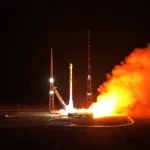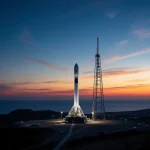
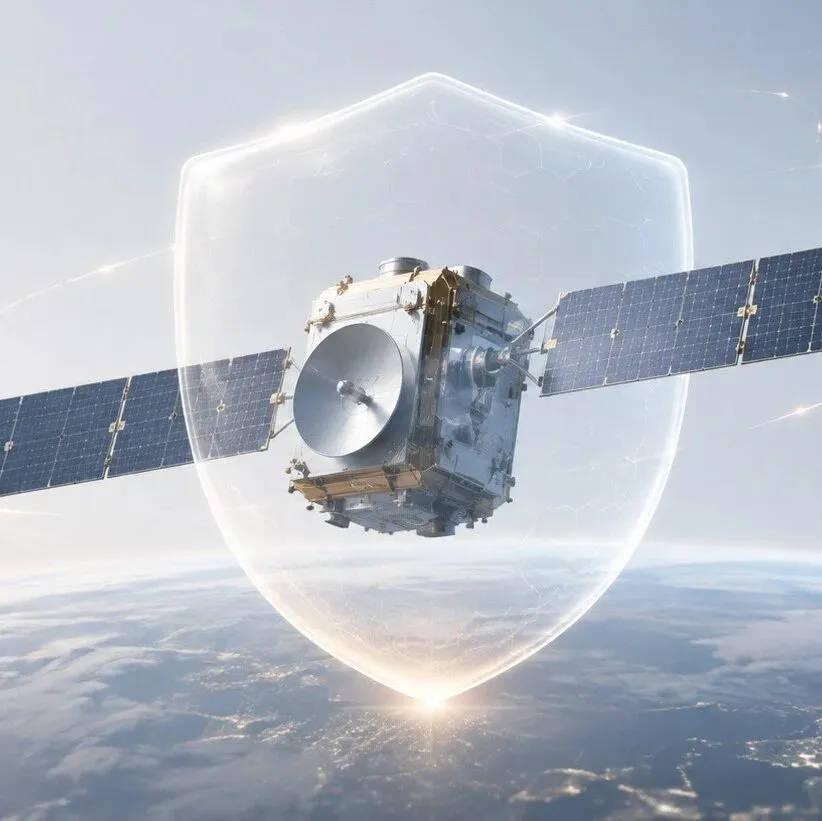
In 1984, two communications satellites, Westar 6 and Palapa B2, were placed into incorrect orbits due to an upper-stage malfunction. Their insurers were already facing a massive loss, but instead of simply paying out the claims, they signed an agreement with NASA to have the Space Shuttle retrieve the two satellites from space and return them to Earth.
NASA records from the period show that the retrieval fee was $2.75 million per satellite. Both satellites were later refurbished and relaunched.[5] This was not science fiction, but a real case in which insurance capital actively supported “repair instead of write-off.”
More than four decades later, Space Shuttle-style rescue missions are history, while robotic servicing spacecraft are beginning to approach, inspect, and dock with satellites. A more practical question has emerged again: when a satellite fails, will insurers choose to pay the claim, or support sending a spacecraft to repair it?
Whether the insurance industry can help drive this business ultimately comes down to one decidedly unromantic question: is the expected loss after repair actually lower than the cost of paying the claim directly? Operators remain the primary beneficiaries of servicing, while insurers are more likely to serve as underwriters, participants in rule-setting, and co-payers in specific claims.
What insurers are buying is not the act of “repairing a satellite” itself, but greater certainty that the eventual payout will be lower. That logic connects rocket launches, satellite health management, in-orbit operations, and commercial contracts into a single chain.
01 First, What Does Space Insurance Actually Cover Today?
Space insurance is generally divided according to mission stage. Pre-launch coverage may include transportation, testing, fueling, and final assembly. Exactly when launch coverage begins, and whether it ends at spacecraft separation or extends through orbit raising, deployment, and in-orbit testing, depends on the terms of the specific policy. “From liftoff to separation” should not be treated as the only possible boundary. Commercial in-orbit insurance mainly covers total or partial satellite failures during operations, while third-party liability insurance addresses damage caused to others by space activities.[1]
In-orbit insurance is concerned with more than whether a satellite still physically exists. Munich Re’s product information distinguishes among total loss, partial loss, and constructive total loss. Performance degradation and shortened usable life may also factor into loss calculations, although whether compensation is triggered depends on the definitions in the contract.[2]
The market is relatively small, yet it is exposed to highly concentrated volatility. In its Q1 2026 report, Aon estimated that space insurance premiums exceeded $650 million in 2025, with claims of about $503 million, implying an estimated loss ratio of 77.4%. In 2023, by comparison, approximately $550 million in premiums was matched by $1.43 billion in claims. Aon listed only 25 underwriters in 2026, with theoretical launch and in-orbit insurance capacities of approximately $709.4 million and $669.4 million respectively, excluding capacity in the Chinese market.[3] A handful of major losses can therefore be enough to change pricing and underwriting appetite the following year.
Source: Author’s analysis based on publicly available information.
02 Why Might Insurers Be Willing to “Repair First, Pay Later”?
The basic logic of insurance is to turn uncertain large losses into predictable premiums. Once an anomaly occurs, an insurer is not necessarily limited to passively writing a check. Where permitted by the contract, reducing the severity of the loss can itself create value.
A historical insurance policy made public by the U.S. Securities and Exchange Commission stated that, after paying a total-loss or constructive-total-loss claim, insurers could acquire an interest in the residual value of the damaged satellite or related proceeds. This only demonstrates that such contractual arrangements have existed; it does not mean they are standard across all current policies.[4]
The UNIDROIT Protocol to the Convention on International Interests in Mobile Equipment on Matters Specific to Space Assets, adopted in 2012, also preserves insurers’ salvage rights where provided under applicable law or contract. However, as of August 26, 2026, the Space Protocol had still not entered into force. It is therefore useful for understanding international rule-making discussions, but it should not be treated as universally applicable law today.[4]
The 1984 recovery case described above shows that insurers can actively organize loss-mitigation efforts. At the same time, that mission depended on the Space Shuttle, astronauts, and highly specific orbital circumstances, so it cannot be used directly as a pricing template for today’s robotic servicing missions.
A more intuitive way to frame the decision today is:
Expected net loss reduction = reduction in payout from successful servicing − servicing cost − delay losses − additional liability risk
The “reduction in payout from successful servicing” must also be adjusted by two probabilities: the probability that the failure is actually serviceable, and the probability that the servicing mission succeeds.
The savings come from the difference between a direct insurance payout and whatever payout would still be required after servicing. Servicing costs include the spacecraft, launch, operations, and any necessary modifications. Additional risks include accidental contact with the customer satellite, debris generation, and third-party liability.
Only when the net benefit is positive — and when the policy, licenses, command authority, and salvage rights all permit it — would an insurer have a reason to participate. This remains an explanatory model rather than a standardized industry pricing formula.
Source: Author’s analysis based on publicly available information.
03 Three Ways Insurance Could Support In-Orbit Servicing — but the Evidence Is Uneven
Already happening: servicing spacecraft are obtaining dedicated insurance coverage. In-orbit servicing vehicles themselves can fail during launch, lose navigation capability, fail to capture a target, or suffer accidental damage. Lloyd’s disclosed that Astroscale began discussions with insurers during the early stages of its ELSA-d demonstration mission and ultimately secured a customized policy. In the event of a valid claim, the coverage could be used for repair or replacement of the servicing spacecraft and for related launch costs.[6] This demonstrates that insurance can provide financial protection for high-risk new mission types, but the insured asset in this case was the demonstration servicing spacecraft itself — not a commercial customer satellite being repaired at an insurer’s expense.
Trend and regulatory signal: serviceable design may influence future underwriting. Insurers have good reason to ask whether a customer satellite includes docking or refueling interfaces, whether telemetry can support fault diagnosis, and how an abnormal proximity operation can be safely aborted. A UK government consultation on orbital liabilities and insurance explored linking mission sustainability measures with liability limits, while explicitly recognizing that risk may change during different phases of in-orbit servicing.[7] However, the publicly available information reviewed for this article is not sufficient to show that “serviceable satellite design already routinely results in lower premiums.” A more defensible conclusion at this stage is that it may influence whether an insurer offers a quote, the scope of coverage, deductibles, and the portion of risk retained by the insured.
Historical precedent exists, but modern robotic cases remain limited: insurance participation in claims mitigation. The 1984 recovery case proves that insurers can pay for rescue operations to avoid even larger losses. In modern robotic servicing, operators and insurers may similarly share servicing costs, residual value, and failure liabilities. But publicly disclosed cases in which insurers directly purchase robotic repair services for customer satellites remain rare and cannot yet be described as an industry norm. The funding structure would need to be written into contracts in advance.
04 In-Orbit Servicing Could Also Make Insurance More Expensive
When a servicing spacecraft approaches a customer satellite, the risk changes from “one satellite failing on its own” to “two spacecraft conducting a joint operation.”
Errors in relative navigation could cause a collision. A capture mechanism could impose forces or torques beyond what the customer satellite can tolerate. Loss of attitude control could generate debris. Sharing telemetry and command interfaces across companies also introduces cybersecurity and data-liability risks. After servicing is completed, it may also be necessary to redefine whether the original manufacturer’s warranty remains valid.
Therefore, in-orbit servicing may reduce the severity of certain losses while increasing accident frequency and liability complexity during the servicing phase.
Insurers would need to distinguish at least four layers of coverage: property insurance for the servicing spacecraft itself; liability or property coverage for damage to the customer satellite during servicing; third-party liability for damage to other space objects; and business interruption or contractual losses resulting from servicing failure.
Trying to compress all four layers into a vaguely defined “in-orbit servicing insurance” policy would only make pricing more difficult.
ISO 24330:2022 already identifies operators, servicing providers, simulation and safety-tool developers, and insurers as participants in rendezvous, proximity operations, and on-orbit servicing, while setting out programmatic principles and best practices.[8] It is not a universal mechanical interface standard, but it does show that insurance should not appear only as a financial attachment after a mission is completed. It should enter discussions about mission design, operating rules, and contingency procedures from the beginning.
Source: Author’s analysis based on publicly available information.
05 What Types of Satellites Are Most Worth Repairing Today?
The targets most likely to produce a viable business case usually share four characteristics: high value per satellite; a clearly understood failure mode; payload and power systems that remain healthy; and the ability to continue generating substantial revenue after servicing.
Geostationary communications satellites fit these conditions particularly well. Northrop Grumman disclosed that MEV-1 docked with Intelsat 901 in 2020 and took over attitude and orbit control. After completing five years of service, it ended its first mission in April 2025 and docked with another customer satellite in May.[9] This proves that commercial satellite life extension is already happening. However, MEV provides external propulsion and attitude-orbit control; it does not refuel the customer satellite or replace internal components.
More complex general-purpose repairs are still crossing major engineering hurdles. NASA cancelled its planned OSAM-1 mission, which was intended to refuel Landsat 7, a satellite not originally designed with servicing interfaces. NASA cited technical, cost, and schedule risks, changing industry demand, insufficient return, and the lack of a follow-on commercialization partner.[10]
ESA’s RISE mission contract with D-Orbit is valued at €119 million and targets a 2028 launch. The mission is intended to first demonstrate safe rendezvous and docking before beginning commercial life-extension services.[11] The former mission has already been cancelled, while the latter remains under development as a future demonstration. Neither should be described as part of an existing commercial satellite repair network.
This also explains why insurance alone cannot automatically create a market.
Many low Earth orbit small-satellite constellations rely on redundancy and rapid replenishment. If the cost of repairing a single satellite approaches the combined cost of manufacturing and launching a replacement, operators are more likely to deploy a new satellite instead.
By contrast, a high-value GEO satellite that continues to generate stable cash flow may produce a clear financial return from even one additional year of service.
The first market for in-orbit servicing will therefore not encompass every satellite failure. It will concentrate on failures that are technically repairable, economically worth repairing, and capable of returning to useful service afterward.
06 Whether Premiums Can Fall Depends on Data, Not Slogans
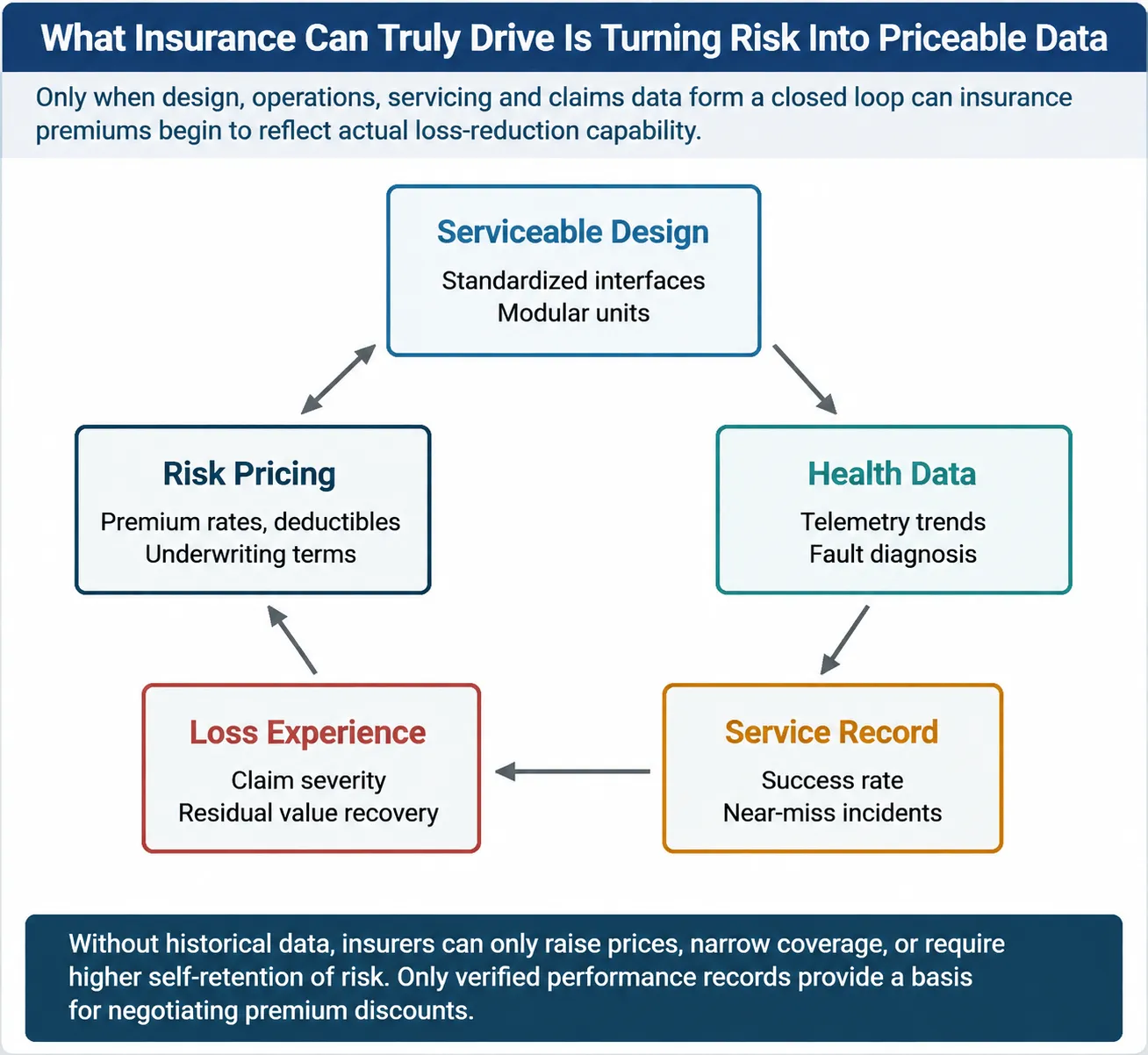
Insurance pricing depends on observable loss frequency and severity. If a servicing provider has completed only one demonstration mission, insurers have little basis for assessing capture success rates, near-miss events, or reliability across repeated missions. They may therefore raise prices, narrow coverage, or require companies to retain more of the risk themselves.
As missions accumulate, the most valuable data will include target-identification error, the number of aborted approach attempts, capture loads, attitude stability after docking, post-servicing lifetime, anomaly rates on customer satellites, and the amount by which actual claims were reduced.
Satellite design may also change in response.
An ESA research review published in 2026 emphasized that modularity, replaceable units, and servicing-compatible architectures can make refurbishment more economical.[12]
For insurers, the value of a standardized interface is not that it “looks advanced.” Its value lies in reducing mission-specific tooling, shortening approach operations, increasing the probability of success, and allowing different servicing providers to substitute for one another.
Only when serviceable design, health telemetry, servicing track records, and claims data form a closed loop can premiums and policy terms begin to reflect actual loss-reduction capability.
Source: Author’s illustration based on publicly available information.
07 So, Will Insurers Become the First Customers?
A more accurate description is this: operators will remain the primary beneficiaries of servicing value, while insurers may become early underwriters, participants in rule-setting, and co-payers in specific claims.
Insurers will not support in-orbit servicing simply because they like new technology. They will put money behind it only when risks can be identified, prices can be calculated, and rights can be enforced.
The most important developments to watch in the future are not which companies announce that they “can repair satellites,” but five harder indicators: whether repeat customers emerge; whether service providers can work on satellites they did not design themselves; whether insurance policies explicitly cover servicing operations; whether servicing is actually used after failures to avoid major payouts; and whether satellites with standardized interfaces and complete health data can obtain better underwriting terms.
Insurance will not solve the engineering challenges of in-orbit servicing, but it may force engineering capabilities to become verifiable, repeatable, and priceable. When that happens, space repair will move from a one-off feat to a real business.
As satellite operations become more complex, the ability to design spacecraft with future servicing, upgrades, and mission flexibility in mind is becoming increasingly valuable. STARPATH GLOBAL provides customized satellite solutions for organizations seeking mission-specific spacecraft, payload integration, and tailored space capabilities. From concept design to delivery, our team can help develop satellite systems aligned with different application requirements and operational goals.
References
Information and mission status were reviewed as of August 26, 2026. Commercial mission status in this article is distinguished according to historical missions, operational servicing, demonstrations, development programs, and planned missions.
[1] Lloyd’s, Space risk location guidance, accessed August 26, 2026; AXA XL, Space Insurance, accessed August 26, 2026.
[2] Munich Re, Space and satellite insurance solutions, accessed August 26, 2026.
[3] Aon, Q1 2026 Space Insurance Market Report, 2026.
[4] U.S. Securities and Exchange Commission, publicly available historical satellite insurance policy, Form 20-F exhibit, 2006; UNIDROIT, Space Protocol, 2012 (not yet in force as of August 26, 2026).
[5] NASA Johnson Space Center, NASA Roundup, October 5, 1984; NASA, 40 Years Ago: STS-51A – The Ace Repo Company, November 8, 2024.
[6] Lloyd’s, Astroscale: Mission to clean up space, accessed August 26, 2026; Astroscale, ELSA-d Finalizes De-Orbit Operations, January 24, 2024.
[7] UK Government, Consultation on Orbital Liabilities, Insurance, Charging and Space Sustainability, updated March 5, 2024.
[8] ISO, ISO 24330:2022 Space systems – Rendezvous and Proximity Operations and On Orbit Servicing – Programmatic principles and practices, July 2022.
[9] Northrop Grumman, SpaceLogistics, accessed August 26, 2026.
[10] NASA, On-orbit Servicing, Assembly, and Manufacturing 1, accessed August 26, 2026.
[11] ESA, ESA to build first in-orbit servicing mission with D-Orbit, October 14, 2024.
[12] ESA, Building a circular economy in space: ESA studies pave the way, 2026.