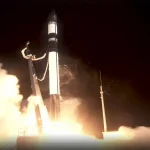
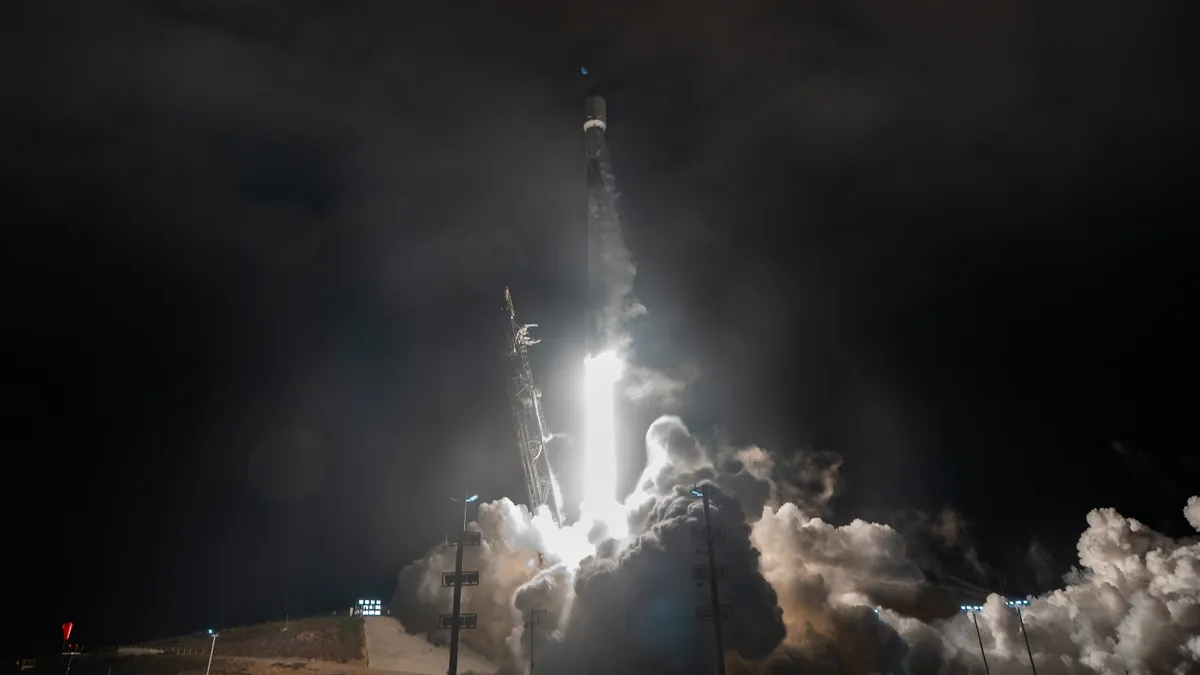
A SpaceX Falcon 9 launched 27 Starlink satellites from Space Launch Complex 4 East (SLC-4E) at Vandenberg Space Force Base in California on Sept. 2, 2026 at 1:42 a.m. PT (4:42 a.m. ET). Credit: SpaceX
SpaceX launched 27 Starlink broadband satellites from California on September 2, extending the company’s low Earth orbit communications network while bringing one of its Falcon 9 first stages within two missions of the fleet’s reuse record.
The Falcon 9 lifted off from Space Launch Complex 4 East at Vandenberg Space Force Base at 1:42 a.m. local time, or 08:42 UTC. The mission, designated Starlink Group 15-23, marked the 35th flight of first-stage booster B1063.
About eight and a half minutes after liftoff, B1063 landed on the droneship Of Course I Still Love You in the Pacific Ocean. The Falcon 9 upper stage continued toward low Earth orbit and deployed the 27 satellites approximately 62 minutes after launch.
B1063 Nears Falcon 9’s Reuse Record
B1063 is now two flights short of the 37-mission Falcon 9 booster record established by B1067 in late August. Its flight history illustrates how SpaceX has expanded booster reuse from an experimental capability into the operating foundation of a high-frequency launch system.
The first stage began its career in November 2020 with the Sentinel-6 Michael Freilich ocean-observation satellite. It subsequently supported NASA’s Double Asteroid Redirection Test, the Transporter-7 rideshare mission, an Iridium-OneWeb launch, missions for the U.S. Space Development Agency and National Reconnaissance Office, the Luxembourg Defence Directorate’s NAOS Earth-observation mission, and 25 Starlink flights.
This mix of civil, commercial, defense and internal constellation missions is operationally important. A booster that has flown payloads with different orbital requirements and customer-assurance regimes provides a broader demonstration of reusable-launch maturity than one used exclusively for standardized Starlink deployments.
At this stage of the Falcon 9 program, the principal engineering challenge is no longer proving that an orbital-class booster can fly again. It is controlling cumulative wear across engines, tanks, avionics, thermal-protection hardware and landing systems while sustaining short refurbishment cycles. Each additional flight also expands the inspection and performance dataset SpaceX can use to determine component lifetimes and maintenance intervals.
That accumulated flight experience does not mean every booster can be processed identically. Hardware condition, mission energy, ascent loads, landing profile and exposure to the marine environment can affect inspection requirements. SpaceX’s ability to repeatedly return high-flight-count stages to service nevertheless indicates that its refurbishment and acceptance processes are operating at industrial scale.
Starlink Drives an Industrial Launch Cadence
The mission was SpaceX’s 102nd Falcon 9 flight of 2026. Of those launches, 79 were dedicated to Starlink deployment, meaning the broadband constellation accounted for more than three-quarters of Falcon 9 activity during the year through September 2.
SpaceX also conducted two Falcon Heavy missions and two suborbital Starship test flights during the same period. Its second Falcon Heavy launch of 2026, on August 30, sent NASA’s Nancy Grace Roman Space Telescope toward its operational destination.
The high proportion of Starlink missions gives SpaceX a level of demand certainty that conventional launch providers rarely possess. As the owner of both the launch system and its largest payload program, the company can adjust deployment schedules around vehicle, range, droneship and satellite availability without negotiating each change with an external customer.
That vertical integration supports a continuous operating loop: satellites move through production, batches are assigned to available rockets, recovered boosters return for inspection, and launch infrastructure is reused for the next campaign. The result is a production-oriented model in which cadence depends on the combined throughput of satellite manufacturing, launch-site processing, booster refurbishment, fairing availability, marine recovery and regulatory coordination.
Vandenberg is central to that model because it supports trajectories suited to high-inclination Starlink orbital planes. SpaceX’s western launch and recovery infrastructure also allows missions to proceed independently of its Florida operations, where Falcon vehicles support Starlink, commercial, national-security, science and crewed flights.
Constellation Scale Changes the Deployment Economics
The 27 spacecraft join a Starlink constellation containing more than 11,000 active satellites, making it the largest satellite network ever assembled. After initial deployment, the satellites must complete checkout and use onboard propulsion to reach their operational orbits before entering commercial service.
Individual Starlink launches add only a fraction of the total constellation, but the value of SpaceX’s deployment model lies in repetition. Frequent launches allow the company to expand capacity, replace aging or failed spacecraft, introduce updated satellite hardware and redistribute network resources as demand changes.
The architecture also creates a continuing replenishment requirement. Satellites in low Earth orbit offer lower communications latency than traditional geostationary systems, but they experience atmospheric drag and have shorter design lives. Maintaining an 11,000-plus-satellite network therefore requires sustained spacecraft production and launch capacity, not merely an initial deployment campaign.
For competing broadband constellations, the difficult benchmark is the integrated system rather than Falcon 9 or Starlink alone. Rivals must secure satellite manufacturing capacity, spectrum and market access, ground infrastructure, user terminals and a dependable launch manifest. SpaceX controls most of those elements internally, allowing improvements in booster reuse and launch tempo to feed directly into constellation growth.
B1063’s 35th mission demonstrates the practical connection between reusable launch hardware and megaconstellation economics. Each recovered stage preserves a major piece of flight hardware for another mission, while recurring Starlink demand supplies the launch volume needed to keep the reusable fleet active. Together, those two factors have turned Falcon 9 operations into a sustained transportation system rather than a sequence of isolated launches.