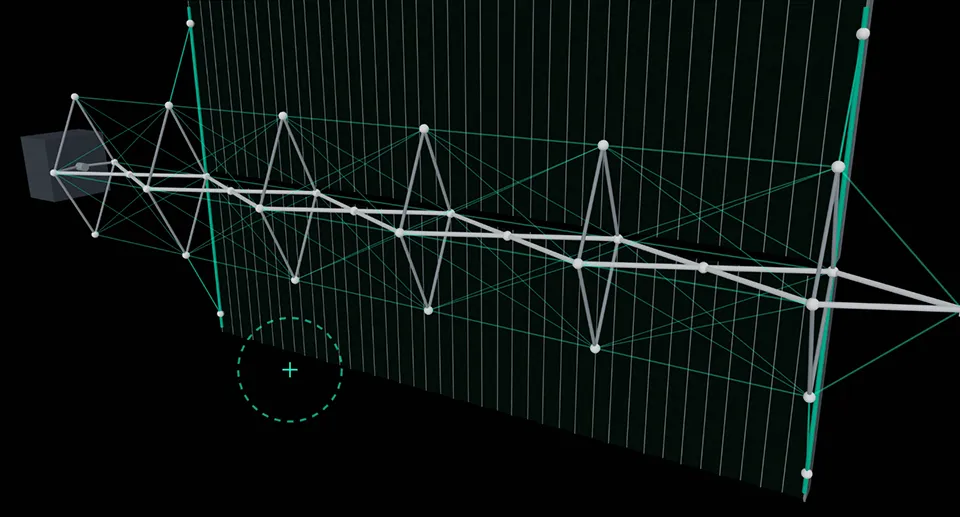
Beyond Reach Labs is opening a 16,000-square-foot manufacturing and testing facility at Brooklyn’s Industry City complex in New York on September 24, establishing dedicated production capacity for its Flarewing deployable solar array. The system is designed to provide high-density electrical power for commercial space stations, orbital computing platforms and direct-to-device satellite networks.
Founded by former SpaceX employees and backed by startup accelerator Y Combinator, Beyond Reach Labs plans to use the site for hardware assembly, cleanroom integration and deployment testing. Environmental test equipment will also support the qualification of initial Flarewing flight units ahead of planned commercial demonstration launches.
Flarewing is intended to address one of the central constraints facing large orbital platforms: fitting enough power-generation hardware inside a launch vehicle’s payload fairing. Conventional rigid panels and accordion-style arrays can consume substantial fairing volume as power requirements increase, potentially limiting the amount of payload equipment that can be launched alongside them.
The company says its array folds into a package approximately the size of a standard dining table for launch. Once in orbit, a mechanical articulation system deploys the solar blanket structure to roughly the length of a football field.
Beyond Reach Labs claims that the combination of lightweight structures and high-density blanket packaging could generate up to 10 times more electrical power per launch vehicle than traditional rigid solar-panel assemblies. That comparison is based on launch-volume and structural-mass efficiency rather than solar-cell efficiency alone.
If demonstrated in flight, that packaging advantage could reduce the number of launches required to assemble the power infrastructure for megawatt-class orbital systems. Such power levels are being considered for commercial space stations, large communications platforms and space-based computing systems operating high-performance processors and supporting equipment.
These applications require electricity not only for their primary payloads but also for thermal control, data handling and high-throughput communications. More capable computing hardware can increase both power consumption and the heat that must be removed, linking available electrical capacity directly to the size and performance of the overall spacecraft.
Large flexible arrays introduce their own engineering requirements. The deployment mechanism must reliably release and tension the blanket after launch while maintaining structural stability and electrical continuity. Ground qualification therefore includes repeated deployment trials and environmental tests intended to reproduce launch loads and relevant orbital conditions.
Following the facility’s opening, Beyond Reach Labs plans to begin equipment integration and Flarewing deployment testing at the Brooklyn site. Qualification of the first flight units and commercial demonstration launches will be the next major tests of whether the system can translate its compact ground configuration into reliable high-power operation in orbit.