In-orbit services need the means to get things done: robots that can capture spacecraft, repair equipment and build new hardware. These capabilities bring together several families of technology, from docking systems to additive manufacturing and robotic assembly. Some already have a commercial track record in orbit; others remain experimental or are preparing for flight demonstrations.
1. Capturing Spacecraft: Four Approaches to Docking and Handling
These approaches overlap rather than form a strict sequence of generations. Their central trade-off is clear: servicing spacecraft that were never designed to be serviced generally demands more capable technology. Existing engine nozzles offer one route into the installed satellite market. Surface-adhesion systems seek to broaden compatibility further. Robotic arms can support a wider range of handling tasks, although capturing an uncontrolled, tumbling object remains particularly demanding.
2. Making Hardware: A Decade of In-Orbit Manufacturing
Additive manufacturing reached the International Space Station in 2014. The first object printed there was a faceplate for the printer’s extruder assembly. Later that year, a digital design transmitted from Earth was turned into a ratchet wrench in orbit. The wrench demonstrated a new approach to space logistics: send the file, then make the hardware where it is needed.
The milestones since then span several fields:
- On-demand polymer tools and parts. The Additive Manufacturing Facility developed by Made In Space, now part of Redwire, has produced more than 200 parts in space. A small orbital hardware workshop is already a reality.
- Bioprinting. The BioFabrication Facility first reached the station in 2019. Microgravity can reduce the tendency of soft printed tissue to collapse under its own weight, supporting research into structures that are difficult to fabricate on Earth. A human knee meniscus was successfully bioprinted in orbit, with the achievement announced in 2023.
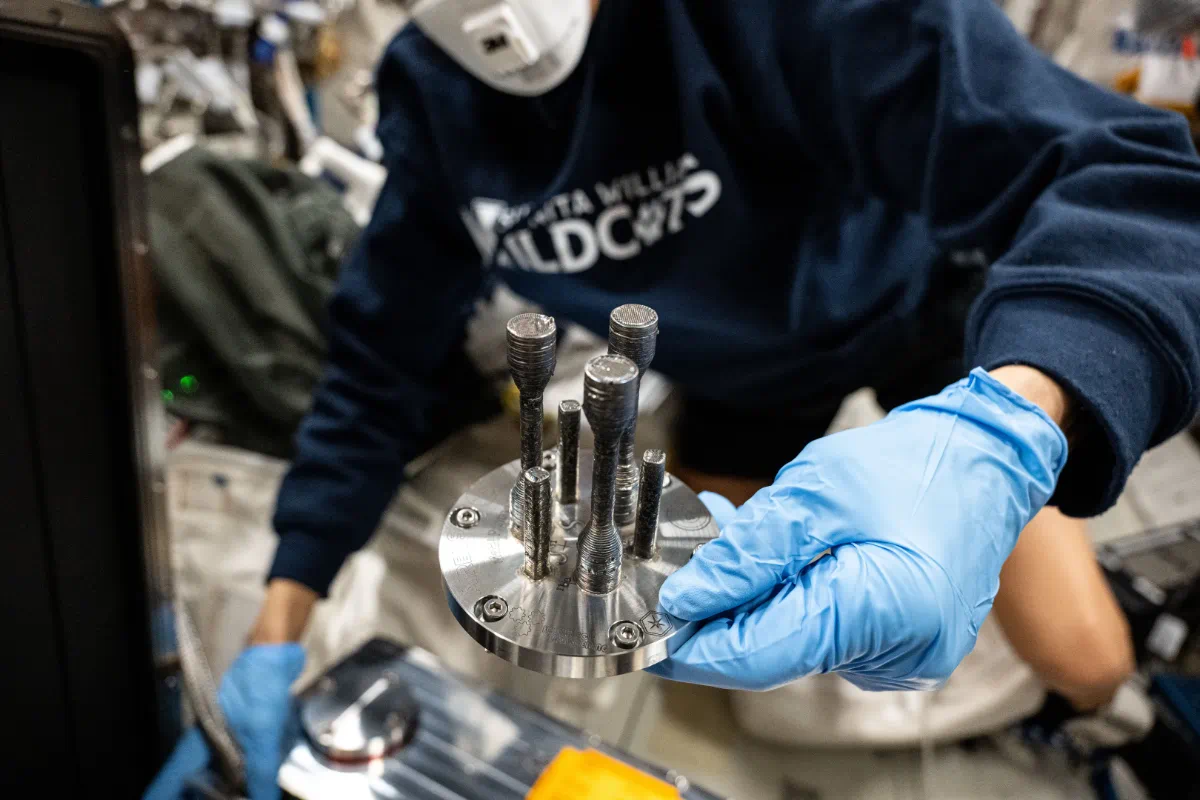
- Metal printing. ESA’s Metal 3D Printer was delivered aboard a Cygnus cargo spacecraft in early 2024. Its stainless-steel printing experiments investigate how manufacturing in microgravity affects printed parts and their material properties, including strength and quality.
- Semiconductors and crystals. Redwire’s Manufacturing of Semiconductors and Thin-Film Integrated Coatings facility reached the station in 2024 and produced 18 thin-film semiconductor samples during its initial mission. Protein-crystal research also explores whether microgravity can improve crystal growth and support pharmaceutical development. These experiments should be distinguished from routine commercial production.
- Dedicated commercial manufacturing spacecraft. UK-based Space Forge launched ForgeStar-1 in June 2025 and announced successful plasma generation aboard the spacecraft in December. This demonstrated conditions needed for gas-phase crystal growth on a free-flying commercial platform—a step toward semiconductor-material production, rather than proof of high-volume manufacturing.
The commercial question is therefore not simply what can be made in space, but which products gain enough from the space environment to justify the cost. Candidates include higher-quality crystals, materials with improved microstructures and delicate biological structures. The advantage must be demonstrated through testing; microgravity alone does not guarantee perfect crystals or defect-free alloys.
3. Putting It Together: In-Orbit Assembly
Printing produces components. Assembly turns components into working systems.
The EU-funded PERASPERA In-Orbit Demonstration project, or PERIOD, developed an orbital-factory concept for the International Space Station’s external Bartolomeo platform. The proposed demonstration combines robotic handling, antenna manufacturing, satellite assembly, reconfiguration and verification. Its published work describes technology development and preparation for an orbital demonstration, rather than an already operating satellite assembly line.
The underlying idea is to launch components and combine them in orbit. This complements the more familiar approach of launching a folded spacecraft and deploying it after arrival. Both approaches seek to overcome launch-vehicle packaging constraints. Assembly could also allow large, delicate structures to be completed after they have passed through the launch environment.
The most ambitious applications involve large antennas, megawatt-class solar arrays and extensive radiator structures. If orbital data centers grow substantially, their supporting infrastructure could become a major market for in-space assembly. At present, these remain prospective applications rather than established industrial demand.
In-situ resource utilization, or ISRU, extends the same thinking to long-duration missions on the Moon and beyond. Researchers are investigating landing-pad construction, building materials made from local regolith and processes such as selective separation sintering. These technologies remain separate from orbital data-center construction, but share a common objective: reduce the amount of finished hardware that must be delivered from Earth.
4. Where the Technologies Meet: Maintaining and Expanding Orbital Computing
For orbital computing, robotics and manufacturing could eventually provide three valuable capabilities:
- Component replacement. Robotic systems could replace computing modules or battery packs, provided the spacecraft is designed with accessible, compatible interfaces.
- Capacity expansion. In-space manufacturing and assembly could help build larger radiator structures and trusses, reducing the constraints imposed by launch fairings.
- Hardware upgrades. Newly delivered computing modules could allow orbital facilities to keep pace with processor development, subject to power, cooling, radiation tolerance and interface compatibility.
These are development goals, not routine services available today. Together, however, they point toward a different operating model: space infrastructure that can be maintained, expanded and upgraded throughout its working life.
5. Three Tests for the Orbital Factory Business Case
Qualification. Producing a part does not automatically make it suitable for a critical flight application. Materials, manufacturing processes, inspection methods and component performance must satisfy the requirements of the intended use. Qualification approaches for in-space production are still developing.
Logistics. Launching feedstock, operating manufacturing equipment and returning products to Earth can outweigh the benefits of producing them in orbit. The economics vary sharply between a replacement tool used onboard and a high-value material sold on Earth.
Scale. Many demonstrations still produce individual components or small batches of samples. Output varies considerably by process, making a single industry-wide count misleading. The broader challenge is to turn experimental success into repeatable production with predictable quality, throughput and cost.
In important respects, orbital manufacturing resembles terrestrial 3D printing in its early years: promising demonstrations have established technical possibilities, while industrial scale remains a substantial challenge.
Conclusion
Capture, repair and manufacture: these capabilities could reshape how space assets are operated. The transition will depend on more than robotic dexterity or a successful print. It also requires serviceable spacecraft designs, qualified processes and a business case that survives the full logistics bill.
For organizations assessing future space infrastructure, those requirements begin with decisions made on the ground. STARPATH GLOBAL draws on China’s established satellite supply chain to help match mission needs with suitable spacecraft, payloads and assembly, integration and testing resources. Teams can explore the options with STARPATH GLOBAL to understand the capabilities, interfaces and costs relevant to their plans.
Feature image: The first metal part 3D printed aboard the International Space Station in 2024. Credit: ESA/NASA.