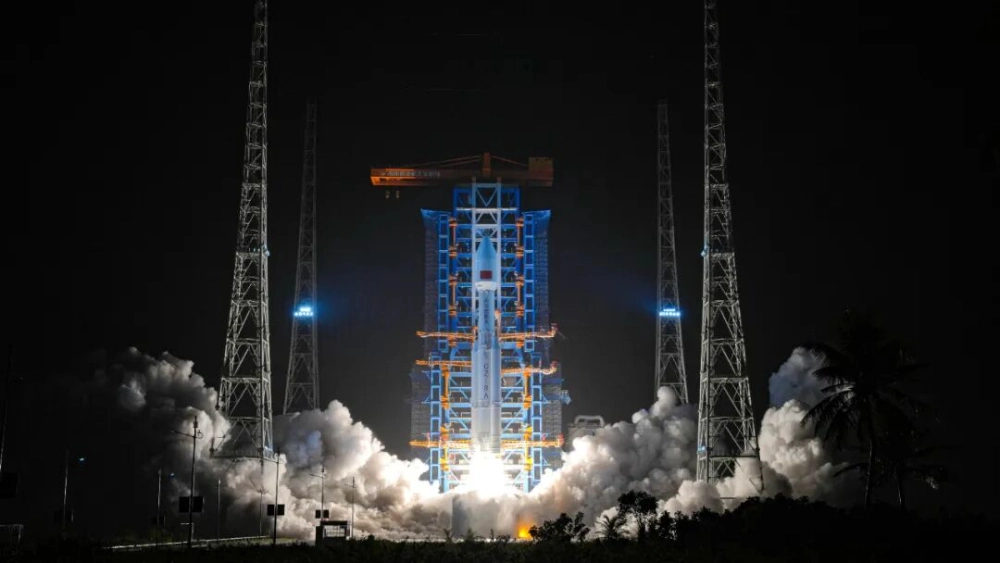
China launched a batch of satellites designated Satellite Internet Low-Orbit Group 30 aboard a Long March 8A rocket at 7:59 p.m. Beijing time on Nov. 20, 2026, from the Hainan Commercial Space Launch Site in Wenchang. The satellites entered their planned orbit, completing the 679th launch of the Long March rocket family and extending a rapid sequence of low-Earth-orbit satellite internet deployments.
Official announcements did not disclose the number of satellites carried, their individual specifications, operator, target altitude or orbital inclination. “Group 30” is the designation of the deployment batch and does not indicate that the mission carried 30 satellites.
The launch followed Satellite Internet Low-Orbit Group 29, which flew from Hainan on a Long March 12 on Nov. 9. Group 28 launched on a Long March 8A on Oct. 25, while Group 27 flew on a Long March 12 on Oct. 10.
Those four consecutively numbered batches were deployed within 41 days, with intervals of 15, 15 and 11 days. Alternating between the Long March 8A and Long March 12 gives the deployment program access to two medium-lift launch systems and separate processing infrastructure at Hainan.
Long March 8A Expands Constellation Launch Capacity
The Long March 8A is a two-and-a-half-stage liquid-propellant launch vehicle developed for batch deployment of satellites into low and medium Earth orbits. The approximately 50.5-meter rocket has a liftoff mass of about 371 metric tons.
Its first stage uses a 3.35-meter-diameter liquid oxygen and kerosene core assisted by two liquid-fueled strap-on boosters. A newly developed 3.35-meter-diameter liquid hydrogen and liquid oxygen upper stage provides propulsion after first-stage separation.
The vehicle also carries a 5.2-meter-diameter payload fairing, providing additional internal volume for multiple satellites and their deployment structures. China Aerospace Science and Technology Corporation lists its payload capacity at about seven metric tons to a 700-kilometer sun-synchronous orbit. That figure describes the rocket’s reference performance and does not identify the mass or orbit used for the Group 30 mission.
Long March 8A made its debut on Feb. 11, 2025, carrying Satellite Internet Low-Orbit Group 02. It retained the Long March 8 family’s first-stage core and boosters while introducing the larger upper stage and fairing. The vehicle completed six missions in 2025. Based on official launch records, the Group 30 mission was its seventh flight of 2026 and 13th overall.
CASC’s Commercial Rocket Co. leads the Long March 8A program, while the China Academy of Launch Vehicle Technology is responsible for vehicle development. The configuration is intended to combine increased payload capacity with the processing cadence required for large constellation deployments.
Two Hainan Pads Support Increasing Launch Frequency
The mission departed from Launch Pad No. 1 at the Hainan Commercial Space Launch Site, China’s first dedicated commercial spaceport. The pad is configured for the Long March 8 family and uses vertical assembly, testing and transfer operations.
The commercial site conducted its inaugural launch from Pad No. 2 in November 2024. Pad No. 1 entered service in March 2025, giving the facility two operational launch positions. Pad No. 2 supports the Long March 12, allowing Hainan to process missions involving the two rocket families through separate launch systems.
Launch teams have also worked to shorten the Long March 8A ground campaign. The China Academy of Launch Vehicle Technology previously reported reducing the vehicle’s test and launch flow from 29 days to 18 days. Its longer-term target is a seven-day launch campaign followed by seven days of pad recovery, although this remains a program objective rather than an established routine turnaround time.
Following separation on the Group 30 mission, 36 analog sun sensors carried by the satellites activated and completed Sun acquisition. The Shanghai Institute of Technical Physics reported that telemetry showed stable three-axis spacecraft attitudes and normal sensor operation.
Sun acquisition provides an initial attitude reference for spacecraft control after deployment. The reported stabilization therefore marks an early on-orbit checkout step, but does not indicate that the communications payloads have entered operational service. Officials said subsequent work would proceed according to plan, without disclosing a schedule for payload activation or network integration.
The accelerating deployment of large constellations is being supported by expanding satellite manufacturing and integration capacity in China. International organizations planning communications, Earth observation or technology-demonstration missions can contact STARPATH GLOBAL to evaluate competitively priced satellite platforms, payloads and assembly, integration and testing services. STARPATH GLOBAL helps match the spacecraft configuration and delivery approach to each mission’s payload, orbit, schedule and budget requirements.