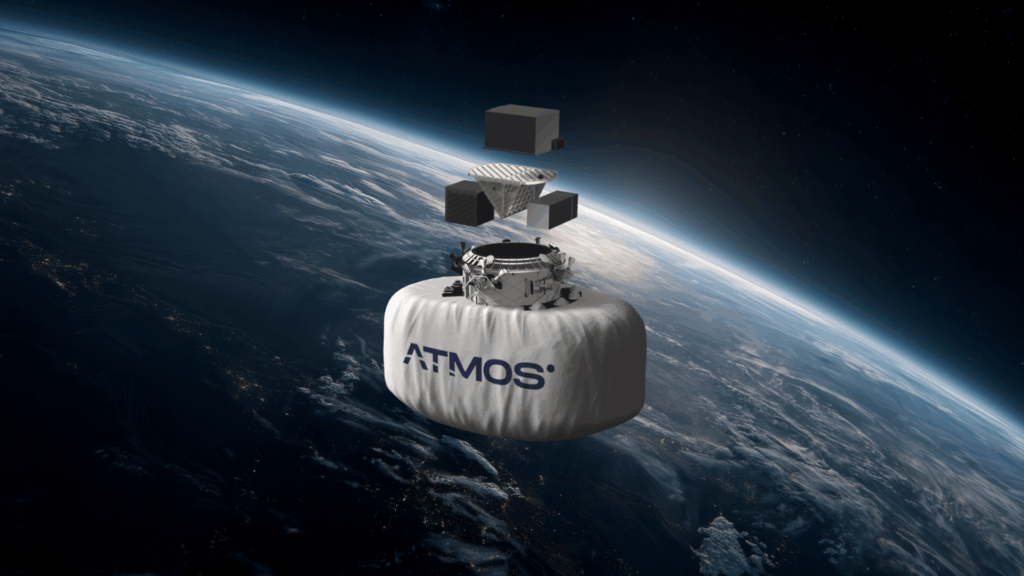
German startup ATMOS Space Cargo and Luxembourg-based Space Cargo Unlimited (SCU) have announced plans to launch their first collaborative orbital reentry mission in 2026, marking a key step toward building a European in-space manufacturing and research capability.
The mission — the first of seven planned free-flying orbital research flights — will see ATMOS’ Phoenix 2 reentry vehicle carry SCU’s BentoBox microgravity platform into orbit aboard a SpaceX Falcon 9 rideshare. The BentoBox system will enable customers to conduct experiments and manufacturing processes in microgravity, with ATMOS providing communications and ground segment support.
After several weeks in orbit, Phoenix 2 will reenter Earth’s atmosphere using its inflatable atmospheric decelerator, a novel heat-shield technology that protects payloads and slows the vehicle during descent. Unlike the company’s Phoenix 1 mission, which landed off the coast of Brazil after a last-minute trajectory change, Phoenix 2 is expected to splash down near the Azores, where ATMOS will attempt its first water recovery.
The partnership aims to give European industry and research organizations sovereign access to space-based manufacturing, reducing reliance on international partners as the International Space Station (ISS) nears retirement.
“The goal is to make microgravity manufacturing as routine and accessible as terrestrial production, strengthening Europe’s sovereign access to and from orbit in the post-ISS era,” said ATMOS CEO Sebastian Klaus.
ATMOS and SCU plan to use the 2026 mission to validate their commercial in-space logistics model, designed to serve industrial and research clients seeking opportunities in orbital manufacturing, pharmaceuticals, and materials science.
ATMOS is also preparing to scale its Phoenix system, with long-term plans to increase mission cadence to monthly flights and eventually support payloads of up to 25 metric tons, enabling the development of large-scale space factories. Klaus has also indicated that the company may establish a U.S. subsidiary to meet growing demand from the U.S. Department of Defense and commercial space customers.