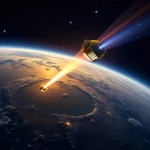

Busek Co. Inc., Founded in 1985 by Vlad Hruby and headquartered in Natick, Massachusetts, has become a trusted innovator in the field of electric and green propulsion systems. The company specializes in designing, manufacturing, and providing flight-qualified thrusters, power systems, and test services for spacecraft across all mission profiles from CubeSats to deep-space exploration. Busek’s commitment to engineering excellence is reflected in its collaborations with NASA, the U.S. Air Force, ESA, and multiple commercial clients.
As a vertically integrated propulsion provider, Busek manages development all the way to delivery and qualification supporting reliability through in-house clean rooms, inspection and test facilities. Their mission is to push the frontier of spacecraft propulsion, ensuring safe, efficient and sustainable access to space.
Hall Effect Thrusters

Busek offers a robust family of Hall thrusters, designed for high-efficiency, high-performance missions. The flagship BHT-200 is the first U.S.-built Hall thruster flown in space, with heritage on TacSat-2, FalconSat-5 and FalconSat-6 satellites; it delivers up to 13 mN thrust and 1,390 s specific impulse. For higher power missions, the massive BHT-20K provides 1 N thrust at 20 kW, with ~2,515 s specific impulse, and supports xenon, krypton, or iodine propellants. These thrusters maximize delta-V, enabling satellite repositioning, orbit transfers, and deep-space missions with compact electric propulsion systems.
Electrospray Thrusters

Busek’s electrospray thrusters deliver ultra-precise micro-Newton level thrust for precision pointing and station-keeping. Their systems, including the BET-MAX multi-axis package based on BET-300P microthrusters, offer thrust from <1 µN up to 150 µN with sub-µN resolution ideal for drag-free satellites and observatories like LISA Pathfinder. The technology demonstrated <0.2 µN/√Hz noise and 80%+ efficiency, proving Busek’s capability in pioneering ultra-fine spacecraft control systems.
RF Ion Thrusters

Busek leads in radio-frequency (RF) gridded ion thrusters, eliminating cathode issues and enabling long life. The BIT-3 thruster delivers up to 1.1 mN thrust and ~2,150–2,300 s Isp with xenon or iodine, using an iodine-compatible design that removes high-pressure tanks. Its solid iodine propellant and inductively coupled discharge make it ideal for deep-space CubeSat missions, with over 3,200 s Isp and 2 km/s delta-V demonstrated. These features enable efficient, high-impulse electric propulsion in miniature form factors.
Monopropellant Thrusters

Busek offers “green” monopropellant thrusters using ASCENT, a safer and denser alternative to hydrazine. The BGT-X5 is a 0.5 N system in a 1U volume, with 220–225 s specific impulse and 565 N-s total impulse. These thrusters integrate post-launch pressurization, avoiding toxic hydrazine hazards and simplifying ground operations. Busek’s green thrusters support CubeSat maneuvering while significantly reducing cost and risk.
Manufacture & Test

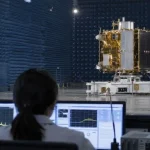
All Busek thrusters are built and qualified in-house across multiple cleanrooms, with the capacity to produce from single units to thousands. They follow rigorously documented design-for-manufacturability standards and tight metrology inspections under ASME and ASTM protocols. Each thruster undergoes full qualification testing including long-duration life tests to ensure mission readiness and reliability, based on decades of flight heritage and performance data.
From high-power Hall thrusters to nano-Newton electrospray systems, iodine-compatible RF ion engines, and safe green monopropellant units, Busek offers a comprehensive suite of advanced propulsion technologies. Their dedication to in-house design, manufacture, and testing underpins spacecraft mobility across LEO, GEO and deep-space missions.