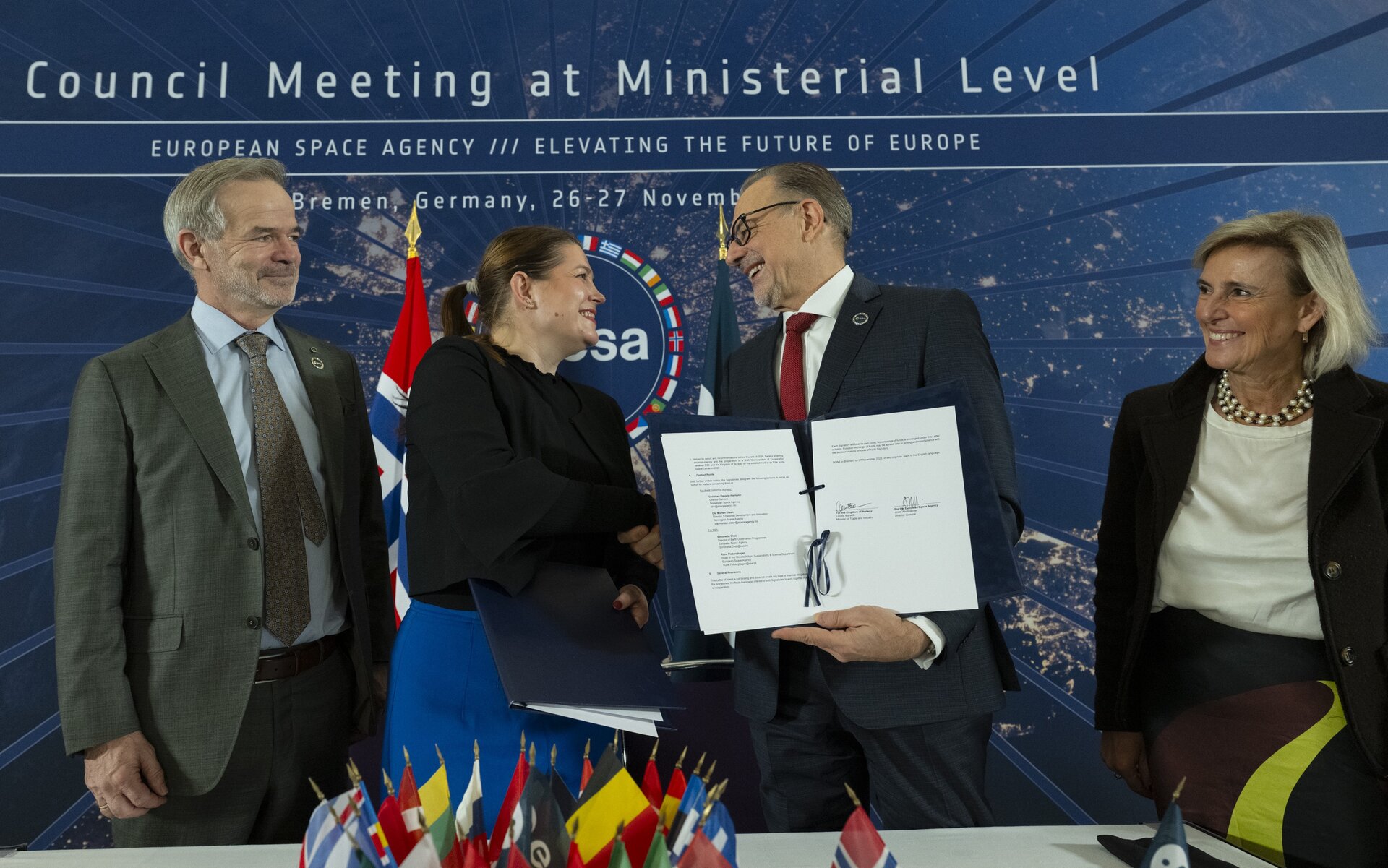
The European Space Agency (ESA) and Norway have signed a letter of intent to explore the establishment of an ESA Arctic Space Centre in Tromsø, a move aimed at strengthening Europe’s scientific, environmental and strategic capabilities in the High North. The agreement was announced on Nov. 27 during ESA’s ministerial conference.
Under the plan, a joint ESA–Norway working group will spend the next two years defining the centre’s mission, scope and governance framework, with the objective of formally opening the facility in 2027. The proposed centre would focus on Earth observation, navigation and telecommunications, with a particular emphasis on environmental monitoring and sustainable development in the rapidly changing Arctic region.
ESA Director General Josef Aschbacher described the Arctic as a critical region for the planet’s future. “The Arctic is at the centre of our planet’s future,” Aschbacher said, pointing to the growing global implications of climate change, economic activity and security dynamics in the region. Space-based data already plays a central role in tracking ice loss, monitoring shipping routes and supporting emergency response, with the new centre expected to expand these capabilities. Norwegian Space Agency (NOSA) Director General Christian Hauglie-Hanssen said the goal is to better coordinate Arctic science and security needs using ESA’s full range of space technologies.
Norway’s geographic position and long-standing investment in space infrastructure have made it a key European gateway to the Arctic. Tromsø already hosts the Norwegian Space Agency, Kongsberg Satellite Services, the Arctic University of Norway and a cluster of climate and polar research institutions. Norwegian Trade and Industry Minister Cecilie Myrseth said the initiative would benefit both Norway and Europe. “The Arctic is where the big geopolitical questions are being played out,” she said, adding that Norway’s polar location and experience offer clear advantages for European cooperation.
The agreement also followed discussions at the ESA ministerial conference over the strategic role of Andøya Spaceport in northern Norway. Andøya, Europe’s northernmost orbital launch site, is one of the few capable of accessing polar and sun-synchronous orbits used by Earth-observation satellites. The spaceport completed the first launch from its new orbital pad earlier this year. Myrseth said Andøya should be viewed as complementing, rather than competing with, launches from Europe’s primary spaceport in Kourou, French Guiana, and urged ESA members to ensure that European launcher capabilities are not disadvantaged.
If approved, the ESA Arctic Space Centre in Tromsø would become a focal point for coordinating satellite-based climate research, navigation services and security-related monitoring in the Arctic, reinforcing Europe’s long-term presence in one of the world’s most strategically sensitive regions.