The European Space Agency (ESA) has postponed a key drop test of its Space Rider reusable spaceplane after an anomaly occurred during a helicopter-assisted ascent phase in May, delaying the final stage of the vehicle’s landing qualification campaign.
ESA confirmed that the incident took place during a two-week test campaign that concluded on May 8, when teams aborted the final full-scale drop test involving a prototype of the spacecraft’s re-entry module.
The agency said an investigation into the anomaly remains ongoing.
Final Qualification Test Interrupted
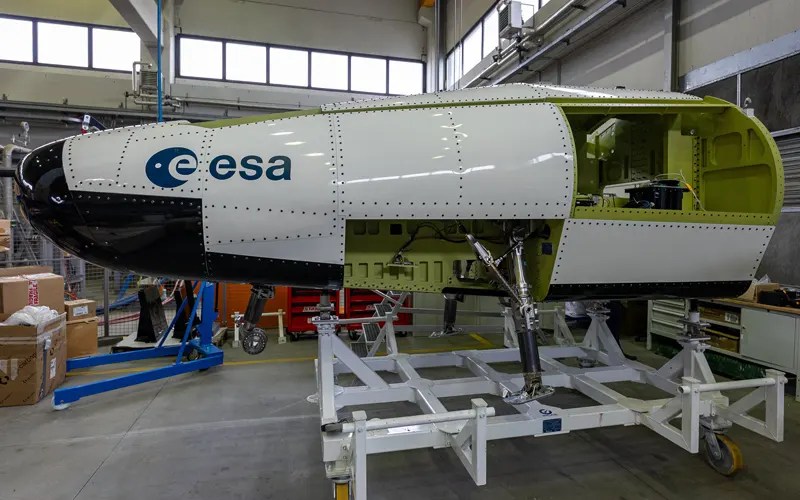
The planned test involved the Descent and Landing Test Model, a full-scale mock-up of Space Rider’s Re-entry Module designed to replicate the spacecraft’s mass, aerodynamic characteristics, dimensions, and landing gear configuration.
The campaign represented the final stage of ESA’s drop-test program before the spacecraft’s first orbital mission.
Previous test campaigns conducted in August 2024 and June 2025 used a 3,000-kilogram mass simulator rather than a full-scale vehicle model.
ESA had originally aimed to conduct the final drop test earlier in 2026.
Anomaly Occurred During Captive Ascent
According to ESA, the issue arose during the captive ascent phase of the test.
During this stage, the test vehicle was being lifted to release altitude beneath a CH-47 Chinook helicopter before the planned drop sequence.
The agency did not disclose further details regarding the nature of the anomaly.
An ESA spokesperson said the vehicle was recovered safely and that investigations are continuing.
“The test vehicle has been carried back in a safe condition, and investigation is ongoing.”
Test Rescheduled for Later This Year
While the anomaly contributed to the postponement, ESA indicated that scheduling limitations at the test facility are the primary reason for the extended delay.
The agency said the final system drop test is now expected to resume no earlier than October 2026.
ESA’s head of strategy and institutional launches for space transportation, Lucía Linares, told reporters during a June briefing that the test would take place after the summer and before the end of the year, although no specific date has been announced.
Space Rider Program Remains on Track
Despite the delay, ESA officials indicated that the overall Space Rider development schedule remains largely unaffected.
The reusable spacecraft’s inaugural mission is currently targeted for the first quarter of 2028 aboard a Vega C rocket.
That timeline leaves more than a year of schedule margin between the planned completion of testing and the vehicle’s first orbital flight.
Flight Hardware Already Produced
The Space Rider program has continued to advance in other areas.
In November 2025, Space Rider Program Manager Dante Galli said all flight hardware had already been manufactured.
At the time, components were either undergoing integration or verification testing ahead of final assembly.
The spacecraft is designed as an uncrewed reusable orbital vehicle capable of remaining in space for extended periods before returning to Earth and landing on a runway.
ESA sees the vehicle as a platform for scientific research, technology demonstrations, in-orbit manufacturing experiments, and commercial missions.
Europe Advances Reusable Space Capabilities
Space Rider forms part of Europe’s broader effort to develop reusable space transportation systems and expand independent access to low Earth orbit.
Once operational, the spacecraft will launch aboard the Vega C rocket and return payloads to Earth after completing missions lasting up to several months.
The latest delay highlights the technical challenges associated with developing reusable spacecraft, particularly systems designed to perform controlled atmospheric re-entry and autonomous runway landings.
However, ESA maintains that the program remains on schedule to achieve its planned first flight in 2028.