In September 2022, DART slammed into Dimorphos at more than 13,700 mph, releasing some 10 billion joules of energy and shortening the moonlet’s 12-hour orbit around the larger asteroid Didymos by about 33 minutes, 25 times the most conservative expectation. But the collision destroyed the spacecraft, and only distant telescopes and a small CubeSat that detected the impact flash could observe the immediate aftermath. Scientists were left without the full picture of the damage DART caused.
Hera arrived in the vicinity of Didymos and Dimorphos on November 4, 2026, after a two-year journey from a launch pad in Florida. The system currently orbits the Sun about 120 million miles from Earth. On Wednesday, ESA released Hera’s first views of the scar DART left behind. The images show the car-sized impactor carved a crater nearly as large as Dimorphos itself, a rugged chunk of rock measuring about 500 feet across.
“I would say we had two kinds of predictions: either we made a crater, or we reshaped the asteroid,” said Patrick Michel, Hera’s principal investigator from the Côte d’Azur Observatory in Nice, France. “In fact, we did both because the crater is so large that the shape has changed.” Michael Kueppers, ESA’s Hera mission scientist, said the DART impact left Dimorphos tumbling wildly in its orbit, while Didymos continues spinning on its axis as DART observed in 2022.
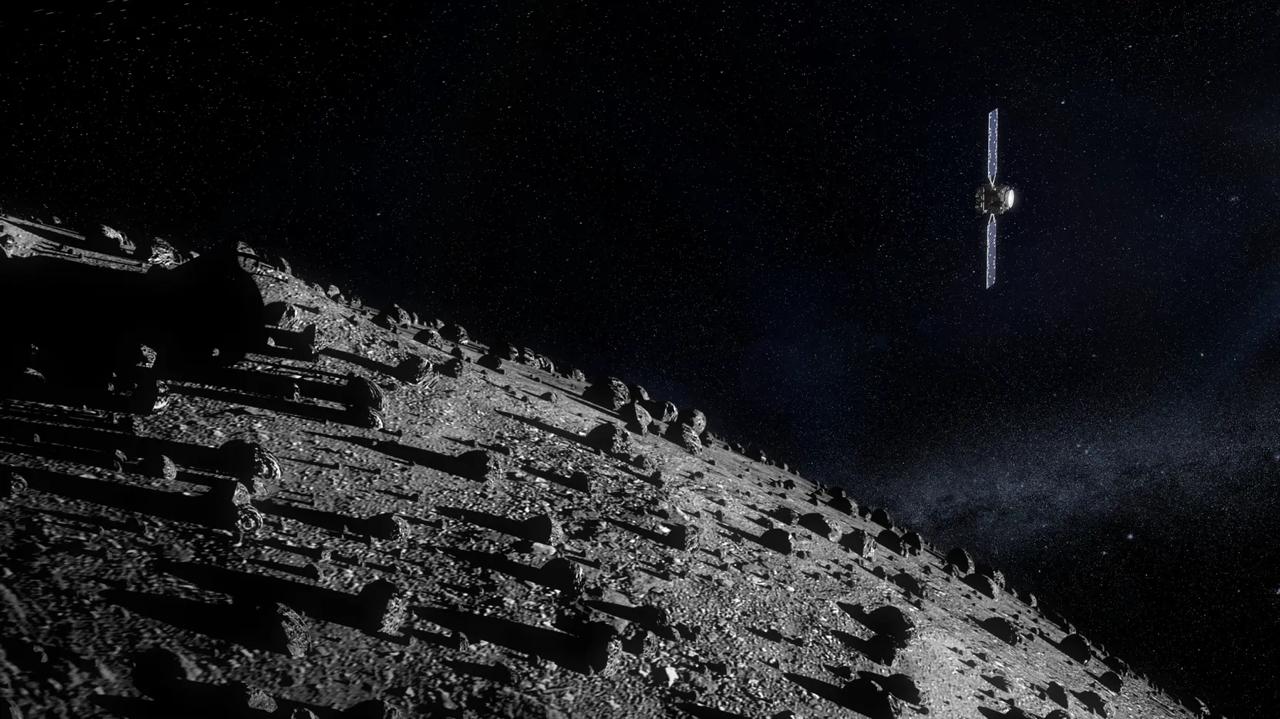
Hera also spotted hundreds of boulders surrounding the double asteroid, ranging in size from a football to a washing machine. “Hera came to visit two asteroids, and we found hundreds of companions,” said Naomi Murdoch, a planetary scientist at the Institut Supérieur de l’Aéronautique et de l’Espace in Toulouse, France. One explanation is that DART threw the boulders off Dimorphos, but scientists cautioned they need more data before confirming this. The debris might instead be relics from the ancient creation of Dimorphos.
Scientists will use Hera’s observations to reconstruct the dynamics of DART’s impact and better understand how a future deflection mission might move an asteroid that actually threatens Earth. Because near-Earth asteroids vary widely in shape, density, and composition, detailed knowledge of Dimorphos’s physical properties will anchor predictive computer models. “Once we understand, we have a breakthrough, which really solves planetary defense,” Michel said.
Over the next six months, Hera will fly closer to Didymos and Dimorphos to obtain more detailed observations. The spacecraft is set to release two small CubeSats, Milani and Juventas, in January to attempt landings on Dimorphos and collect data on its composition, internal structure, and mass. The boulder field poses an added risk to the deployments. “We saw a couple of images that didn’t reassure me,” said Margherita Cardi, project manager for the Milani CubeSat. “There is a mix of excitement and panic.” Claudia Balossi, spacecraft systems engineer for Juventas, said her mission’s trajectory would take it directly through the boulders before a landing attempt where it will measure the asteroid’s gravity field. “We are right in the middle of it,” she said.