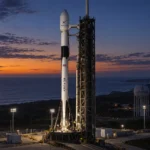
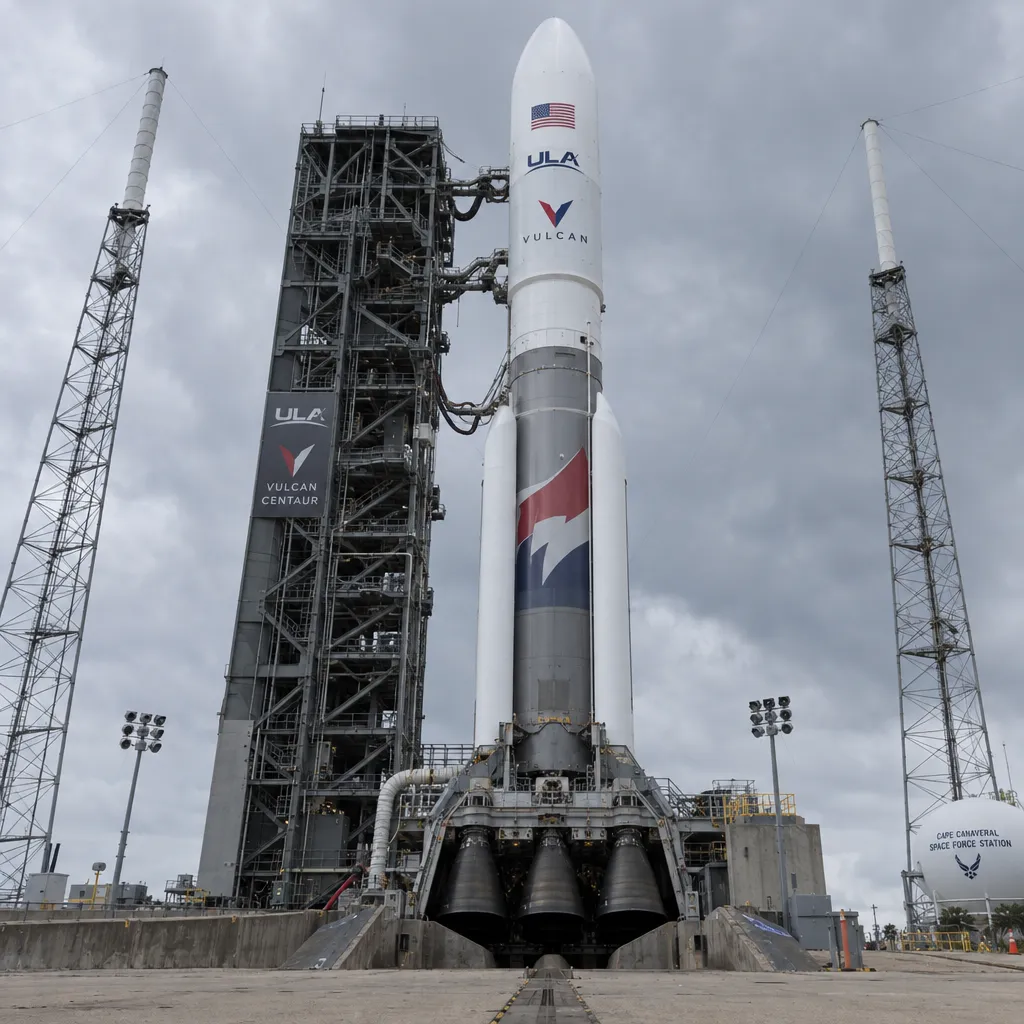
The flight was meant to end a nine-month hiatus imposed after a solid rocket booster nozzle anomaly on the Vulcan’s fourth mission in February. ULA leaders were optimistic as the fifth Vulcan lifted off at 12:40 p.m. EST from Cape Canaveral Space Force Station, carrying 40 Amazon Leo satellites weighing more than 50,000 lb., the heaviest payload ULA has ever flown. It was the first of 38 Vulcan launches contracted to deploy the bulk of Amazon’s 3,232-member low Earth orbit network. Initial launch attempts on Nov. 13 and 14 were scrubbed due to ground systems issues.
The rocket’s twin methane-fueled BE-4 engines, built by Blue Origin, and six redesigned solid rocket boosters, built by Northrop Grumman, fired as expected to boost the 215-ft. vehicle off Space Launch Complex 41. Preliminary analysis indicates the BE-4s operated as designed but underperformed due to a fuel supply issue now under investigation. The low thrust appears to be “the result of inadequate fuel supply from the vehicle to the BE-4 engines, not from the performance of the engines,” ULA said Nov. 18, adding that the second stage “was unable to recover from the performance loss, resulting in loss of mission.”
The rocket flew with a Centaur V upper stage optimized for low Earth orbit, 6 ft. shorter and filled with one-third less liquid propellant than the higher-energy Centaur V used on the previous four missions. Preliminary analysis shows the modified solid rocket boosters performed as expected. ULA CEO Mark Peller told Aviation Week before the launch that additional nozzle design changes might be incorporated for future flights. The separate investigation into the February SRB nozzle anomaly, which occurred about 20 sec. after liftoff on the USSF-87 mission, remains ongoing.
The failure removes BE-4 engine performance from the anomaly investigation, a relief for Blue Origin, which also flies the engines on its New Glenn rocket. The BE-4s on the Amazon Leo 1 mission were the first to fly since Blue Origin retrofitted the engines’ main oxidizer valves following a May static fire mishap that destroyed a New Glenn rocket. Blue Origin expects to return New Glenn to flight in January.
The grounding compounds pressure on ULA, which has already seen six near-term NSSL missions shifted to SpaceX amid the SRB nozzle investigation, including GPS satellites and payloads for the Space Force. The Space Force placed a hold on Vulcan NSSL launches until that investigation is complete. “While Sunday wasn’t exactly the outcome we had hoped for, we stand with our industry partners,” Brig. Gen. Eric Zarybnisky said Nov. 17. “It still is rocket science, and we look forward to continuing to work with ULA as we work through this anomaly investigation.” Peller said national security remains “one of the cornerstones of our business.”
The Vulcan’s timeline to return to flight remains uncertain. The Space Force has not said whether additional future missions could be swapped following the Nov. 15 failure. ULA, a joint venture of Lockheed Martin and Boeing, remains one of three companies certified for the most sensitive NSSL payloads. The February SRB nozzle investigation also remains open.