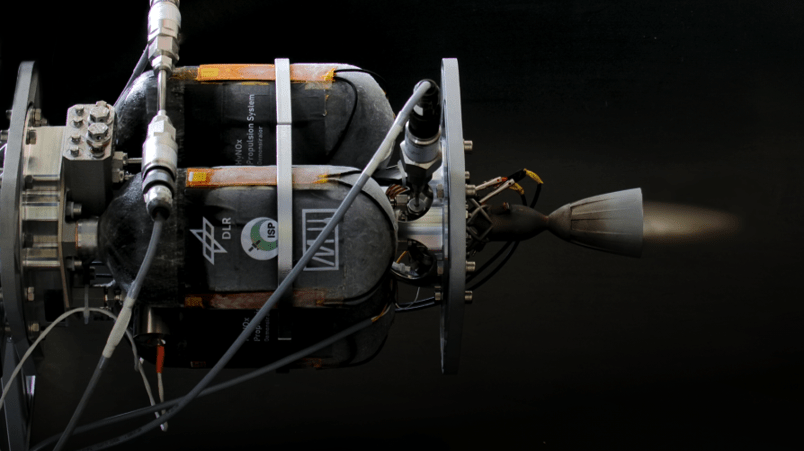
German propulsion startup ISPTech has raised €5.5 million in a seed funding round to expand development and production of spacecraft propulsion systems that use non-toxic fuels.
The company said the new capital will help increase its workforce, build an in-house propulsion testing facility and scale production of its propulsion systems from several units annually to dozens per year by the end of the decade.
The funding round was led by Join Capital and included participation from High-Tech Gründerfonds, Faber, First Momentum Ventures, Lightfield Equity, Final Frontier Liftoff, German Aerospace Center and Start-up BW Seed Fonds.
Founded in 2023 by former engineers from the German Aerospace Center, chief executive Lukas Werling and co-founder Felix Lauck, ISPTech develops propulsion systems intended to reduce the operational risks and regulatory burdens associated with conventional satellite fuels such as hydrazine.
The company is developing two propulsion systems. The HyNOx system targets spacecraft weighing less than 500 kilograms and uses a bipropellant combination of ethane and nitrous oxide. The HIP_11 system is designed for spacecraft above 500 kilograms and uses hydrogen peroxide combined with an ionic liquid fuel.
According to the company, the HIP_11 fuel mixture has higher density than hydrazine, allowing spacecraft to achieve greater delta-v from a tank of the same volume.
“Non-toxicity helps test faster. You can develop faster, iterate faster, and the propellants are cheaper. You [also] have less regulations,” Werling said. “What we see is that the performance for those commercial applications is not a key driver.”
ISPTech said it has already secured customers, including ATMOS Space Cargo, and plans to deliver its first propulsion systems later this year.
The company is also exploring additional propulsion configurations, including the possibility of using the HIP_11 propellant in both chemical and electric propulsion systems within a single architecture.
Such an approach could allow spacecraft to combine high-thrust maneuvering capabilities with lower-thrust, energy-efficient propulsion for longer missions.