SWISSto12 and Mitsubishi Electric Corporation signed a memorandum of understanding on September 14 covering advanced satellite payloads, radio-frequency products and market development in Japan and the wider Asia-Pacific region, while Mitsubishi Electric placed a separate order for phased-array antenna products supporting a Japanese government secure communications program in geostationary orbit.
The companies did not disclose the antenna contract’s value, product quantity, operating frequency, delivery schedule or the identity and deployment timeline of the government program.
The order gives the broader partnership an immediate hardware component. Under the MoU, Mitsubishi Electric will combine its satellite-system development, manufacturing and integration capabilities with SWISSto12’s proprietary additive-manufacturing designs and production processes.
The companies said they intend to pursue opportunities in Japan and other Asia-Pacific markets, including sovereign communications applications across land, maritime, airborne and space systems. The MoU establishes a framework for that work but does not represent a disclosed procurement commitment beyond the phased-array antenna contract.
Mitsubishi Electric’s Defense & Space Systems business has extensive experience developing and integrating government and commercial spacecraft. For SWISSto12, cooperation with an established Japanese prime contractor provides a route into programs that require close coordination between payload hardware, onboard electronics, spacecraft interfaces and mission-level integration.
SWISSto12 Chief Executive Emile de Rijk said the partnership would support Japan’s next-generation sovereign communications capabilities and address growing regional demand for advanced payload and RF technology. Masahiko Arai, Mitsubishi Electric’s executive officer and group president for Defense & Space Systems, said the companies would combine SWISSto12’s additive-manufacturing technology and small geostationary satellite platform with Mitsubishi Electric’s defense and space manufacturing experience.
Additive Manufacturing Moves Into Secure GEO Payloads
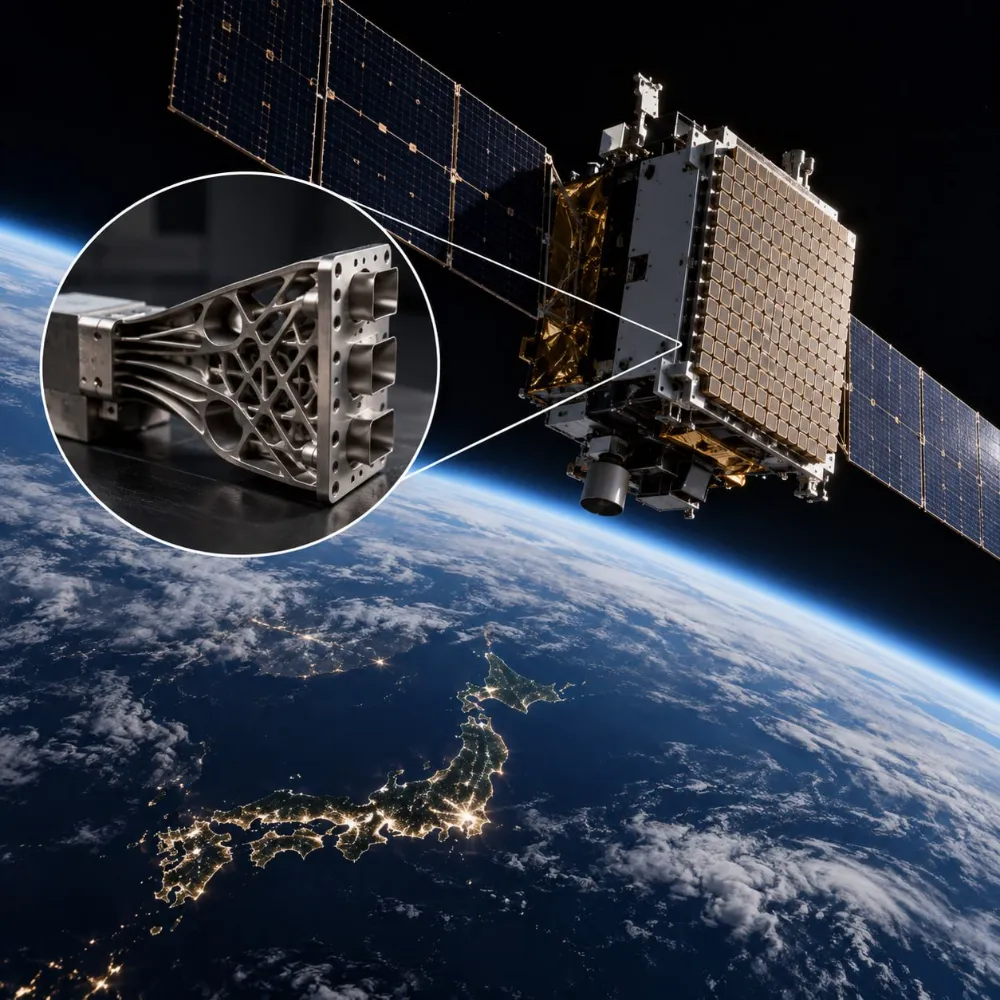
SWISSto12 uses additive manufacturing to produce antennas, filters, waveguides and other passive RF components with geometries that can be difficult or expensive to manufacture through conventional machining and assembly. The process can consolidate multiple RF functions into fewer parts, reducing mass, interfaces and assembly work while allowing engineers to optimize internal signal paths.
Those characteristics are relevant to phased-array systems, which use multiple radiating elements and controlled signal phases to form and steer beams. Unlike mechanically pointed antennas, phased arrays can redirect coverage electronically, support multiple beams and provide greater operational flexibility. The exact architecture of the products ordered by Mitsubishi Electric was not disclosed.
For a geostationary secure communications satellite, antenna performance must be balanced against spacecraft mass, thermal conditions, power availability and long-duration reliability. Additively manufactured RF assemblies can help reduce payload mass and component count, although completed flight hardware still requires RF characterization, environmental qualification and integration with the satellite’s electronics and structure.
SWISSto12 markets these technologies through its HummingLink portfolio, which includes advanced payloads, active phased-array antennas and RF products for low, medium and geostationary orbits. The company said more than 2,000 of its products are already operating in space.
The Swiss company, founded in 2011 as a spinout from the Swiss Federal Institute of Technology Lausanne, is also developing HummingSat, a compact geostationary communications satellite platform. SWISSto12 said it is delivering payloads for several low Earth orbit constellations and multiple HummingSat spacecraft for international operators.
The company reported $140 million in revenue for 2025, more than $500 million in contracted orders and compound annual growth of 110% since 2022. Those figures indicate that the Mitsubishi Electric agreement forms part of a wider expansion from individual RF components into complete payloads and satellite systems.
The next measurable step will be delivery and integration of the phased-array antenna products for the Japanese government GEO program. Any expansion into additional payload contracts or joint Asia-Pacific programs will depend on the opportunities developed under the MoU.