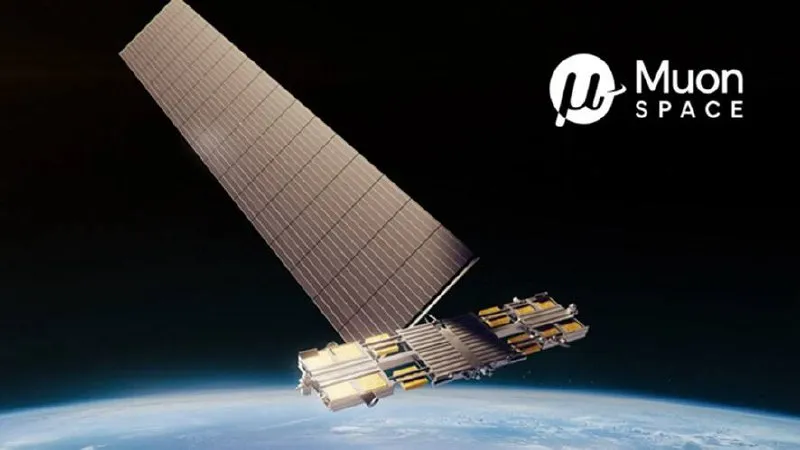
Muon Space has raised $250 million in a Series C financing round as the California satellite developer moves to expand spacecraft production, broaden its dual-use satellite platforms and support a growing pipeline of commercial, government and international sovereign customers.
The oversubscribed financing, announced Aug. 20, brings Muon Space’s total equity funding to more than $386 million. The round was led by Eclipse Capital and included new and existing investors such as Galvanize, Google, Salesforce Ventures, Wellington Management, I Squared Capital and Woven Capital. Existing backers Radical Ventures, Congruent Ventures, Costanoa Ventures, Activate Capital, ACME Capital, ArcTern Ventures and Overlap Holdings also participated.
The financing comes as Muon transitions from a startup focused on individual satellite programs into a higher-volume space infrastructure company. The company has deployed 11 satellites across six launches, with seven launched during the first half of 2026 and a reported 100% mission success record.
The immediate challenge is no longer proving that Muon’s spacecraft can work. It is building enough of them, quickly enough, to serve a growing collection of constellation customers.
Muon Is Moving From Satellite Projects to a Production System
Founded in 2021, Muon Space has built its business around what it calls the “Mission Foundry” model. Rather than treating each spacecraft as a largely independent engineering project, the company combines mission design, spacecraft platforms, payload integration, software, operations and data services into an integrated production system.
That approach is intended to address one of the longstanding bottlenecks in satellite manufacturing: the difficulty of moving from a successful prototype to a repeatable constellation.
Traditional spacecraft programs can involve lengthy custom engineering, separate suppliers and long qualification cycles. For constellation operators, however, the economics change when dozens or hundreds of satellites must be produced. Common spacecraft architectures, standardized interfaces and repeatable manufacturing processes can reduce engineering effort and make production more predictable.
Muon has been building toward that model for several years.
In June 2025, the company expanded its Series B financing to $146 million and said the funding would support expanded satellite production, vertical integration of propulsion and infrared and radio-frequency instruments, automated constellation operations and expansion of its ground-station network. It also acquired Starlight Engines, bringing propulsion technology into the company.
The company’s new San Jose production center is the physical manifestation of that strategy. The 130,000-square-foot facility contains manufacturing and testing operations and is designed to support production of as many as 500 satellites annually by 2027, a roughly tenfold increase over Muon’s previous production capacity.
The Series C therefore represents more than another round of venture funding. It is an attempt to finance the transition from an engineering-led business into an industrial-scale spacecraft manufacturer and mission operator.
A Rapidly Expanding Flight Pipeline
Muon enters the financing with a significantly larger operational footprint than it had only a year ago.
Seven satellites launched during the first six months of 2026, bringing the company’s deployed fleet to 11 spacecraft across six launches. More than 50 additional customer satellites are now in development, with 13 already manifested for launch over the coming year.
Two programs are particularly important to the company’s shift toward operational constellations.
The first is Vindlér 2.0, developed for Sierra Nevada Corporation. The satellites provide radio-frequency data and analytics, giving customers another source of information for understanding activity across the electromagnetic spectrum.
The first three Vindlér 2.0 satellites launched March 31, 2026, marking the operational debut of the constellation.
The second is FireSat, developed with the Earth Fire Alliance. Muon launched the first operational three FireSat spacecraft in July 2026, moving the program beyond its initial demonstration phase toward a dedicated wildfire-monitoring constellation. The satellites are designed to improve the detection and monitoring of fires from orbit.
These programs illustrate the breadth of Muon’s strategy. The company is not building a constellation around a single commercial application. Instead, it is attempting to use a configurable spacecraft and production architecture across defense, environmental monitoring, sensing and other data-intensive missions.
That diversification is important to the economics of a satellite factory. A production line is more valuable when it can support multiple customers and mission types rather than depending on a single large constellation.
The Technical Bet: Standardized Platforms With Mission-Specific Payloads
Muon is effectively betting that satellite manufacturing can adopt some of the principles that transformed other high-technology industries: standardized building blocks, vertical integration, automation and higher production volumes.
The company’s Halo technology stack is intended to integrate spacecraft platforms, payloads and software-defined mission orchestration. Its spacecraft portfolio includes different classes designed for different mission requirements rather than relying on one satellite size for every customer.
In June 2026, Muon unveiled Condor-Ultra, a larger platform designed for constellations ranging from hundreds to thousands of spacecraft. The company said the platform is intended for high-power communications, sensing and orbital-computing missions, with configurations designed for deployment from SpaceX’s Starship as well as current medium-lift launch vehicles including Falcon 9 and Rocket Lab’s Neutron.
This matters because the next phase of satellite constellations is increasingly moving beyond simple communications payloads. Operators want more processing, larger sensors, higher data rates and greater power availability in orbit.
Muon is also integrating propulsion more deeply into its manufacturing architecture. Its acquisition of Starlight Engines gave the company control over a propulsion technology based on Hall-effect thrusters using zinc propellant and a solid-metal feed system. Bringing propulsion into the company’s internal supply chain is intended to reduce dependence on an external component that can otherwise become a production bottleneck.
The company’s production philosophy is consequently broader than simply assembling satellites faster. It is trying to control more of the systems that determine spacecraft delivery schedules.
Why 500 Satellites a Year Matters
A production target of 500 spacecraft annually would put Muon in a fundamentally different category from traditional custom satellite manufacturers.
The significance is not that every satellite will necessarily be identical. High-volume constellation manufacturing generally requires a balance between standardization and customization. The bus, avionics, propulsion, software and interfaces can be standardized while payloads and mission configurations vary.
That is the logic behind Muon’s “high-mix, high-volume” manufacturing approach.
The company’s San Jose facility was designed with cleanrooms, spacecraft assembly, optical-instrument integration, mission operations and in-house propulsion capabilities. It is intended to accommodate spacecraft from smaller platforms through much larger vehicles, rather than functioning as a single-purpose assembly line.
If Muon can achieve high utilization of that facility, the economics could be significant. Fixed engineering and manufacturing costs can be distributed across more spacecraft, while repeatable processes can reduce the amount of labor required for each vehicle.
But the target also creates a new challenge: demand.
A factory capable of producing 500 satellites per year only becomes economically attractive if enough customers are willing to buy those satellites. Muon’s current pipeline of more than 50 spacecraft in development suggests substantial demand, but converting development programs into funded, launched and operational constellations will be critical to the company’s next stage.
Muon’s Position in a Crowded Satellite Manufacturing Market
Muon is entering a market where several companies are pursuing related ideas, although their business models differ.
Loft Orbital has emphasized standardized satellite infrastructure that allows customers to fly payloads without developing an entire spacecraft program from scratch. Apex is pursuing productized satellite buses and mass manufacturing, while K2 Space is developing larger, high-power satellite platforms designed to provide substantially more spacecraft capability per launch.
Muon distinguishes itself by pushing farther toward an end-to-end constellation model. Its stated objective is not merely to sell a satellite bus. The Mission Foundry combines mission architecture, spacecraft, payloads, software and operations.
That distinction could become increasingly important as customers become more interested in outcomes rather than individual spacecraft.
A government customer seeking persistent sensing, for example, ultimately needs usable data rather than a satellite sitting in orbit. A wildfire-monitoring organization needs timely fire information rather than simply a functioning payload. An RF-intelligence operator needs processed information and analytics rather than raw signals alone.
Muon is therefore positioning itself closer to a systems integrator and infrastructure provider than a conventional satellite manufacturer.
The Series C Also Points Toward Space-Based Computing
The company’s new funding will support not only spacecraft production but also advanced payloads, on-orbit artificial-intelligence computing and very high-bandwidth satellite connectivity.
That broadens Muon’s ambitions beyond conventional Earth observation.
On-orbit computing can reduce the amount of raw data that must be transmitted to Earth. Instead of sending every image or sensor measurement to a ground station, a spacecraft can process data onboard, identify relevant events and transmit only the information required by users.
For applications such as wildfire detection, defense sensing or large-scale Earth observation, this can reduce communications requirements and shorten the time between sensing and decision-making.
Muon is also pursuing real-time, ultra-high-bandwidth connectivity through a partnership involving SpaceX’s Starlink network. The company has previously described plans to integrate Starlink mini laser terminals into its spacecraft, potentially giving future missions higher-capacity links between satellites and the broader network.
Together, these capabilities point toward a broader concept of space infrastructure in which satellites are not simply remote sensors. They can become distributed nodes for sensing, processing, networking and data delivery.
Why the Timing Is Significant
Muon is raising capital at a time when government agencies and commercial operators are increasingly looking for large numbers of relatively affordable spacecraft.
Defense organizations are moving toward proliferated architectures in which capability is distributed among many satellites rather than concentrated in a small number of extremely expensive platforms. Commercial Earth observation and environmental monitoring are following a similar trajectory because more satellites can increase revisit frequency and geographic coverage.
The result is a structural change in the satellite market.
The traditional model optimized for maximum capability from each individual spacecraft. The constellation model often optimizes the overall network instead. Losing one satellite does not necessarily eliminate the mission, while adding more spacecraft can improve coverage and resilience.
This creates a natural market for manufacturers capable of delivering large numbers of spacecraft with consistent performance.
Muon has already signaled that it expects this trend to accelerate. In February 2026, the company said it had 20 satellites manifested for launch over a 20-month period across government and commercial programs, covering hyperspectral imaging, RF sensing, thermal-infrared sensing, weather intelligence and other missions.
The current Series C provides capital to turn that growing manifest into a much larger industrial operation.
The Next Test Is Execution, Not Fundraising
The $250 million financing gives Muon substantial resources, but the company’s next challenge will be operational execution.
Scaling from dozens of spacecraft in development toward hundreds of satellites per year requires more than factory space. It requires reliable suppliers, repeatable testing, propulsion availability, payload integration, launch access, software infrastructure and a customer base capable of sustaining production.
Constellation companies also face the challenge of maintaining quality as production accelerates. A defect that affects one satellite can become far more consequential when the same design is deployed dozens or hundreds of times.
Muon therefore needs its Mission Foundry concept to work across the entire lifecycle, from design and manufacturing through launch, commissioning, operations and data delivery.
The company’s recent record provides an initial indication that it can execute at increasing tempo. Eleven satellites have now been deployed across six launches, and the company has moved both Vindlér 2.0 and FireSat toward operational service in 2026.
The next phase will test whether that success can be reproduced at much greater volume.
A Potential Inflection Point for Commercial Space Manufacturing
Muon Space’s Series C is significant because it reflects a broader transition in the space industry: the emergence of satellite manufacturing as an industrial-scale infrastructure business.
The company is betting that spacecraft can increasingly be treated as configurable products rather than bespoke engineering projects. Its new San Jose facility, expanding spacecraft portfolio, in-house propulsion and growing mission pipeline are all pieces of that strategy.
The $250 million investment gives Muon the opportunity to accelerate that transition. If the company can fill its production capacity with funded constellation programs and maintain reliability as volumes increase, it could become one of the more important U.S. suppliers for the next generation of distributed sensing, communications, defense and orbital-computing systems.
For now, the milestone is less about the valuation attached to the company than the production target behind the financing: up to 500 satellites a year by 2027.
Achieving that number would mark a major shift in Muon’s scale. More importantly, it would test whether the company’s central proposition — that complete space-based capabilities can be designed, manufactured and deployed in months rather than years — can move from an attractive startup thesis to a repeatable industrial model.