NASA has called off the effort to save the Neil Gehrels Swift Observatory after the private spacecraft sent to raise the aging telescope’s orbit failed to overcome persistent attitude-control problems.
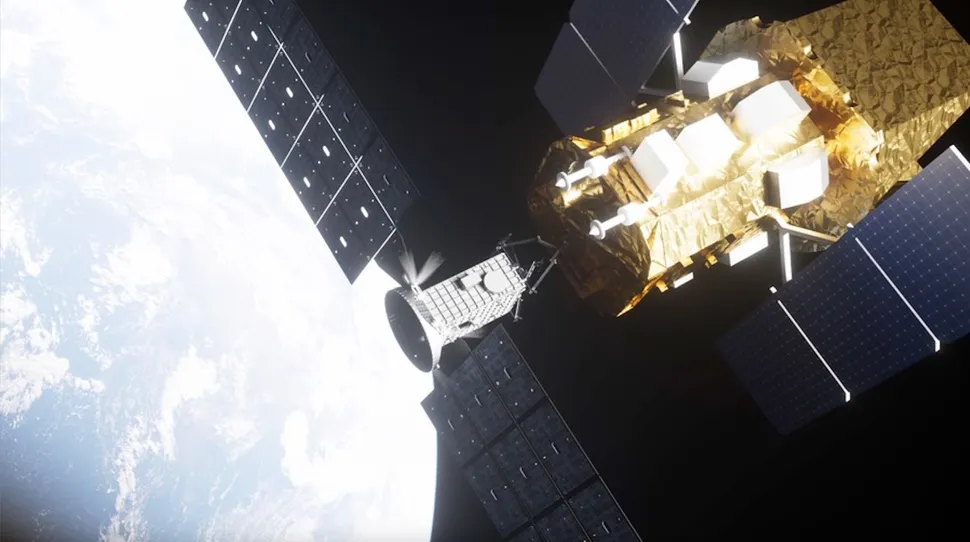
The Swift Boost mission was intended to demonstrate a new model for satellite servicing: instead of replacing an aging spacecraft, a relatively small commercial vehicle would rendezvous with it, capture it robotically and use its own propulsion to move the spacecraft into a higher orbit. The mission was particularly ambitious because Swift was never designed to be serviced in orbit.
The rescue spacecraft, called LINK and developed by Arizona-based Katalyst Space Technologies, launched on July 3, 2026, aboard the final flight of Northrop Grumman’s air-launched Pegasus XL rocket. About three weeks later, LINK began spinning uncontrollably after suffering failures involving its attitude-control system. Engineers attempted to recover the spacecraft, but NASA announced on Aug. 19 that the original orbital-boost objective would no longer be pursued.
The failure means Swift is still on a path toward atmospheric reentry later in 2026. However, NASA and Katalyst have not abandoned LINK entirely. The spacecraft will still attempt to rendezvous with Swift and conduct proximity operations, allowing engineers to gather data that could influence future satellite-servicing missions.
The outcome is a setback for NASA’s attempt to demonstrate commercial orbital servicing, but it also exposes one of the central engineering challenges of the emerging space-logistics industry: reaching an aging spacecraft is only the beginning. Controlling the servicer, matching the target’s motion, safely making contact and transferring momentum are all separate problems that must work together.
A nine-month race to rescue a 21-year-old observatory
Swift has been operating far beyond its original mission design life.
The spacecraft launched from Cape Canaveral on Nov. 20, 2004, aboard a Delta II-derived Delta 7320 rocket. Developed through an international partnership involving NASA, the United Kingdom and Italy, Swift was designed primarily to investigate gamma-ray bursts, among the most energetic explosions in the universe. NASA renamed it the Neil Gehrels Swift Observatory in 2018 in honor of Neil Gehrels, who helped develop the mission and served as its first principal investigator.
Swift was built around a particularly valuable scientific capability. Its Burst Alert Telescope detects gamma-ray bursts and rapidly determines their locations. The spacecraft can then autonomously slew toward the event and bring the X-Ray Telescope and Ultraviolet/Optical Telescope onto the target.
That rapid response is central to Swift’s scientific value. A gamma-ray burst can last from milliseconds to minutes, while its afterglow evolves rapidly. Swift was therefore designed not merely as a telescope but as a time-domain observatory capable of detecting an event and quickly coordinating observations across multiple wavelengths. NASA says the observatory can relay an initial burst position to the ground within roughly 20 seconds and autonomously repoint in less than about 90 seconds.
The original mission was expected to last only about two years. Instead, Swift continued producing science for more than two decades.
That longevity created a very different problem from the usual end-of-life scenario for low-Earth-orbit satellites. Swift remained scientifically useful, but its orbit was gradually becoming unsustainable.
Why Swift was falling back to Earth
Low Earth orbit is not truly empty.
Even hundreds of kilometers above the surface, the atmosphere contains enough extremely thin gas to generate aerodynamic drag. The effect is tiny during each orbit but accumulates over thousands of revolutions.
As a spacecraft loses orbital energy, its altitude decreases. The lower it goes, the denser the residual atmosphere becomes, increasing drag and accelerating orbital decay.
Swift’s problem was aggravated by increased solar activity, which heats and expands the upper atmosphere. A satellite at a given altitude can therefore experience substantially more drag during periods of heightened solar activity.
Swift had originally operated at a considerably higher altitude, but by 2026 its orbit had fallen to roughly 347 kilometers, or about 216 miles, according to reporting on the rescue effort. NASA had already taken steps to conserve the observatory as its orbital lifetime shortened, including shutting down its scientific instruments earlier in the year.
The rescue concept was straightforward in principle: put another spacecraft in orbit, find Swift, attach to it and raise the combined vehicle to a higher altitude.
In practice, virtually every part of that sequence is difficult.
LINK was attempting something much harder than a normal satellite launch
Katalyst Space Technologies developed LINK under a NASA contract worth about $30 million. The company moved from contract award to launch in roughly nine months, an unusually compressed schedule for a spacecraft intended to perform autonomous rendezvous and robotic capture.
The spacecraft was delivered to orbit on July 3 by a Pegasus XL launched from Northrop Grumman’s L-1011 Stargazer aircraft. The flight was historically significant for another reason: it was the final Pegasus launch after decades of operations by the air-launched rocket.
LINK’s mission architecture required it to first locate and approach Swift, then establish a controlled relative trajectory. It would have needed to match the target’s position and velocity closely enough to perform a capture maneuver.
That is fundamentally different from launching a conventional satellite.
A normal launch vehicle only has to place a spacecraft into an appropriate orbit. A servicing spacecraft has to operate inside that orbit and continuously control its motion relative to another object.
The target is also moving at several kilometers per second around Earth. Any small error in relative velocity can translate into a rapidly increasing separation or an unsafe approach.
The challenge becomes even greater when the target was never designed for docking.
Swift does not have the standardized servicing interfaces found on spacecraft designed from the beginning for future robotic maintenance. Katalyst therefore had to study historical spacecraft documentation and imagery to determine where its robotic arms could safely make contact. Earlier mission planning called for LINK to use three robotic arms to capture Swift.
There was another complication: Swift’s optical instruments are sensitive to pointing conditions. A careless maneuver could expose vulnerable hardware to the Sun or otherwise place the observatory in an unfavorable attitude.
In other words, the rescue spacecraft had to approach an old, uncooperative satellite whose geometry and attitude were not optimized for robotic servicing, while avoiding a collision and maintaining precise control.
The rescue spacecraft itself became the problem
The mission initially appeared to be progressing after LINK reached orbit and established communications.
But roughly three weeks after launch, the spacecraft developed serious attitude-control problems and began spinning. Earlier reports described failures involving two of LINK’s three reaction wheels, while engineers also worked with its propulsion system to reduce the rotation and recover control.
Reaction wheels are a fundamental part of spacecraft attitude control. By accelerating or decelerating an internal wheel, a spacecraft can change its orientation without continuously firing thrusters.
The advantage is precision and efficiency. The disadvantage is that the system depends on mechanical components that can fail.
A servicer such as LINK needs particularly reliable attitude control because rendezvous operations demand accurate knowledge and control of the spacecraft’s orientation. A spacecraft that cannot reliably point its sensors, propulsion system or robotic arms is effectively unable to perform a precision capture.
Engineers attempted recovery measures, including software changes and alternative use of the spacecraft’s propulsion capabilities. The effort reduced the severity of the uncontrolled motion but did not restore sufficient confidence to execute the original capture and orbit-raising sequence.
NASA therefore made the critical distinction between ending the rescue objective and ending the mission entirely.
LINK will still attempt to rendezvous with Swift and conduct proximity operations. That could provide useful engineering data on relative navigation, communications, spacecraft dynamics and operations around an aging target even though Swift will not receive the intended orbital boost.
Swift’s loss is bigger than the loss of one satellite
Swift is not simply an old observatory approaching retirement.
Its scientific contribution is tied to a type of astronomy in which timing is everything. The observatory was specifically designed to identify transient high-energy events and rapidly follow them across gamma-ray, X-ray, ultraviolet and optical wavelengths.
Swift has also contributed to the broader transition toward time-domain astronomy, in which astronomers increasingly treat the universe as a changing environment rather than a static collection of objects.
Its observations have helped characterize gamma-ray bursts and their afterglows and have supported studies of phenomena involving massive stars, compact-object mergers and black holes. NASA says Swift detects roughly 100 bursts per year and has provided one of the most comprehensive datasets on gamma-ray-burst afterglows.
The end of Swift therefore removes a long-running scientific asset, even though the observatory has already operated far beyond its nominal two-year mission.
The practical lesson for future space telescopes is equally important: orbital lifetime can become a limiting factor even when the science instruments themselves remain valuable.
The failed rescue does not invalidate commercial satellite servicing
The most important industry question is whether the Swift failure represents a failure of the broader servicing model.
It does not.
Satellite servicing has already demonstrated that spacecraft can rendezvous and physically connect with operational satellites. Northrop Grumman’s Mission Extension Vehicle program provides the clearest commercial example.
MEV-1 docked with Intelsat’s IS-901 in February 2020, while MEV-2 later docked directly with Intelsat’s IS-1002 in geostationary orbit. The servicing spacecraft use their own propulsion systems to provide life extension to satellites whose onboard propellant is running low.
The difference is that those missions operate in geostationary orbit and were designed around established servicing architectures.
Swift is in low Earth orbit, where atmospheric drag is continuously changing the orbital environment. Its target was also an older spacecraft without dedicated servicing hardware.
That makes the Swift Boost mission a particularly demanding demonstration of non-cooperative servicing.
The broader market is moving toward increasingly sophisticated forms of orbital logistics: inspection, relocation, repair, component replacement, refueling, debris removal and eventually robotic assembly. Northrop Grumman’s next-generation servicing architecture, for example, is intended to expand beyond simple life extension toward inspection, repair, upgrades, relocation and debris-removal applications.
Katalyst’s experience highlights why the market will likely evolve incrementally. A spacecraft that can safely rendezvous is not necessarily a spacecraft that can dock. A spacecraft that can dock is not automatically capable of refueling. And a servicer that can manipulate a cooperative satellite may still struggle with an uncontrolled or damaged target.
Each capability adds another layer of autonomy, sensing and fault tolerance.
China is pursuing the same orbital-logistics problem from a different direction
The Swift rescue also comes at a time when China is investing heavily in technologies that could keep spacecraft operational for longer and manipulate satellites after launch.
China’s Shijian-21 spacecraft demonstrated a particularly important capability in 2022. After rendezvousing with the defunct Beidou-2 G2 satellite in geostationary orbit, Shijian-21 captured it and moved it into a higher disposal orbit. NASA’s 2025 review of in-space servicing technologies lists the mission as a completed demonstration of active docking and relocation.
China subsequently pushed the concept toward orbital refueling. Shijian-25 launched on Jan. 7, 2025, with the stated purpose of verifying satellite fuel replenishment and life-extension technologies. In June and July 2025, Shijian-25 and Shijian-21 were observed conducting repeated close-proximity operations in geostationary orbit, with external tracking indicating that the spacecraft may have docked for a refueling-related demonstration.
China’s commercial sector has also begun exploring orbital servicing. In 2026, the Yuxing-3 06 spacecraft, developed by Sustain Space, a subsidiary of Emposat, demonstrated robotic-arm technologies associated with future in-orbit refueling operations. Chinese state media described the spacecraft as a “space gas station” concept designed to support future servicing missions.
The comparison should not be overstated. China’s demonstrations and NASA’s Swift Boost mission involve different orbital regimes, spacecraft architectures and mission objectives.
But strategically, they point toward the same emerging reality: spacecraft are increasingly being treated as assets that can be maintained, moved and serviced rather than disposable objects launched once and abandoned.
That shift has implications for both commercial space economics and military space operations.
The Hubble question becomes harder
The Swift rescue was also important because it could have provided experience relevant to another aging NASA observatory: the Hubble Space Telescope.
Hubble is in a higher orbit than Swift and has historically benefited from astronaut servicing missions, which replaced components and upgraded instruments during the Space Shuttle era. That servicing model is no longer available in the same form.
A robotic spacecraft capable of rendezvousing with, capturing and repositioning an aging observatory could therefore have offered NASA a potentially useful new tool.
The Swift failure does not mean Hubble cannot be serviced. The two spacecraft are substantially different, and Hubble’s orbit, configuration and servicing history would create its own engineering requirements.
But it does remove an opportunity to demonstrate the full end-to-end capability on Swift before attempting an even more consequential mission.
That makes the data gathered during LINK’s remaining proximity operations especially important.
A failure that may accelerate the next generation of servicing missions
The most useful way to interpret the Swift Boost outcome is not as a rejection of orbital servicing, but as a demonstration of how much technology must mature before servicing becomes routine.
Future servicers will need greater redundancy in attitude-control systems, more robust fault-management software and stronger alternatives when a primary control subsystem fails.
Navigation is another critical area. Autonomous servicing spacecraft must determine not only where they are, but where the target is, how it is rotating and how their relative trajectories will evolve seconds or minutes into the future.
Robotic capture introduces another problem: the target’s structural properties may be uncertain, and contact can transfer momentum between the two vehicles. A servicer must therefore control the dynamics of the combined system after contact.
For future missions, standardized servicing interfaces could eliminate some of these problems. Satellites designed from the beginning to accept robotic maintenance could incorporate grapple fixtures, fuel-transfer ports, standardized navigation markers and structural attachment points.
That would make servicing less like trying to repair an old automobile with improvised tools and more like connecting a standardized piece of infrastructure.
The economic case could become significant. If a servicing spacecraft can extend the life of a billion-dollar asset by several years, the cost of servicing may be far lower than designing, manufacturing, launching and commissioning a replacement.
But the economics only work if servicing becomes reliable enough to be insured and routinely purchased.
The end of Swift’s mission marks the beginning of a larger debate
NASA’s decision on Aug. 19 closes the most ambitious phase of the Swift rescue attempt, but it does not end the experiment.
Swift will continue its orbital decline, with atmospheric reentry expected later in 2026. LINK, meanwhile, will still attempt to perform rendezvous and proximity operations, preserving a portion of the mission’s technological objectives.
That distinction matters.
A successful rescue would have been a headline demonstration of commercial spacecraft servicing. Instead, NASA has received a less satisfying but potentially valuable lesson: orbital rescue is unforgiving, and a servicing vehicle must itself possess extremely robust fault tolerance before it can be trusted with another spacecraft.
Swift’s scientific career lasted more than two decades, far beyond its original design life. Its final years now illustrate both sides of the emerging orbital-servicing market. The spacecraft remained valuable enough to justify an unconventional rescue attempt, while the difficulty of that attempt shows why extending the lives of aging satellites is still a technically demanding business.
For NASA, commercial space companies and China alike, the strategic direction is increasingly clear. The next generation of space infrastructure will not be defined solely by how cheaply satellites can be launched. It will also be defined by whether spacecraft can be inspected, repaired, refueled, relocated and ultimately reused after they reach orbit.
Swift could not be saved.
But the attempt may still help determine how the next generation of satellites is built—and how future spacecraft will keep them alive.