Exail has been awarded a contract by NASA’s Goddard Space Flight Center to provide key electro-optical components for the laser system of the LISA mission, a major international space observatory designed to detect gravitational waves and deepen our understanding of the universe. The mission is planned for launch in 2035. The 3.27M€ (3,78M$) contract reflects Exail’s ability to deliver critical photonics technologies for the most demanding space missions, where precision, reliability and long-term performance are essential.
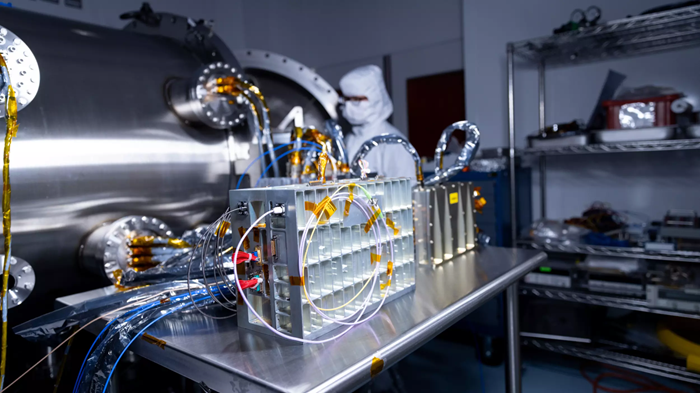
The contract covers the delivery of qualification and flight models of lithium-niobate (LiNbO3) near-infrared phase modulators for the mission’s laser hardware. Exail has been the only manufacturer able to meet NASA requirements in terms of optical input power handling capability. Aging tests demonstrated the ability to withstand power levels exceeding 500 mW without any degradation in modulation performance. NASA has also worked with Exail on the qualification of radiation hardened active (ytterbium-doped) optical fibers for the design of the 2W power amplifier of the LISA laser hardware. These fibers were tested under gamma radiation (reaching 40 krad).
The Laser Interferometer Space Antenna (LISA) will be the first space-based observatory dedicated to studying gravitational waves. Led by the European Space Agency (ESA), LISA is made possible by a collaboration between ESA, its member states, NASA, and an international consortium of scientists. Within the LISA laser architecture, Exail’s phase modulators will equip a Master Oscillator Power Amplifier (MOPA) architecture enabling the precise transfer of reference clock information between spacecraft at ~2.4 GHz, a key requirement for detecting gravitational waves with unprecedented accuracy. These capabilities directly contribute to the overall performance and reliability of the mission’s laser interferometry system.
This contribution enables:
- ultra-precise time synchronization and ranging measurement between spacecraft over millions of kilometers
- robust laser performance in high-radiation environments
- long-term stability required for space-based interferometric measurements (more than 6 years for the LISA mission)
“Being selected by NASA for the LISA mission underscores Exail’s role as a trusted provider of critical photonics systems for the most demanding space programs. This collaboration allows us to help advance the frontier of precision measurement technologies essential to next-generation scientific missions. It also reflects our broader vision: as photonics systems evolve toward ever more accurate and reliable field-deployable platforms, engineers face a shared challenge, ultimate performance depends not only on the quality of each component, but on the stability and robustness of the entire integrated optical chain.” said Yves Deiss, America sales manager at Exail
“Exail engineers were among the rare to be able to offer modulators able to accommodate the high optical input power, as required for the laser hardware of LISA. After evaluating different products over many years, Exail was the only manufacturer worldwide able to meet all the technical requirements for the reference clock transmission functionality.“ highlighted Kenji Numata, a laser scientist at NASA Goddard Space Flight Center. This success is part of a broader trend for Exail, which is already involved in leading-edge space programs such as GRACE Follow-On. This contract strengthens Exail’s role in the global space ecosystem, particularly in high-performance photonics for scientific and institutional missions.