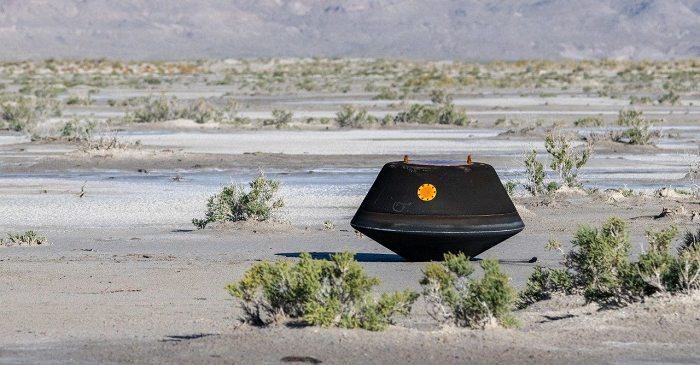
NASA’s OSIRIS-REx capsule safely landed in the desert, carrying the agency’s first asteroid sample from Bennu, a carbon-rich asteroid. This sample, about the size of a cup, could unlock insights into the origins of organic compounds crucial for Earth’s life and planetary formation.
Just prior to landing, the capsule entered the atmosphere traveling more than 27,000 mph. It then gently landed in the sands of the U.S. government’s Utah Test and Training Range.
A specialized recovery team led by Lockheed Martin – who designed, built and currently flies the mission for NASA – comprising representatives from NASA’s Goddard Space Flight Center, NASA Johnson Space Center, and the University of Arizona, then secured the capsule.
“The landing was safe, recovery was a huge success, and we’re thrilled that the next phase of this mission can now begin,” said Kyle Griffin, vice president and general manager of Commercial Civil Space at Lockheed Martin. “This particular sample return is monumental – scientists are about to open a time capsule with some of the earliest history of our solar system inside.”
After approaching the capsule landing area in helicopters, the recovery team carefully searched for any hazardous material, sampled the neighboring soil, wrapped the 100-lb capsule in protective material, and attached it for transport via helicopter to an on-site cleanroom at the range. There, the sample is being processed for shipment on a military aircraft to curation team members at NASA Johnson in Houston, Texas, who will make it available for study.
In total, about 60 people from NASA, the University of Arizona, Lockheed Martin and range personnel took part in the capsule landing and recovery efforts, plus a team of about 25 engineers operating the spacecraft from Lockheed Martin’s Mission Support Area in Denver.
Advanced Exploration Technology Testbed
- The OSIRIS-REx mission pioneered key technologies relevant to the future exploration of small bodies in our solar system, beyond its immediate follow-on mission. They include:
- Specific techniques for operating in microgravity
- Autonomous guidance to the surface of a small body with Natural Feature Tracking
Unique sample collection from an asteroid, with the Lockheed Martin-invented, reverse-vacuum Touch and Go Sample Acquisition Mechanism (TAGSAM) device
Next Stop: Apophis
Following the successful landing and showcase of key technologies, OSIRIS-REx will now be dubbed OSIRIS-APEX and enter its extended mission phase, beginning its journey to its follow-on mission target: near-Earth asteroid Apophis.
To date, OSIRIS-REx’s major mission milestones include:
- Launching on Sept. 8, 2016, from Cape Canaveral Space Force Station.
- Arriving at Bennu on Dec. 3, 2018, where it conducted a two-year detailed survey of the asteroid.
- Extracting a sample from the asteroid by “tagging” it on Oct. 20, 2020.
- Departing the asteroid to head back to Earth on May 10, 2021.
Click here to learn more about NASA’s OSIRIS-APEX mission.