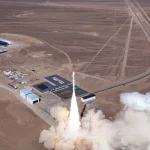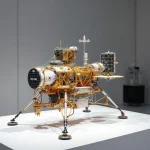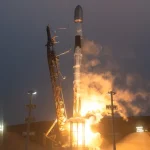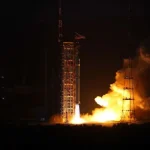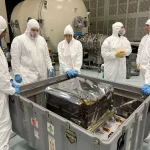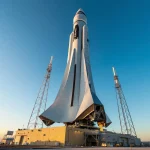
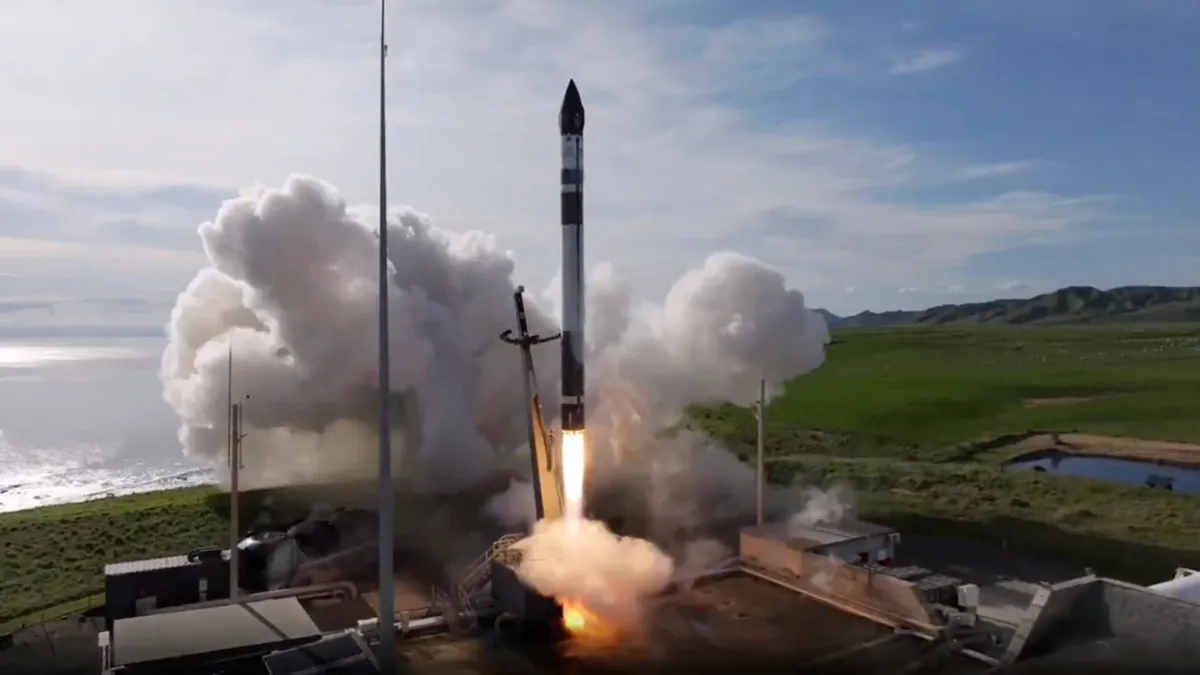
An Electron rocket launched a synthetic aperture radar (SAR) spacecraft for the Tokyo-based company Synspective from Rocket Lab’s New Zealand site on Sept. 18, 2026 at 11:22 p.m. EDT (0322 GMT and 3:22 p.m. local time on Sept. 19). Credit: Rocket Lab
Rocket Lab launched Synspective’s 12th StriX synthetic aperture radar satellite on September 19, continuing the rapid deployment of the Japanese company’s commercial Earth-observation constellation. The Electron rocket lifted off from Launch Complex 1 on New Zealand’s Māhia Peninsula at 03:22 UTC and deployed the spacecraft into a 572 km low Earth orbit inclined at 38 degrees.
The dedicated mission, named “Owl By The Dozen,” delivered its single payload approximately 53 minutes after liftoff. It was Rocket Lab’s 12th launch for Synspective, its 17th mission of 2026 and the company’s 96th launch overall.
Synspective’s StriX satellites use synthetic aperture radar, or SAR, to produce Earth-observation data during both day and night and through clouds that can prevent optical satellites from collecting usable imagery. The company is developing the constellation to support urban development, construction and infrastructure monitoring, disaster response, environmental observation and national security applications.
Unlike optical sensors, which depend on sunlight and relatively clear atmospheric conditions, SAR instruments transmit microwave signals toward Earth and measure the returned energy. This allows operators to monitor floods, landslides, ground deformation and infrastructure changes during severe weather or at night, when timely optical imagery may be unavailable.
Dedicated Electron Missions Support a Faster Deployment Cadence
Rocket Lab has served as the sole launch provider for the StriX constellation since 2020. The latest flight came just 17 days after Electron launched Synspective’s 11th StriX satellite on the “Owl Around The World” mission, demonstrating the deployment cadence available through a series of dedicated small-launch missions.
Dedicated launches allow Synspective to select orbital parameters and deployment schedules without sharing a larger rocket with unrelated payloads. That flexibility can be important for radar constellations, where spacecraft must be distributed across carefully selected orbital planes to improve revisit rates and geographic coverage.
Electron is an 18-meter, two-stage small launch vehicle designed to provide dedicated access to orbit for small satellites. While rideshare missions aboard larger rockets can offer lower costs per kilogram, a dedicated vehicle gives constellation operators greater control over launch timing and insertion orbit. Synspective’s repeated use of Electron reflects that operational tradeoff as it moves from initial spacecraft demonstrations toward a larger commercial network.
The September 19 mission also continued Rocket Lab’s practice of assigning owl-themed names to Synspective launches, a reference to the StriX constellation’s name and its ability to observe Earth in darkness.
Synspective Targets a 30-Satellite SAR Network
Tokyo-based Synspective plans to establish a constellation of 30 SAR satellites by the end of the 2020s. Rocket Lab has another 15 missions booked to support the remaining deployment program before 2030.
Expanding the number of satellites is intended to shorten the interval between observations of the same location. Higher revisit rates are particularly important for disaster management and infrastructure monitoring, where customers need to detect changes quickly rather than rely on isolated images.
A larger constellation can also support more frequent monitoring of distributed assets such as roads, railways, ports, construction sites and energy infrastructure. By comparing radar observations collected over time, analysts can identify surface movement or structural changes that may not be readily visible in conventional imagery.
The next contracted Electron missions will continue building orbital capacity toward Synspective’s planned 30-satellite network, while providing Rocket Lab with a long-term launch campaign tied to one of Japan’s largest commercial radar-imaging programs.