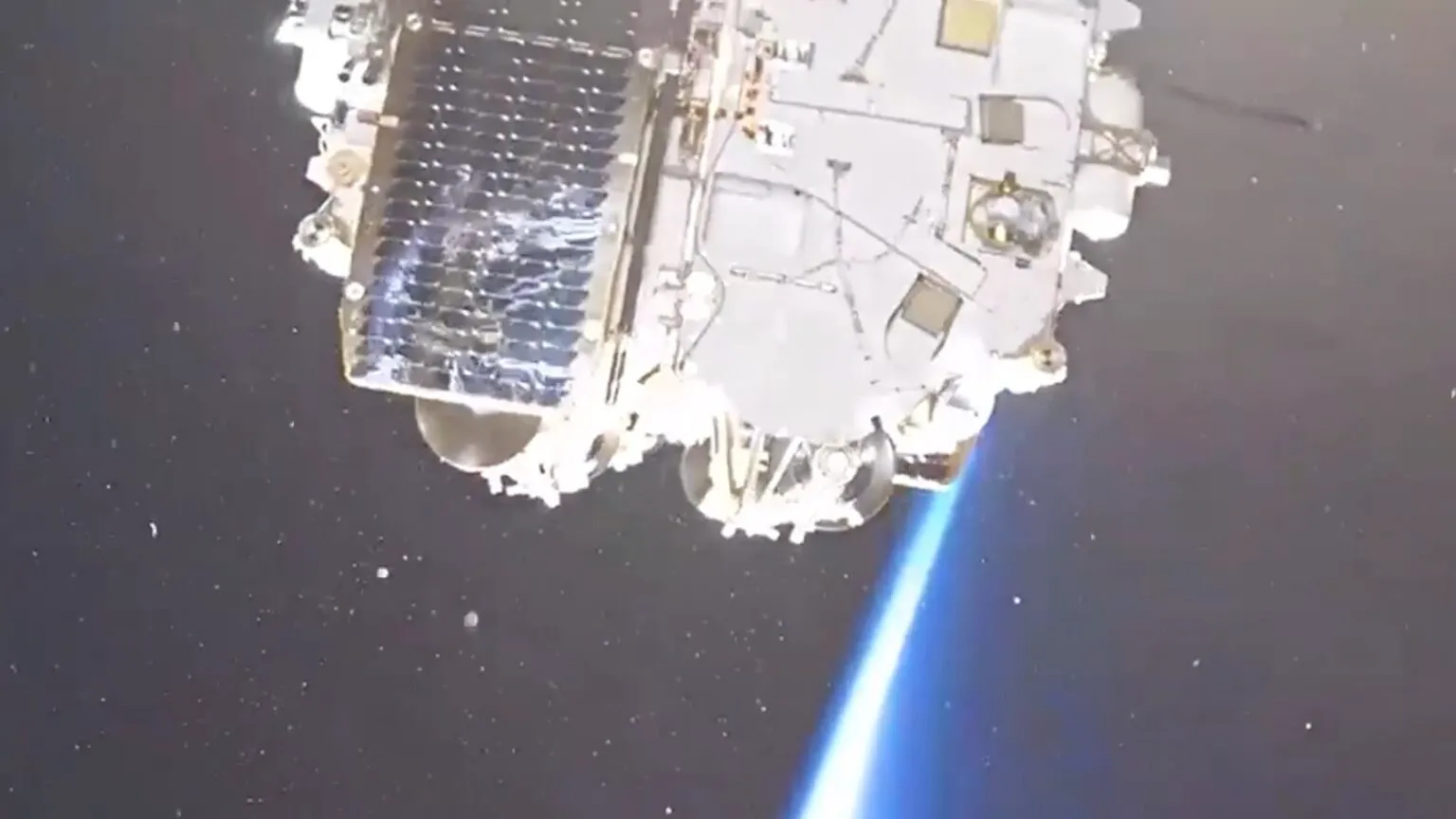
Russia’s effort to build a sovereign low-Earth orbit broadband network has encountered propulsion problems and at least three probable satellite failures during the deployment of its first 32 operational Rassvet spacecraft.
Bureau 1440, the Moscow-based company developing Rassvet, launched two batches of 16 satellites on March 23 and July 19, 2026. Both missions used Soyuz-2.1b rockets to place the spacecraft into low insertion orbits, from which their onboard plasma propulsion systems were expected to raise them toward their operating altitude.
None of the 32 satellites had reached the originally disclosed altitude of approximately 800 kilometers by the end of August. Public orbital data also indicate that most spacecraft from the second launch are climbing substantially more slowly than the first group, raising questions about propulsion performance, commissioning progress and the constellation’s deployment schedule.
The evidence does not establish that the entire program is failing. Bureau 1440 may have adopted an operating altitude near 500 kilometers or could be holding some spacecraft at lower altitudes for testing and orbital-plane phasing. The company, however, has not publicly explained the divergent orbital behavior or confirmed a change in the system’s architecture.
At Least Three Satellites Appear to Have Failed
The first 16 Rassvet-3 satellites were launched from Plesetsk Cosmodrome on March 23 and released into an orbit roughly 300 kilometers above Earth. The spacecraft were then expected to use low-thrust plasma engines to conduct a gradual orbit-raising campaign.
Twelve satellites from that group have reached orbits slightly above 500 kilometers. A thirteenth may still be climbing toward the same altitude.
One spacecraft conducted no meaningful orbit-raising maneuvers and reentered Earth’s atmosphere in early June, approximately 75 days after launch. Two others have remained at substantially lower altitudes and showed little or no recent progress, suggesting that they may have propulsion, power or spacecraft-control problems.
The second batch was launched on July 19, again with 16 satellites. Two of those spacecraft apparently never began raising their orbits and have continued to descend under atmospheric drag, making reentry increasingly likely. Three others initially maneuvered but subsequently appeared to stop climbing. Eleven were observed raising their altitudes in early August, although none had reached 500 kilometers by the end of the month.
Based on those trajectories, at least three of the 32 satellites—the spacecraft already lost and the two July vehicles that never maneuvered—likely suffered outright failures. The status of several others remains uncertain.
Orbital tracking alone cannot identify the underlying technical cause. A satellite that stops climbing could have experienced a propulsion anomaly, insufficient electrical power, an attitude-control problem or a deliberate pause ordered by operators. Bureau 1440 has not released enough telemetry or operational information to distinguish among those possibilities.
An Unconfirmed Shift From 800 to 500 Kilometers
Rassvet’s orbital plan has become a central uncertainty. Earlier program information pointed to an operating altitude of about 800 kilometers, but the main group from the March launch has clustered near 500 to 520 kilometers.
That pattern could indicate that Bureau 1440 selected a lower operational shell after evaluating the first production spacecraft. It could also represent an extended intermediate phase for commissioning, propulsion testing or orbital-plane separation.
Electric propulsion produces low thrust and can require months to raise a satellite’s orbit, particularly when the spacecraft must gain hundreds of kilometers after separation. The slow climb is therefore not, by itself, proof of a malfunction. However, the wide performance differences within two nominally similar batches are harder to explain as a uniform deployment strategy.
Operating at approximately 500 kilometers would offer several advantages. The shorter distance to user terminals would reduce signal propagation time and link loss, while atmospheric drag would help remove failed satellites from orbit rather than leaving them as long-lived debris.
The tradeoff is reduced geographic coverage per satellite. A constellation designed around an 800-kilometer shell would generally need additional spacecraft, orbital planes or both to provide comparable continuous coverage at 500 kilometers. A lower orbit also increases drag and requires more station-keeping propellant, potentially shortening spacecraft life if the propulsion and power systems were not sized for that environment.
A permanent altitude change could consequently affect Rassvet’s satellite count, replenishment rate, spectrum filings, ground-network design and overall business case.
Early Failures Test Bureau 1440’s Production System
Some spacecraft losses are expected during the transition from prototypes to serial production. About 5% of SpaceX’s first batch of 60 Starlink spacecraft failed shortly after launch, while the group’s cumulative failure rate eventually reached approximately 13%. The next 420 Starlink satellites recorded a failure rate of around 3%, and the rate for the current Starlink Version 2 generation has fallen to approximately 0.01%.
Other proliferated constellations have also encountered early operational difficulties. Some of the first 42 operational data-relay satellites launched for the U.S. Space Development Agency experienced thermal and propulsion problems, extending their orbit-raising schedules.
These comparisons show that initial anomalies do not necessarily invalidate a constellation architecture. The more important questions are whether the failures share a common cause, whether the design can be corrected rapidly and whether the operator possesses enough manufacturing and launch capacity to replace defective spacecraft without undermining the deployment schedule.
Rassvet’s immediate challenge is that Bureau 1440 must establish this learning cycle with a much smaller industrial and launch base than SpaceX. SpaceX manufactures satellites at high volume, launches frequently on its own reusable rockets and receives operational data from thousands of spacecraft. Bureau 1440 depends on Russia’s Soyuz launch infrastructure and is attempting to scale production in a national space industry that has historically manufactured only a few dozen satellites per year.
The performance differences within each Rassvet batch make production consistency especially important. Bureau 1440 must determine whether the anomalies arose from a common design weakness or from unit-level problems involving thrusters, propellant systems, solar arrays, avionics, thermal control or integration quality.
That investigation feeds directly into assembly, integration and testing. If multiple spacecraft experienced related failures, Bureau 1440 may need to revise propulsion-system acceptance tests, expand thermal-vacuum or electromagnetic compatibility verification, or strengthen component screening before launch. Such measures could reduce near-term production throughput even if they improve the reliability of later batches.
For a broadband constellation, manufacturing yield matters almost as much as individual satellite performance. A failure rate that may be acceptable during an experimental mission becomes expensive when repeated across hundreds of spacecraft, consuming launch capacity and delaying the point at which the network can provide continuous service.
Commercial Service Target Faces Schedule Pressure
Bureau 1440 previously demonstrated key technologies with three Rassvet-1 satellites launched in 2023 and three larger Rassvet-2 spacecraft launched in 2024. Those missions tested broadband connections, 5G non-terrestrial network technologies and intersatellite laser links.
The 2026 launches marked the transition from experimental spacecraft to satellites intended to form an operational network. Bureau 1440 has said it plans to begin commercial service in 2027 and expand Rassvet to 292 satellites by that year, followed by 924 spacecraft by 2035.
With only 32 operational-generation satellites launched by the end of July—and several apparently unavailable or underperforming—the 2027 target requires a steep acceleration in manufacturing, testing and launch cadence.
Approximately 16 additional launches would be needed to bring Rassvet’s coverage over Ukraine anywhere close to continuous if future missions continue carrying 16 spacecraft each. That estimate does not account for replacements required after satellite failures.
The satellites currently near 500 kilometers can provide only intermittent regional connectivity as their orbital tracks pass over a user. Twelve Rassvet satellites are reportedly arranged to pass over Ukraine twice per day, creating communication windows lasting up to approximately 90 minutes.
Despite that limited availability, the existing constellation could still support more precise strikes by remotely controlled unmanned systems or provide communications during individual satellite passes. Continuous broadband service, however, requires a much denser constellation distributed across multiple orbital planes and supported by ground gateways, user terminals and network-management infrastructure.
Rassvet’s strategic importance has increased since SpaceX restricted access in February 2026 for unregistered Starlink terminals operating in Ukraine. Russian forces had reportedly used gray-market terminals for battlefield communications and drone operations, making a domestically controlled satellite network increasingly valuable to Moscow.
Ukraine Targets Rassvet’s Launch Infrastructure
Ukraine is taking steps to make further Rassvet deployments more difficult. Ukrainian forces have struck the factory responsible for manufacturing the Soyuz rockets needed to launch Rassvet payloads and dispatched drones against Plesetsk Cosmodrome, the military launch site used for the constellation’s first two operational missions. The drone attacks had not scored a direct hit on Plesetsk at the time of reporting.
The Institute for the Study of War assessed that attacks against facilities central to Russia’s satellite and launch industries could restrict its ability to deploy additional spacecraft and further delay the establishment of a domestic Starlink analogue.
The effect could extend beyond individual launch delays. Rassvet depends on a coordinated supply chain covering satellite production, Soyuz manufacturing, upper-stage availability, launch-site operations and mission integration. Disruption at any one of those points could reduce launch cadence, while damage to specialized manufacturing equipment may be harder to overcome than losses involving conventional infrastructure.
Soyuz is also a core launch vehicle for Russia’s broader space program, supporting navigation, reconnaissance and other government missions as well as crewed flights to the International Space Station. Any constraint on Soyuz production or launch operations could therefore force Russia to prioritize among military, civilian and constellation missions.
Rassvet has demonstrated that Russia can manufacture and launch batches of relatively large broadband satellites, but it has not yet demonstrated the reliability, production throughput or protected launch capacity required for a resilient service. The next missions—and whether Bureau 1440 formally defines its final orbital architecture—will show whether the current difficulties are routine commissioning problems or evidence of deeper barriers to constellation-scale deployment.