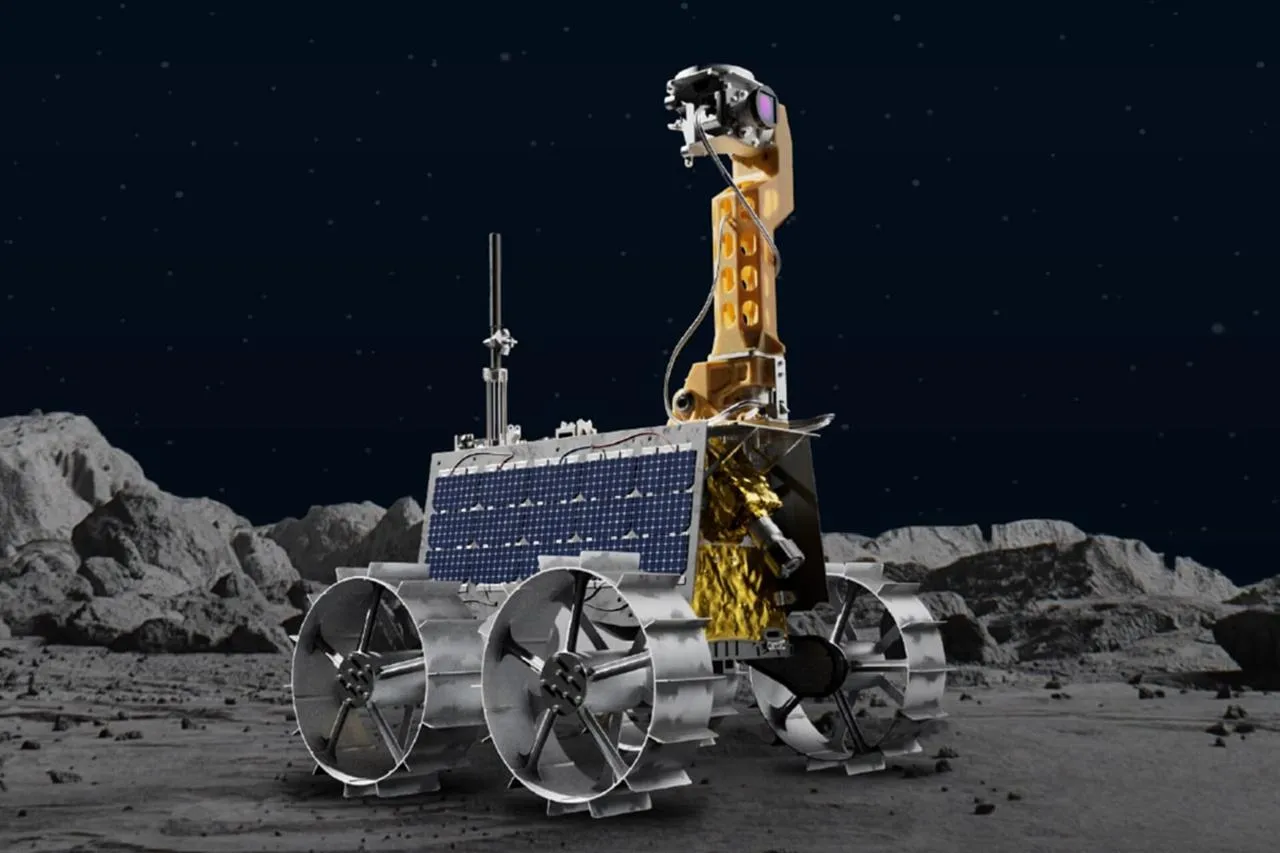
The European Space Agency and ispace-Europe have formally signed the implementation agreement for MAGPIE, a commercially led rover mission designed to investigate water ice and subsurface geology near the Moon’s south pole.
The Phase 2 agreement was signed on September 1, 2026, during ESA’s Space for Inspiration event in Copenhagen, Denmark. The ceremony followed ESA’s July 2026 award of a €65 million contract to the Luxembourg-based company.
MAGPIE—short for Mission for Advanced Geophysics and Polar Ice Exploration—is scheduled to launch in 2029 aboard ispace’s Mission 4 ULTRA lunar lander. If successful, it will become ESA’s first lunar rover and Europe’s first rover to operate on the Moon.
The roughly 10-Earth-day surface mission will search for water and other volatile compounds, characterize the lunar regolith and examine subsurface geological structures. The findings are intended to support both lunar science and the planning of future robotic and crewed operations in the south polar region.
A Contract Covering the Mission End to End
The €65 million Phase 2 contract covers the remaining development and execution of MAGPIE, including rover and payload development, manufacturing, testing, delivery to the lunar surface, mission operations and the provision of scientific data to ESA.
ispace-Europe is serving as prime contractor and will lead the mission from system design through surface operations and data delivery. This gives the company responsibility not only for the rover platform but also for coordinating payload integration, environmental qualification, interfaces with the lander and the surface operations architecture.
The rover will travel aboard ispace’s Mission 4 ULTRA lander through a cooperation arrangement between ESA and the Japan Aerospace Exploration Agency. Mission 4 is also expected to demonstrate high-precision landing technology for polar regions under a grant awarded through Japan’s Space Strategy Fund, which is administered by JAXA.
Accurate landing is particularly important for polar missions. Scientific value and rover survivability can vary sharply over relatively short distances because of local slopes, illumination conditions, communications geometry and the boundaries of permanently shadowed terrain. Reducing landing dispersion can place the rover closer to scientifically valuable deposits while limiting the distance it must traverse during a short surface campaign.
Four Measurement Techniques Target Lunar Volatiles
MAGPIE will carry a drill, a volatile analyzer, ground-penetrating radar and neutron-detection instruments. The instruments are designed to produce complementary observations rather than relying on a single indicator of water ice.
The rover’s Lunar Volatiles Scout package will include an instrumented Volatiles Sampler drill supplied by the Technical University of Munich. ESR Technology of the United Kingdom will provide the drill translation unit, while The Open University will supply an ion-trap mass spectrometer for analyzing volatile compounds. RAL Space will lead joint assembly and testing of the volatile analyzer with support from The Open University.
The University of Oslo’s Centre for Space Sensors and Systems will provide Lunar RiMFAX, a ground-penetrating radar intended to examine subsurface layering and geological structures. The Institute of Experimental and Applied Physics at the Czech Technical University in Prague will contribute a neutron spectrometer suite comprising Neutron HardPix and Radiation HardPix instruments.
Neutron measurements can identify hydrogen-enriched material beneath the surface, but hydrogen detection alone does not establish its chemical form. Radar can provide information about buried structures and possible ice-bearing layers, while drilling and mass spectrometry offer more direct access to the composition of local material. Correlating those datasets across several rover stops should help distinguish between concentrated ice deposits, hydrated minerals and more diffuse volatile-bearing regolith.
Mobility is therefore central to MAGPIE’s scientific design. Measurements at multiple locations will allow researchers to examine how volatile abundance and regolith properties change with terrain, illumination and geology. That spatial comparison is more useful for resource prospecting than a single stationary measurement.
Polar Conditions Drive Rover Design and Testing
The lunar south pole presents a demanding environment for a small solar-powered rover. Low Sun angles create long shadows and rapidly changing illumination across cratered terrain, while areas in permanent shadow can reach temperatures far below those experienced at sunlit sites.
MAGPIE’s planned operational lifetime of about 10 Earth days limits the time available for commissioning, traverses, drilling and science measurements. Mission planners will consequently need to balance mobility against power, thermal conditions, communications opportunities and the time required to operate each instrument.
The distributed European payload team also creates integration demands. Mechanical interfaces, electrical power, data handling, thermal control and electromagnetic compatibility must be validated across hardware supplied by organizations in Germany, the United Kingdom, Norway and the Czech Republic.
The mission team is now working toward the rover’s Structural Thermal Model readiness review. That model will be used to assess whether the design can withstand the mechanical loads and thermal conditions associated with launch, transit, landing and lunar operations. The next major milestone will be locomotion testing focused on rover mobility performance.
These activities will be critical because a surface mission cannot recover from issues such as wheel-regolith interaction problems, deployment failures or thermal incompatibilities after landing. MAGPIE’s short mission duration further reduces the margin for troubleshooting.
A Commercial Model for European Lunar Exploration
MAGPIE is the first mission under ESA’s Moon Explore initiative, which is intended to develop exploration capabilities through smaller, faster and less expensive missions. Instead of developing every element through a conventional agency-led program, ESA is purchasing an integrated mission from a commercial prime contractor while drawing on scientific and engineering contributions from several member states.
That model could give Europe a way to fly focused lunar missions more frequently while building operational experience ahead of larger programs such as ESA’s Argonaut lunar cargo lander. MAGPIE will provide practical experience in rover manufacturing, payload integration, surface mobility, mission control and lunar science operations—capabilities that cannot be matured entirely through laboratory testing.
The contract also represents an important step for ispace-Europe following TENACIOUS, the European-designed and assembled rover launched aboard ispace’s Mission 2 in 2025. Although that mission did not place the rover on the lunar surface, its development gave the Luxembourg team experience in building flight hardware and integrating a rover with a commercial lunar lander.
For ispace, MAGPIE links its European rover business with the company’s Japanese lander program and JAXA-supported precision-landing work. For ESA, it combines European instruments and mission leadership with externally provided lunar transportation, reflecting the increasingly international and commercially distributed structure of lunar exploration.
Water ice is strategically important because it could supply water for crews and potentially be processed into oxygen and hydrogen. Before extraction systems can be designed, however, missions must establish how much ice is present, where it is concentrated, how deeply it is buried and how its distribution varies across the polar terrain. MAGPIE is intended to reduce those uncertainties through mobile, multi-instrument measurements rather than demonstrate resource extraction itself.
ESA plans to release additional information about its small-mission portfolio and other lunar activities in October 2026.