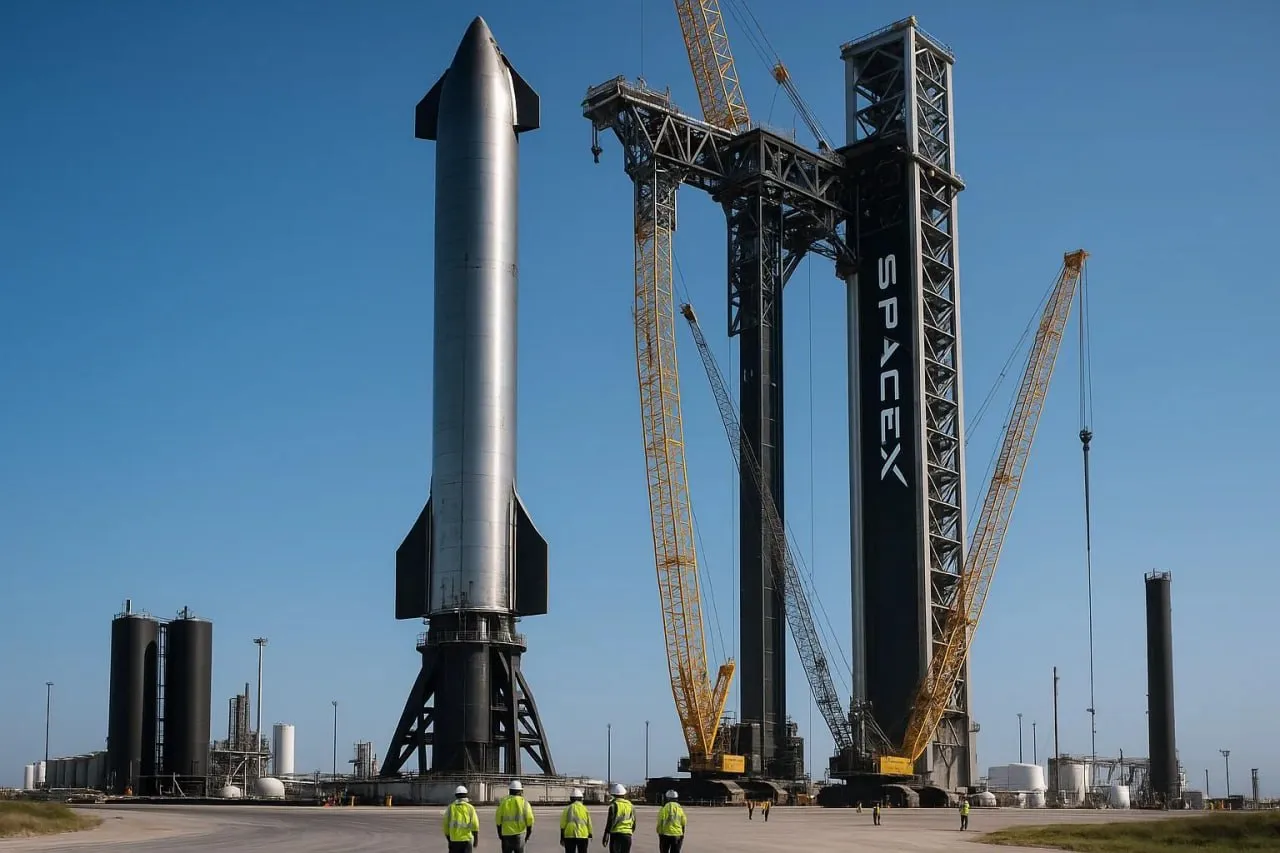
SpaceX has submitted communications applications to the U.S. Federal Communications Commission for Starship Flight 14, formally identifying the mission as the program’s first attempt to place the vehicle into a sustained Earth orbit.
The paperwork requests authority to operate launch-vehicle communications during a window beginning September 15, 2026, and extending through March 15, 2027. The opening of that regulatory window indicates the earliest possible launch date rather than a firm schedule.
SpaceX still requires flight authorization from the Federal Aviation Administration, and technical preparations at Starbase must be completed before liftoff.
Flight 14 Moves Beyond Starship’s Suborbital Test Profile
Although previous Starship missions have reached space and accelerated to near-orbital velocity, they followed deliberately suborbital trajectories. The upper stage coasted around part of Earth before reentering within the same mission, eliminating the need for a deorbit burn if the vehicle lost control.
The Flight 14 applications describe an “orbital second stage,” marking an important change in both mission design and operational responsibility. Achieving a stable orbit requires more than extending the flight path: Starship must complete insertion with sufficient accuracy, maintain attitude and power in orbit, support payload deployment, and execute a controlled deorbit sequence before reentry.
This progression raises the importance of propulsion-system reliability. Earlier suborbital missions could enter the atmosphere along a predetermined corridor without restarting the main engines in space. An orbital mission must demonstrate that Starship can reliably leave orbit, a capability needed to prevent the large vehicle from becoming an uncontrolled reentry hazard.
The communications architecture is also more demanding. SpaceX requested backup frequencies at 2228.5 MHz and 2234.5 MHz for the ship, while a related application seeks additional spectrum in the 2200–2290 MHz band for the suborbital Super Heavy booster. Trajectory data will be provided to the National Telecommunications and Information Administration, the U.S. Air Force and NASA.
These links support command, telemetry and tracking throughout phases in which Starship may be beyond the coverage of ground stations near Texas. Reliable communications are particularly important during orbital operations, payload deployment and preparations for deorbit.
Operational Starlink V3 Deployment Is the Central Payload Test
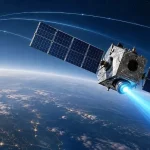
Flight 14 is expected to carry roughly 20 Starlink V3 satellites and attempt to deliver them into an operational orbit. Success would transform Starship from a vehicle conducting developmental flight tests into a launch system capable of adding usable spacecraft to SpaceX’s broadband constellation.
Flight 13, launched July 24, carried 20 production Starlink V3 satellites and successfully completed an Indian Ocean splashdown. Because that mission retained a suborbital trajectory, however, the satellites were not placed into permanent orbit and subsequently reentered with the mission profile. Their deployment primarily tested Starship’s payload handling and dispenser systems.
Flight 14 is intended to complete the next step: orbital insertion followed by the release of satellites capable of entering service. SpaceX has said each Starlink V3 satellite is designed to provide approximately 1 terabit per second of downlink capacity, substantially increasing the network capacity delivered by each spacecraft.
The combination of larger satellites and a high-throughput launch vehicle is central to SpaceX’s Starlink expansion strategy. Falcon 9 remains capable of launching current-generation Starlink spacecraft at a high cadence, but Starship’s much larger payload volume and mass capacity are designed to deploy heavier, higher-capacity satellites in greater numbers.
An orbital deployment would therefore validate several tightly connected systems: the payload bay and its door mechanism, the satellite dispenser, on-orbit navigation, collision-avoidance planning and the timing of deployment relative to Starship’s deorbit maneuver. A failure in any one of those areas could prevent the satellites from reaching usable orbits even if the launch vehicle completes insertion.
Booster 21 and Ship 41 Complete Major Propulsion Tests
Hardware preparations have advanced alongside the regulatory filings. Ship 41 completed a full-duration, approximately 60-second static-fire test involving all six of its Raptor engines on August 21. SpaceX then conducted a full-duration static fire of all 33 engines on Booster 21 on August 28.
Static-fire completion does not by itself establish flight readiness. SpaceX must still review propulsion data, complete vehicle inspections, integrate the two stages and perform final pad and countdown testing. Orbital flight also places greater emphasis on software validation, flight termination provisions and mission-control procedures extending beyond the short suborbital campaigns flown so far.
Flight 13’s intact splashdown provided SpaceX with evidence that the latest Starship configuration could withstand reentry. Flight 14 will need to repeat that performance after a longer mission and an orbital deorbit maneuver, potentially exposing the spacecraft to different thermal and targeting conditions.
SpaceX is expected to return the upper stage to an ocean splashdown rather than attempt to catch it at Starbase. Chief Executive Elon Musk said on August 20 that the first tower catch of a Starship upper stage was more likely to occur “in a few months,” stepping back from an earlier suggestion that the maneuver could be attempted on Flight 14.
Super Heavy recovery remains a separate mission objective. Returning the booster toward Starbase tests the navigation, engine relight and terminal-guidance systems required for rapid first-stage reuse, while an ocean recovery for Ship 41 limits the risk associated with combining orbital insertion and an upper-stage tower catch on the same flight.
FCC Approval Is Only One Part of the Launch Process
The FCC applications concern radio-frequency use and do not constitute approval to launch. The FAA Office of Commercial Space Transportation remains responsible for licensing the flight, including assessments of public safety, vehicle performance, debris risk and the planned trajectory.
The distinction is important because an orbital profile introduces different hazards from earlier Starship tests. Regulators must evaluate the insertion and deorbit phases, the disposal plan if the spacecraft experiences a malfunction, and the geographic areas potentially affected during reentry.
The FAA has already completed environmental reviews covering higher Starship launch cadence and additional trajectories from Starbase, including proposed return-to-launch-site operations. Its broader environmental decision allows consideration of as many as 25 annual Starship-Super Heavy orbital launches from the Texas site, but each mission must still comply with the applicable vehicle operator license and safety requirements.
Flight 14 would be a major program transition if it reaches orbit, deploys operational satellites and completes a controlled return. Those objectives move Starship closer to functioning as a working transportation system rather than solely an experimental launch vehicle. They are also directly relevant to SpaceX’s plans for large-scale Starlink deployment and to later missions requiring prolonged orbital operations, propellant transfer and lunar transportation.