The Space Shuttle Program was well underway by January 1986 – with preparations marching toward the launch of the 25th Space Shuttle mission, a mission to place a school teacher in Low Earth Orbit. And while the STS-51L/Challenger mission ended in disaster, from its devastating aftermath came the hope of a new beginning in the form a new and improved Space Shuttle orbiter – an orbiter that has performed some of the most vital and historical missions for humanity over the course of her 19-year, 25-mission career.
OV-105 Endeavour: The Baby with Big Expectations and a Bold History:
**CLICK HERE TO READ PART 2: http://www.nasaspaceflight.com/2011/04/ov-105-endeavour-a-long-standing-dream-realized/
A little over one year after the loss of the sister she never knew, the United States Congress passed legislation officially authorizing the construction of new Space Shuttle orbiter to fill the manifest needs left in the wake of the 51L disaster.
However, before permission to construct a new orbiter was issued, serious consideration was given to refitting the test orbiter Enterprise (OV-101) and having her join the Shuttle fleet as an operational, space-worthy vehicle. This idea was quickly turned down, however, due to cost and time requirements.
 Essentially, it was deemed cheaper and faster to simply build a new orbiter than to refit the Enterprise.
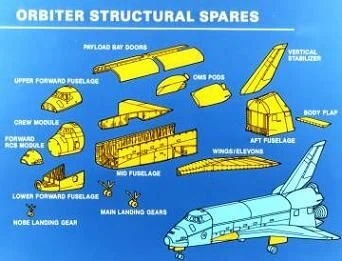
Taking advantage of structural spares created during the construction campaigns of OV-103/Discovery and OV-104/Atlantis, construction of NASA’s newest orbiter, known officially as OV-105 (Orbiter Vehicle 105), gained a significant time advantage by making use of these structural spares.
To this end, the start of structural assembly of OV-105’s Crew Module began on February 15, 1982 — over five years before authorization to build OV-105 was issued.
Aerospace & Defense
(adsbygoogle = window.adsbygoogle || []).push({});
Specifically, the contract to build NASA’s newest, and last, Space Shuttle orbiter was issued to Rockwell International on July 31, 1987.
 Two months later, on September 7, engineers began assembling the body-flap of OV-105 – with assembly beginning on her aft-fuselage on Sept. 28.
Mid-fuselage assembly began on October 19, 1987 followed on November 30 by the start of assembly of the vertical stabilizer.
On December 22, OV-105’s distinctive and tell-tale Delta wings arrived on-dock at her Palmdale, California construction facility from the Grumman group in New York state.
On January 11, 1988, engineers began work on the fabrication and assembly of OV-105’s Forward Reaction Control System thruster pod. The vehicle’s left hand OMS (Orbital Maneuver System) pod arrived on-dock on January 29 followed by the right hand OMS pod on February 16.
 Mating of the wings to the mid-fuselage was completed on May 17, 1988, and the lower fuselage was transported to Palmdale on May 25. The mid- and lower-fuselages were mated together in August 1988. Upper-fuselage assembly began at Downey on August 1 – the same day that final assembly of OV-105 began.
OV-105’s payload bay doors arrived at Palmdale throughout October 1989. The aft-fuselage was delivered on December 15, 1989, followed by the crew module on February 23, 1990. The crew module was mated to the upper-fuselage throughout March 1990.
OV-105 was powered-up for the very first time on July 6, 1990. The vehicle’s body flap was mated to the orbiter in July, the nose cap and vertical stabilizer in September, and the payload bay doors in Sept./Oct. of 1990.
Unlike all previous NASA spacecraft, NASA chose to involve, from the beginning, the general public when it came to choosing a name for the new Space Shuttle orbiter. For the naming contest, students in all elementary and secondary schools in the United States were offered the opportunity to submit names for consideration.
The entries had to include an essay regarding the historical and exploratory significance for the suggested name, as well as information on why the name would be appropriate for the new Shuttle orbiter. State-level winners were selected and forward on for final consideration.
 In the end, the name that was eventually chosen for OV-105 was the most popular entry received, accounting for one-third of the total state-level entry winners.
On April 25, 1991, the Space Shuttle orbiter ENDEAVOUR was proudly rolled out of her Palmdale construction facility by her dedicated workforce.
The Space Shuttle Endeavour is named after two great ships of exploration – the first being the HMS Endeavour, the ship Captained by James Cook on his first voyage from 1768-1771. During the HMS Endeavour’s voyage, she transported Cook to the South Pacific where he observed and recorded the transit of Venus between the Earth and the sun – observations that helped early astronomers calculate the distance of the Earth from the sun.
 Cook’s Endeavour further enabled him to become the first person to fully chart New Zealand, survey the eastern coast of Australia, and discover the Hawaiian Islands.
Cook’s voyage on the Endeavour also carried significant medical prestige of the day and helped establish the usefulness of sending scientists on voyages of exploration.
During the HMS Endeavour’s voyage with Cook, her crew reportedly conducted the first long-distance voyage during which no crewman died from scurvy. To this end, Cook is credited with being the first captain to use diet as a cure for scurvy.
The second great exploratory ship that Space Shuttle Endeavour was named in honor of was the Command Module of Apollo 15.
 Following her rollout from Palmdale, Endeavour was transported overland to Edwards Air Force Base where she was bolted to the top of the Shuttle Carrier Aircraft. Endeavour departed Edwards Air Force Base (Edwards AFB), CA for the first leg of her multi-stop journey to the place she would call home for the next two decades.
Endeavour’s ferry flight delivery stops included Biggs Army Base in Texas, Kelly AFB, and Ellington AFB from May 3-6, 1991. On May 7, Endeavour departed Ellington AFB and gracefully arrived at the Kennedy Space Center, FL – exactly one year to the day before she would launch on her maiden voyage.
Upon delivery, Endeavour was equipped with state-of-art equipment and numerous updates based on lessons-learned from her sisters’ previous flights. During construction, Endeavour was fitted with a 40ft drag chute for use during landing, additional plumbing and electrical connections for the Extended Duration Orbiter (EDO) pallets that would allow up to 28-day missions, updated avionics and advanced General Purpose Computers, improved Inertial Measurement Units and Tactical Air Navigation systems, enhanced Master Events Controllers, enhanced multiplexer-demultiplexers, and improved nose gear steering.
 Endeavour was also equipped with improved versions of the Auxiliary Power Units (APUs) and an enhanced solid-state star tracker. Endeavour is also the lightest orbiter in terms of dry weight – weighing substantially less than Columbia and her other sisters.
One day after her arrival at Kennedy, Endeavour was removed from the SCA and towed directly into the VAB transfer aisle, where she remained for two days before being moved into VAB HB 2 (High Bay 2) for temporary storage.
After one month in storage, Endeavour was moved into OPF-1 (Orbiter Processing Facility bay 1) on July 25, 1991 for receiving inspections and maiden voyage flight processing.
After just over seven months in the OPF, Endeavour was rolled over to the VAB on March 7, 1992 and mated to ET-43 on MLP-2 (Mobile Launch Platform 2) on March 8.
 Five days later, on March 13, Endeavour and the STS-49 stack was rolled out of the VAB and out to Launch Complex 39B where pre-flight processing continued toward the planned Flight Readiness Firing (FRF) of her three Space Shuttle Main Engines (SSMEs).
The FRF – a 20-second test firing of the three SSMEs at the culmination of a wet countdown dress rehearsal – proceeded nominally on April 6. Following the FRF, which was the final step in verifying and validating Endeavour’s Main Propulsion System for flight, all three SSMEs were replaced at launch pad 39B.
Final pre-flight processing proceeded nominally toward a targeted May 4 launch at 20:34 EDT. However, during the Flight Readiness Review (FRR) process, the launch date was moved to May 7 at 19:06 EDT (the opening of the launch window) to ensure better lighting conditions for photographic documentation of the vehicle through first stage flight.
On May 4, the three day countdown to launch began. On launch day, the countdown proceeded nominally to the T-9min hold. The hold was extended for 34mins due to unacceptable weather at the Transoceanic Abort Landing (TAL) site.
 At 19:40:00 EDT on May 7, 1992, the countdown clock reached ZERO and the Solid Rocket Boosters ignited, lifting Endeavour and her seven-member crew off Pad-B and into the history books.
Launch of Endeavour and the STS-49 mission marked the first and ONLY time that a Space Shuttle vehicle conducted its maiden voyage from Pad-B at the Kennedy Space Center; all four of Endeavour’s older sisters embarked on their maiden flights from Pad-A.
At launch, Endeavour weighed 256,597 lbs. Through the combined power of her twin Solid Rocket Boosters, three SSMEs, and twin OMS pod engines, Endeavour was quickly and efficiently inserted into a 195nautical mile (nm) high orbit inclined 28.35-degrees to the equator (resulting in a due east launch trajectory from the Kennedy Space Center).
 Once in orbit, Endeavour’s crew got right to work setting up for the rendezvous with the Intelsat VI satellite – which was stranded and unusable in Low Earth Orbit following its launch on a Titan rocket in March 1990 when its launch system failed to place it in its correct, geostationary orbit.
To facilitate the repair of Intelsat VI, a spacewalk was planned in which two of Endeavour’s crewmembers would physically grab the satellite and attach a capture bar to the satellite. During the spacewalk to grab the satellite, all attempts to grab Intelsat VI and attach the capture bar failed.
The EVA was subsequently called off and rescheduled for the following day, and Endeavour backed away to safe distance. The next day, after a re-rendezvous, all attempts to capture Intelsat VI and install the capture bar failed as well.
 Then, on May 13, a third attempt to capture the satellite was made using three of Endeavour’s crewmembers.
Before capture of Intelsat VI on this day, an Assembly of Station by EVA Methods (ASEM) structure was erected by the crew to assist in the satellite’s capture. The EVA was successful: Intelsat VI was captured, the capture bar attached, a live rocket engine kit installed (a kit that would propel Intelsat VI into its correct orbit), and the satellite released back into orbit.
The EVA marked the first and, to date, only time in history that an EVA was conducted involving three people, the first and, to date, only time that a live rocket kit was attached to a satellite in space during an EVA, and the longest single EVA in history to that point – a record that would stand until STS-102 in March 2001.
The following day, another spacewalk was conducted as part of an ongoing investigation into the ASEM experiment for Space Station Freedom.
 A second planned ASEM spacewalk was cancelled following the lengthy Intelsat retrieval.
This marked the first time that a single Space Shuttle mission featured four EVAs – a record at the time – and the longest total EVA time for a single Space Shuttle mission at the time at 25hrs 27mins.
STS-49 also marked the first mission requiring multiple (three in this case) rendezvous with an orbital spacecraft.
During the mission, Endeavour’s crew also performed Chimerical Protein Crystal Growth, Ultraviolet Plume Imager, and Air Force Maui Optical Station experiments/investigations.
 The maiden voyage of Endeavour concluded at 06:57.38 EDT on May 16th with a landing on runway 22 at Edwards AFB, CA. Upon landing, Endeavour made one more first for the Space Shuttle Program – the first use of a drag chute during landing.
Rollout distance on the runway was 9,490 feet and was conducted without the use of braking. Total mission elapsed time was 8days 21hrs 17mins 38secs – the longest maiden voyage of the five operational Shuttle orbiters.
Endeavour was then de-serviced and ferried back to KSC on May 30. She was towed into OPF-3 on May 31 for post-flight de-servicing and pre-flight processing for STS-47. After 2.5 months, Endeavour was rolled over to the VAB on August 17 where she was mated with ET-49.
 The entire STS-47 stack was rolled out to Pad-B on August 25 for a targeted September 12 launch. The pad flow proceeded uneventfully and Endeavour launched on her second mission – and the 50th Space Shuttle mission – at 10:23:00.0680 EDT 12 Sept. 1992. The launch marked the first on-time launch since STS-61B in November 1985.
STS-47 was a joint NASA/NASDA (National Space Development Agency of Japan) mission – also known as Spacelab-J – with a primary focus on life and material science.
STS-47 marked the first of several times that a Japanese astronaut flew about the Space Shuttle, the first flight of an African-American woman into space, and the first flight of married couple into space.
Overall, the mission included 24 materials science experiments and 20 life sciences experiments. Thirty-five of these experiments were sponsored by NASDA, seven by NASA, and two by NASA and NASDA.
Among the numerous experiments were some focusing on biotechnology, electronic materials, fluid dynamics, human health, cell separation and biology, space radiation, and biological rhythms. The tests were carried out on the crew, Japanese koi fish, cultured animal and plant cells, chicken embryos, fruit flies, fungi & plant seeds, frogs, and frog eggs.
The Israeli Space Agency Investigation About Hornets was also flown about this mission.
 After 7days, 22hrs, 30mins, 23secs in space, Endeavour gracefully touched down on Runway 33 at the Kennedy Space Center at 08:53:24 EDT on Sept. 20, 1992.
After 64 days in OPF-1, Endeavour was moved to the VAB and mated with ET-51. Endeavour and the STS-54 stack was rolled out to Pad-B on December 3, 1992 for a January 13, 1993 launch.
Following a flawless pad flow, Endeavour launched at 08:59:30 EST 13 January 1993 after a 7 minute delay due to concerns with upper level winds.
Later that day, Endeavour’s crew deployed the mission’s primary payload – the TDRS-F (Tracking Data Relay Satellite -F) – into Earth orbit. Following TDRS-F’s deployment, the crew activated the Diffuse X-ray Spectrometer to collect data on X-ray radiation from diffuse sources in deep space.
 Carried in Endeavour’s middeck for STS-54 were several payloads designed to test the effects of microgravity. These payloads/experiments included the Commercial General Bioprocessing Apparatus, the Chromosome and Plant Cell Division in Space Experiment, the Physiological and Anatomical Rodent Experiment, the Space Acceleration Measurement Equipment experiment, and the Solid Surface Combustion Experiment.
The only EVA of the mission was conducted on FD-5 (Flight Day 5) by Mario Runco and Greg Harbaugh. The 4.5-hour spacewalk was designed to test NASA’s knowledge of the working conditions of space and the orbiter’s payload bay. Specifically, Runco and Harbaugh tested their ability to move freely about Endeavour’s payload bay, climb into foot restraints without using their hands, and carry large objects.
 On January 19, Endeavour’s crew prepared their craft for landing. After a one-orbit landing wave-off due to ground fog, Endeavour landed safely at the Kennedy Space Center on runway 33 at 08:37.47 EDT after 96 orbits of Earth and a Mission Elapsed Time (MET) of 5days, 23hrs, 38mins. Her rollout distance at landing was 8,723 feet.
Later that day, Endeavour was moved into OPF-1, where she spent just over two months in processing for her next mission. After being mated to ET-58, the STS-57 stack was moved to Pad-B on April 28.
The Countdown Demonstration Test with Endeavour’s crew was successfully completed on May 7 – exactly one year after her maiden launch.
Endeavour successfully launched on her 4th voyage to space on June 21, 1993 at 09:07.00 EDT. It was the 25th space mission to be launched from Pad-B.
 During the course of the 9-day mission, Endeavour’s crew conducted a series of biomedical and materials science experiments inside the SPACEHAB module; furthermore, the EURECA experiment was retrieved from orbit after having spent a year space following its deployment in the summer of 1992 by Space Shuttle Atlantis.
During the capture of EURECA, an improperly installed electrical connector on Endeavour’s SRMS (Shuttle Remote Manipulator System – or robot arm) prevented EURECA from recharging its batteries and stowing its communications antennas. The Flight Rule requiring the antennas to be stowed was waived and the satellite was lowered into Endeavour’s payload bay.
A subsequent EVA allowed two of Endeavour’s crewmembers to manually secure the antennas with the help of controllers at the Johnson Space Center. The 5hr 50min spacewalk also allowed NASA to perform continued testing on spacewalk maneuverability with an astronaut mounted to the SRMS.
Aboard SPACEHAB for this mission, Endeavour’s crew performed several experiments, including the study of body posture, spacecraft environments, crystal growth, metal alloys, waste water recycling, fluids behavior, and one experiment to evaluate maintenance equipment for Space Station Freedom.
Also flying about Endeavour was WATCH, the Wide Angle Telescope for Cosmic Hard X-rays.
 Endeavour and her crew wrapped up their mission and, after two days of weather wave-offs, landed successfully at the Kennedy Space Center on July 1 at 08:52 EDT.
Processing then immediately began for what can arguably be considered the first of Endeavour’s two most important missions: STS-61 – the mission to save the Hubble Space Telescope.
On October 28, 1993, Endeavour and the STS-61 stack was rolled out to Launch Pad 39A at the Kennedy Space Center. Shortly thereafter, on October 30, a windstorm created a contamination concern (sandblasting grit) with Pad-A’s Payload Changeout Room.
The mission’s payload was not effected by the contamination, but to maintain strict cleanliness standards for the mission’s payloads and Hubble’s new scientific equipment, Endeavour was removed from Pad-A and rolled around to Pad-B on November 15. This was the second pad-switch in Shuttle history.
 At Pad-B, processing encountered a brief problem on November 18 when one of four delta-p transducers on Endeavour’s elevon hydraulic actuator failed. Launch Commit Criteria (LCC) at the time demanded that all four delta-p transducers be functional at liftoff.
However, the delta-p transducer could not be replaced at the launch pad due to the need to access the component through Endeavour’s Main Landing Gear wheel well.
Therefore, a rollback, de-stack, and return to the OPF would have been required.
Upon review of the situation, NASA decided that all four delta-p transducers were not in fact necessary to commit to launch, and the LCC was amended.
Launch on December 1 was scrubbed due to a combination of bad weather at the Shuttle Landing Facility at the Kennedy Space Center and a boat that ventured into the launch restriction zone.
Under the Florida night sky, Endeavour departed launch pad 39B at 04:26.00 EST December 2, 1993 to begin the first Hubble Space Telescope servicing mission.
 During the course of the 11-day marathon mission, Endeavour’s crew performed 5 back-to-back space walks (a feat that has only been tied, never broken) to bring Hubble back to life and correct its vision.
On EVA-1, a spacewalking duo replaced two sets of Remote Sensing Units (containing new gyroscopes for Hubble), replaced a pair of electrical control units, and swapped out eight fuse plugs.
EVA-2, on the following day, was then spent replacing Hubble’s two damage solar arrays.
EVA-3 then saw the replacement of the Wide Field Planetary Camera with a new and enhanced Wide Field Planetary Camera. One of Hubble’s magnetometers – compasses – was also replaced during EVA-3.
EVA-4 followed the next day – the EVA to install Hubble’s corrective optics and save the telescope’s ability to clearly image distant objects in the universe. For this task, two of Endeavour’s crewmembers removed Hubble’s High Speed Photometer and replaced it the COSTAR, the Corrective Optics Space Telescope Axial Replacement unit. The EVA a 100% success!
 After this, Hubble’s altitude was raised by Endeavour through a series of two thruster firings.
The 5th and final spacewalk of the mission replaced the solar array drive electronics and fitted an electrical connection box on the Goddard High Resolution Spectrograph.
Endeavour then redeployed Hubble into Earth orbit before backing away and preparing to come home.
Endeavour landed safely at 00:26.25 EST on December 13 at the Kennedy Space Center. The mission was a smashing success, and Hubble began beaming back its ionic, awe-inspiring, and crystal-clear images of the cosmos a few months later.
In terms of Space Shuttle mission risk assessment, STS-61 carried the highest percentage risk of catastrophic failure – 1in 150 due to space debris and micrometeorite impact concerns – in Shuttle Program history.
 After four months on the ground, Endeavour took to the skies once again when she launched on the STS-59 mission on April 9, 1994 at 07:05.00 EDT. Liftoff of Endeavour occurred from Pad-A – her first launch from Pad-A. It was the 60th space mission to launch from Pad-A at the Kennedy Space Center.
Launch of STS-59 was postponed from April 7 to allow engineers time to verify that Endeavour had vanes of the proper radius in her SSME liquid oxygen preburners. Launch on April 8 was scrubbed at T-5mins and holding due to low cloud cover and high winds at the SLF.
During STS-59, Endeavour’s six-person crew conducted ’round-the-clock observations of Earth using the Spaceborne Imaging Radar-C (SIR-C), the Measurement of Air Pollution from Satellite (MAPS), and the X-Band Synthetic Aperture Radar (X-SAR) experiments.
The crew also performed a Space Tissue Loss investigation and several Get Away Special experiments before returning to Earth on April 20 at Edwards AFB, CA at 12:55 EDT for a total MET of 11days 5hrs 49mins 30secs.
After her return to the Kennedy Space Center, Endeavour was processed for STS-68. After just over a month and a half in the OPF, Endeavour was moved to the VAB on July 21 and out to Pad-A on July 27. This marked the first time that Endeavour was stack on an MLP other than MLP-2.
 On August 18, 1994, Endeavour’s launch countdown proceeded nominal. At T-31secs, the Ground Launch Sequencer handed off control of the countdown and Endeavour’s systems to Endeavour’s five General Purpose Computers (GPCs). At T-6.6secs, Endeavour’s GPCs sent the commands to ignite the three SSMEs in reverse sequence (Engine 3, Engine 2, Engine 1).
At T-3secs, all was nominal, and the three SSMEs were moved to their lift-off positions. At T-2secs, all was still nominal, and Endeavour’s GPCs sent commands to arm the twin Solid Rocket Boosters for ignition.
One-tenth of a second later, at T-1.9secs, the High Pressure Oxidizer Turbopump (HPOT) on SSME-3 exceeded its redline discharge temperature operating limit, tripping a Redundant Set Launch Sequencer (RSLS) abort.
Endeavour’s GPCs reacted immediately and issued simultaneous commands to shutdown SSME-3 and inhibit the ignition sequence of the Solid Rocket Boosters. Once the inhibit command was received and acknowledged from the SRBs, the GPCs ordered the safing of the SRBs to prevent an accidental ignition.
 Once this was in place, commands to shutdown SSME-2 and SSME-1 were issued. As such, SSME-2 and SSME-1 fired past the planned T0 time and were only shutdown once it was assured that the SRBs would not ignite.