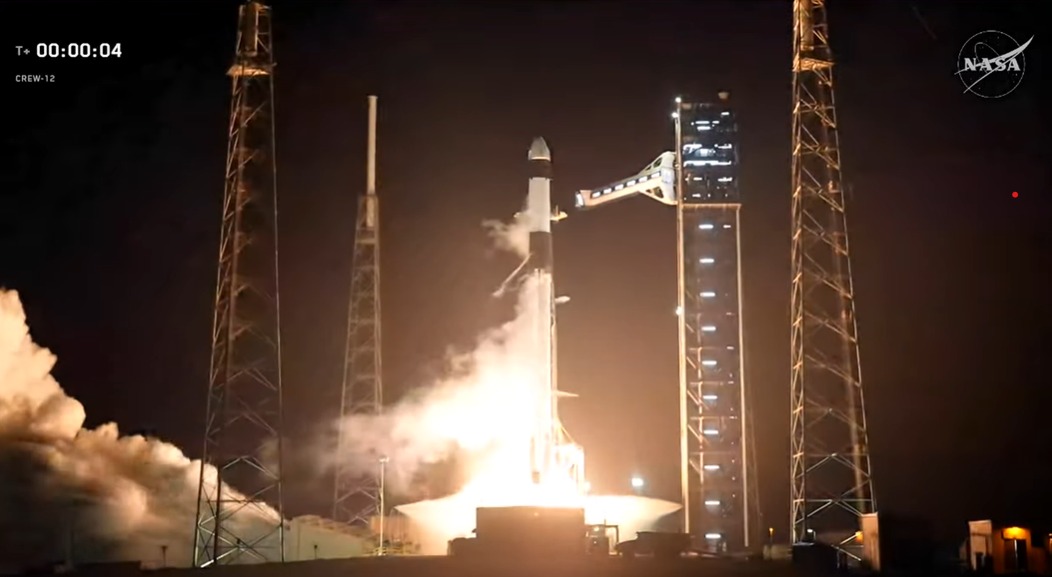
A SpaceX Falcon 9 rocket launched NASA’s Crew-12 mission early Friday, sending four astronauts from the United States, Europe and Russia toward the International Space Station for a long-duration scientific expedition.
The rocket lifted off at 5:15 a.m. EST from Space Launch Complex 40 at Cape Canaveral Space Force Station, carrying a Crew Dragon spacecraft with NASA astronauts Jessica Meir and Jack Hathaway, European Space Agency astronaut Sophie Adenot and Roscosmos cosmonaut Andrey Fedyaev.
The spacecraft is scheduled to dock autonomously with the space-facing port of the station’s Harmony module at about 3:15 p.m. EST on Saturday, Feb. 14. Once aboard, the crew will join the existing Expedition 74 team, restoring the station’s typical complement of seven astronauts following the departure of the previous crew in January.
“With Crew-12 safely on orbit, America and our international partners once again demonstrated the professionalism, preparation, and teamwork required for human spaceflight,” NASA Administrator Jared Isaacman said. “The research this crew will conduct aboard the space station advances critical technologies for deep space exploration while delivering real benefits here on Earth.”
During the flight, SpaceX is monitoring the spacecraft’s automated maneuvers from its mission control center in Hawthorne, California, while NASA oversees station operations from Johnson Space Center in Houston. Live coverage of rendezvous, docking and hatch opening is scheduled to resume Saturday afternoon.
The Crew-12 astronauts will conduct a wide range of experiments aimed at supporting future missions beyond low Earth orbit and improving life on Earth. Planned research includes studies of pneumonia-causing bacteria, technologies for generating intravenous fluids on demand, investigations into how spaceflight affects blood circulation, and experiments to improve plant growth and food production in space.
Crew-12 is part of NASA’s Commercial Crew Program, which partners with private companies to transport astronauts to and from the ISS. The initiative is intended to maintain continuous human presence in orbit while preparing for future exploration missions to the Moon and Mars.