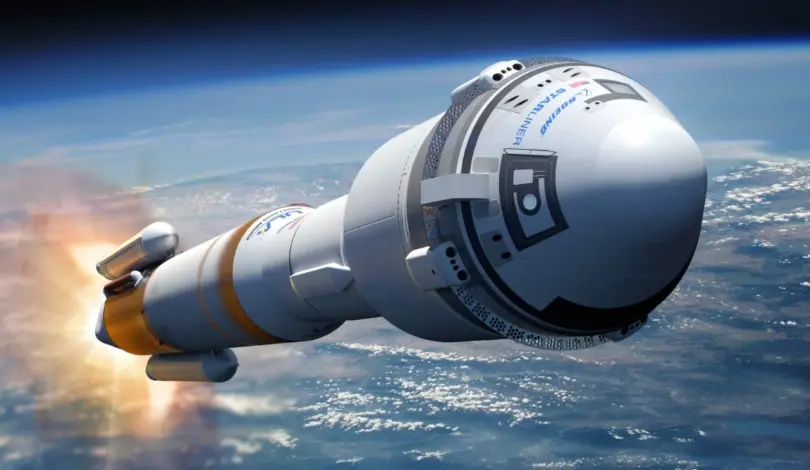
Boeing, one of NASA’s two Commercial Crew providers, is making excellent progress toward the debut of their Starliner vehicle for both its uncrewed and crewed test flights. In addition to the two planned certification missions, NASA has announced that Boeing’s Crew Flight Test, a two-week test mission, could now serve as a more operational six-month crew flight to the International Space Station with not two but three crew members.
Boeing makes progress toward OFT and CFT missions:
Officially, Boeing is targeting August 2018 for its Orbital Flight Test (OFT), their uncrewed certification mission for Starliner, to be followed in November 2018 with their Crew Flight Test (CFT). Those dates are based on the last quarterly review by the Commercial Crew Program in February, and there is some indication that those dates are likely to slip at the next quarterly review in May – with the CFT slipping into 2019.
At the end of March, when Commercial Crew Program Director Kathy Lueders updated the NASA Advisory Council on commercial crew’s progress, she had high praise for Boeing, noting that “Boeing has been making tremendous progress. They had their Launch Segment Design Certification Review with ULA (United Launch Alliance) last fall. “We had are ISS DCR (Design Certification Review) in December. And really, they’ve made tremendous progress towards baselining the open work that needs to be closed out before our upcoming CFT DCR that’s scheduled in the summer timeframe.”
Moreover, delivery schedules are now being worked with Boeing for delivery of their verification products, and Boeing is deep into hardware testing for the vehicles that will fly the OFT and CFT missions as well as undertaking a great deal of software training runs with a Johnson Space Center and the International Space Station Program – software needed to ensure proper flight, rendezvous, and docking with the Station.

Starliner docked to ISS, with Japan’s HTV resupply vehicle visible underneath the Columbus module. (Credit: Nathan Koga for NSF/L2)
“Right now, they’re working all our materials and out gas testing that’s really critical whenever you have a spacecraft that’s getting close to Station,” said Ms. Lueders. “With Station we have to do all the material compatibility, and so the Boeing folks are working through that and making sure we’re meeting the Station requirements there.”
See Also
- Starliner/CST-100 Forum
- ULA Forum Section
- L2 Commercial Crew
- Click here to Join L2
Some of this activity includes a lot of work at White Sands Space Harbor, New Mexico, where Boeing is hot-fire testing its Service Module thrusters and preparing for the all-important launch pad abort test coming up in a few weeks.
“There’s a lot of activity going on at White Sands for the Boeing folks,” noted Ms. Lueders. “They’ve been doing all the engine level testing for the crewed mission, for the CFT mission and then for PCMs (Post Certification Missions – standard crew rotation flights) -1 and -2.”
Space Technology
(adsbygoogle = window.adsbygoogle || []).push({});
For Boeing, part of the ground certification for Starliner involves hot fire testing its Service Module engines, which the company is getting ready to perform at White Sands.
“This is a critical activity that’s obviously testing out the Service Module portion of the vehicle but also provides data for our pad abort testing,” noted Ms. Lueders.
And the two become one….Launch Pad Abort Test is next pic.twitter.com/VSFEtJGAzM
— Christopher Ferguson (@Astro_Ferg) April 9, 2018
This launch pad abort test, which Boeing will perform in the coming weeks at White Sands, is critical in validating Starliner’s ability to successfully pull itself and its crew away from the top of an Atlas V rocket should a catastrophic failure of the Atlas V be detected while on the pad.
Recently, the two halves of the vehicle that will perform the pad abort test were joined together. The pad abort test will see four launch abort engines and 20 orbital maneuvering engines fire to simulate an abort from the Atlas V. Together, the engines will produce about 188,000 pounds of thrust for about six seconds to push the spacecraft to one mile (1.2 km) in altitude.
While technically just a pad abort test, the certification objective will also validate Starliner’s ability to free itself from the Atlas V at any stage during flight should an abort be needed. However, Boeing will not perform an in-flight abort test as one was not mandated by NASA as part of the Commercial Crew Program.
SpaceX and NASA have both opted to voluntarily conduct in-flight abort tests for their new crew vehicles to validate how Dragon and Orion, respectively, perform during potential aborts at MaxQ (moment of maximum mechanical stress on the vehicle during launch).

Starliner performs its pad abort test at White Sands Space Harbor, New Mexico. (Credit: Nathan Koga for NSF/L2)
For Boeing, the pad abort test will also provide an additional opportunity to test the parachute system Starliner will use to safely slow itself down for a land landing upon its return from space. To date, Boeing has completed their second parachute system qualification test and have three additional qualification tests and six reliability drop tests planned, with three of those reliability tests utilizing balloons and three utilizing a long-dart shaped vehicle.
Moreover, Boeing is also making great progress on crew training. “Not only is the hardware getting ready, but Boeing has outfitted and put together all of their trainers,” said Ms. Lueders. “They have a Boeing mock-up trainer, and that outfitting was completed in January. And they’re in the midst of all the activities going on with crew training, all the checkouts that are needed to be able to get ready for not only crew training but also verification of the integrated system.”
This includes the Boeing Engineering Simulator, or BES, which is now operational with crew and Boeing test subjects working through different testing regimes. “Really from a suite of simulators and different tools and from an operational perspective, the Boeing team has been really integrated and is starting to work through the flight planning and checkouts of the system,” noted Ms. Lueders.
Starliner flight vehicles and Atlas V preparations:
At the Kennedy Space Center, work is also progressing on Starliner spacecraft #3 which will fly the OFT uncrewed test flight in August 2018. “Production operations are underway, and we are supporting lower dome first light that happened in mid-March,” updated Ms. Lueders.
First light was the moment when Boeing first powered up Starliner #3, and that vehicle is now progressing through lower dome harness outfitting, side hatch assembly and build, base heat shield assembly, and primary structure for the service module and radiator support installation.
While Starliner #3 will fly first, Starliner #2 is actually ahead in terms of production, but Starliner #2 will be taken from Kennedy, once completed, to El Segundo, CA, for a series of acceptance and environmental tests and will be put through its paces to certify the overall Starliner design for flight.
Thus, Starliner #2 is not available for the OFT. After its test regime, Starliner #2 will return to Kennedy and the C3PF (Commercial Crew and Cargo Processing Facility) where it will be put into flow for use as the first Starliner to carry people to space on the CFT mission.
In terms of the launch vehicles, AV-080 – the Atlas V for the OFT mission – is in flow at ULA’s (United Launch Alliance’s) Decatur, Alabama, production facility. “AV-080 is really in the final stages of assembly,” said Ms. Lueders to the NASA Advisory Council. “The tanks have been joined, all the system integration and assembly and checkouts are done, and they’ve installed the RP-1 (rocket grade kerosene) feed line and engines.

Chris Ferguson, the final Shuttle Commander and now Director of Boeing’s Commercial Crew operations, stands before an Atlas V first stage at ULA’s Decatur, Alabama, production facility. (Credit: NASA)
“The Centaur (upper stage) has both pressure tanks completed, foam applications have been completed, and the engines delivered with verification testing is in work. And then the forward adapter is complete less the coaxial cable installation. So that vehicle is coming along.”
The Atlas V that will launch the CFT crew mission is also in flow. Its RP-1 tank is in final integration and assembly, and the LOX (Liquid Oxygen) tank has been delivered. The Centaur is being assembled, and its two RL-10 engines have been delivered.
Starliner might get extended first crewed mission:
As part of the continued slippage of the first flights of both Starliner and crew Dragon, and an impending deadline in mid-2019 after which NASA has no purchased crew seats aboard the Russian Soyuz rocket and crew capsule, NASA has updated its Commercial Crew Transportation Capability (CCtCap) contract with Boeing to allow for the possibility of the CFT mission adding an additional crew member and extending the flight from 14 days to six months.
Exact details of how to best take advantage of the contract modification are under evaluation, but the changes could allow for additional microgravity research, maintenance, and other activities while Starliner is docked to Station. “This contract modification provides NASA with additional schedule margin if needed,” said William Gerstenmaier, Associate Administrator, Human Exploration and Operations Mission Directorate. “We appreciate Boeing’s willingness to evolve its flight to ensure we have continued access to space for our astronauts.”

Starliner launches atop an Atlas V N22 rocket from Cape Canaveral Air Force Station, FL, carrying new crewmembers to the International Space Station (Credit: Nathan Koga, for NSF/L2).
The current commercial crew flight schedules provide about six months of margin to begin regular, Post Certification Mission crew rotation flights to the Station before NASA’s contracted flights on Soyuz end in fall 2019.
“Turning a test flight into more of an operational mission needs careful review by the technical community,” said Mr. Gerstenmaier. “For example, the spacecraft capability to support the additional time still needs to be reviewed. Modifying the contract now allows NASA and Boeing an opportunity to tailor the duration to balance the mission needs with vehicle and crew capabilities.”
This would not be the first time NASA has expanded the scope of a commercial test flight. NASA had SpaceX carry cargo on its commercial cargo demonstration flight to the ISS under the Commercial Orbital Transportation Services initiative in 2012, which was not part of the original agreement.
There is currently no known timeline for a decision on what to do about CFT’s crew complement and flight duration. However, Steve Stitch, Deputy Manager for Flight Development and Operations with the Commercial Crew Program stated earlier this month that crew assignments for both Boeing’s CFT mission and SpaceX’s DM-2 crewed test flight of Dragon are expected in the “summer timeframe.”