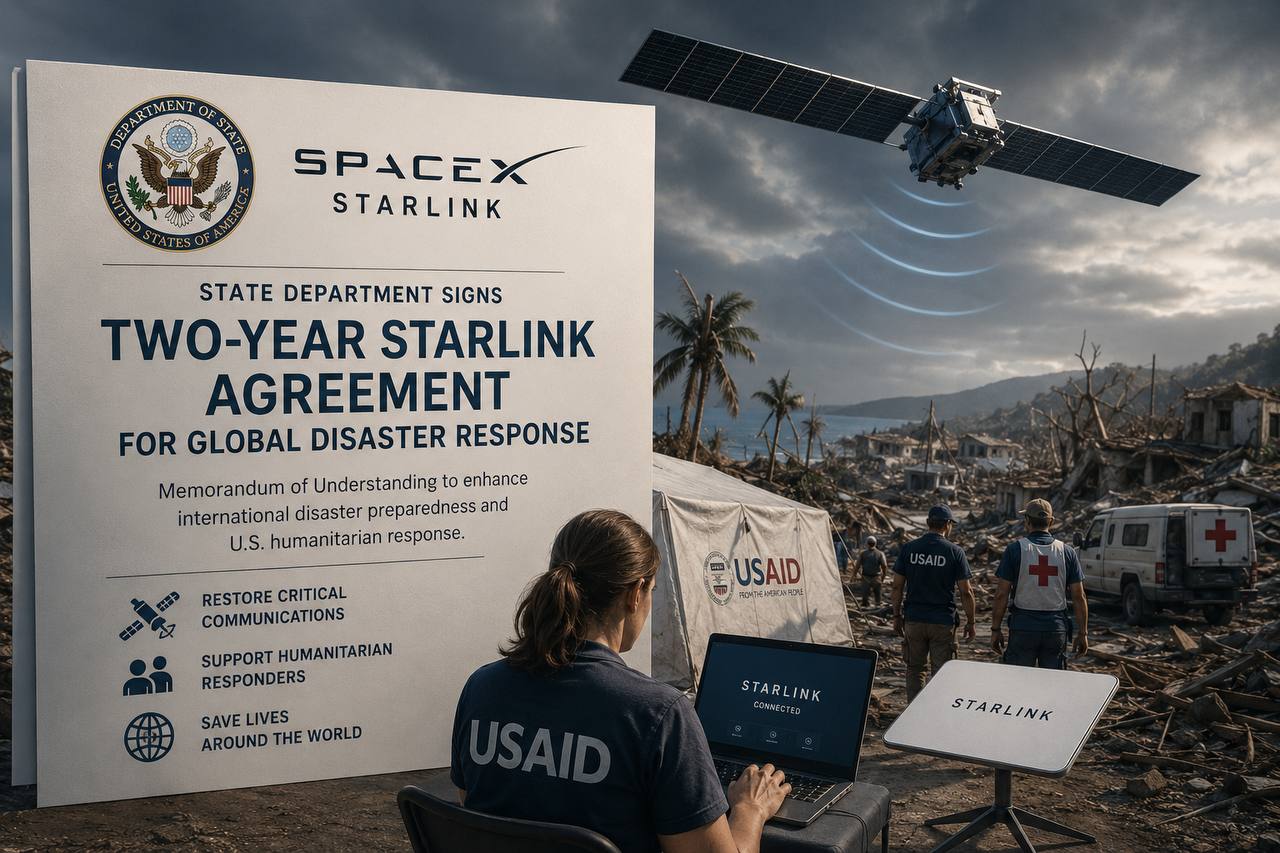
The MoU aims to leverage Starlink’s low Earth orbit satellite technology to restore critical communications when crises and natural disasters damage infrastructure. The agreement was signed the same week SpaceX went public on Nasdaq, marking a formal government commitment to a now publicly traded commercial satellite operator rather than an informal arrangement.
Under the agreement, the department’s Bureau of Disaster and Humanitarian Response will coordinate with Starlink to provide rapid connectivity to emergency responders, humanitarian organizations following disasters, and people in need. The cooperation is intended to harness reliable connectivity to support disaster response teams and help save lives around the world. No dollar figure was specified for the agreement.
In recent months, Starlink has delivered connectivity to communities affected by the Ebola outbreak, Hurricane Melissa, Typhoon Kalmaegi, Cyclone Senyar, Cyclone Ditwah, Cyclone Maila, and Super Typhoon Sinlaku. The State Department stated that U.S. coordination with Starlink to use its connectivity following disasters can save lives and further enhance U.S. humanitarian responses.
The agreement illustrates how deeply Starlink has embedded itself into U.S. government operations. It also raises a question that becomes more pointed now that SpaceX is publicly traded: when a commercial company with public shareholders provides critical humanitarian infrastructure, who is accountable when service is disrupted or terms change. As Starlink becomes infrastructure for government operations globally, the question of what happens when commercial and national interests diverge is no longer theoretical.
The two-year term of the Memorandum of Understanding sets the period over which the State Department and SpaceX will coordinate on disaster preparedness and humanitarian response.