
Tag: Galaxies
-
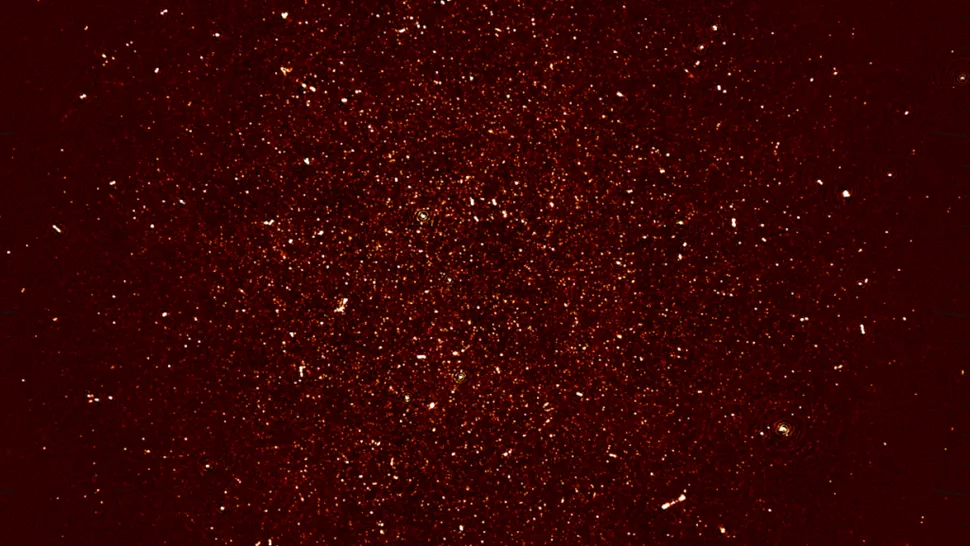
MeerKAT Detects Ancient Hydrogen Signal, Advancing Three-Dimensional Cosmic Mapping
Astronomers using South Africa’s MeerKAT radio telescope have detected faint hydrogen emissions that travelled roughly four to five billion years to Earth, demonstrating a way to study cosmic structure without relying on optical galaxy surveys. Announced on September 1, 2026, the result draws on approximately 96 hours of observations and measures hydrogen at two redshifts,…
-
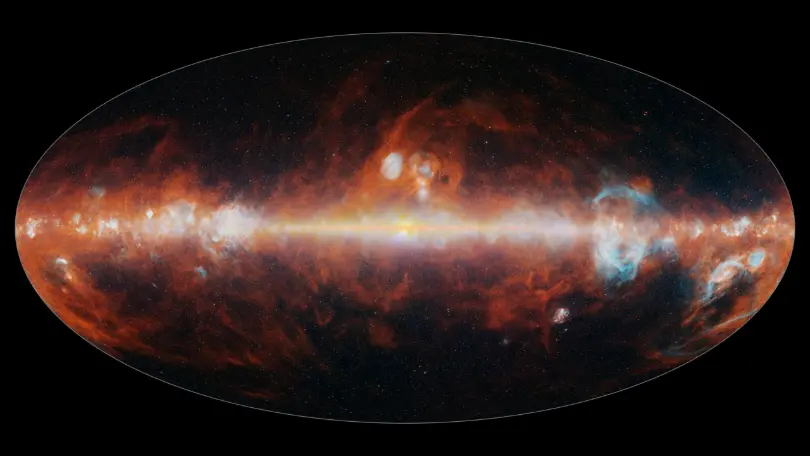
SPHEREx produces first all-sky map, highlights entire universe in infrared light
After launching in March and collecting near-infrared data throughout 2025, NASA’s SPHEREx observatory has completed its first map of the universe. The map, which is comprised of 102 infrared wavelengths, will allow SPHEREx’s team and astrophysicists to research the source of the early universe’s inflation and the distribution of organic molecules throughout the universe. “It’s…
-
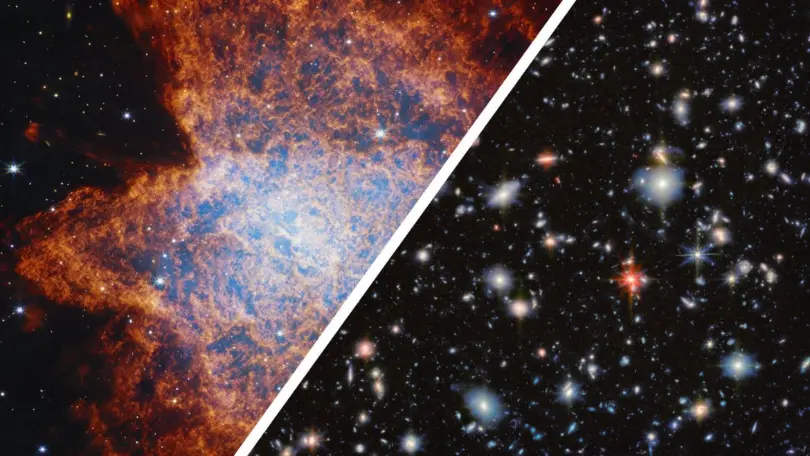
Webb reveals structures in planetary nebula, sheds new light on the Hubble Ultra Deep Field
The joint NASA/European Space Agency/Canadian Space Agency James Webb Space Telescope recently observed the remnants of a dying star shedding its outer layers. The resulting colorful cloud is known as a planetary nebula, and structures in this nebula revealed by Webb hint at the presence of a companion star. Meanwhile, a team of scientists used…
-
Euclid reveals an Einstein ring around a nearby galaxy
Using the European Space Agency’s Euclid space telescope, astronomers have accidentally found a complete Einstein ring around a nearby galaxy known as NGC 6505. This optical effect shows a distorted image of a far-away galaxy as a ring around a separate galaxy in the foreground. NGC 6505’s proximity to Earth and the completeness of its…
-
Spitzer gives scientists insights into black hole eating habits
Using data from NASA’s retired Spitzer Space Telescope, scientists have gained new insights into the eating habits of supermassive black holes at the centers of galaxies throughout the universe. These black holes often fluctuate in brightness from the massive clumps of cosmic material falling into them. However, this is not true for the black holes…
-
Using Hubble and Webb, scientists investigate galaxies responsible for the reionization of the universe
Utilizing the infrared-sensitive instruments of the joint NASA, European Space Agency, and Canadian Space Agency James Webb Space Telescope, as well as observations from the Hubble Space Telescope, scientists recently collected the first spectroscopic observations of some of the oldest galaxies in the universe, some being born during the first one billion years of the…
-
ESA reveals Euclid’s first five images
The European Space Agency (ESA) has released the first full-color images from Euclid, the agency’s latest space telescope designed to study the nature and distribution of dark matter and dark energy in the universe. During a video broadcast on Nov. 7, scientists, engineers, and agency officials unveiled the telescope’s first five images. The images reveal…
-

Webb unveils the secrets of the early universe via deep field, peers into stellar nurseries
With help from the joint NASA/European Space Agency/Canadian Space Agency James Webb Space Telescope (JWST), scientists are peering deep into the universe and uncovering secrets that were previously hidden from visible and X-ray telescopes. The JWST advanced deep extragalactic survey (JADES) utilized Webb’s incredible deep-field surveying abilities to create a deep field that shows over…
-

Using Hubble, researchers accidentally discover ejected black hole forcing star creation
Throughout the universe, supermassive black holes can typically be found at the center of massive galaxies that stretch tens of light years across. However, using Hubble, a team of researchers has discovered a supermassive black hole that appears to have been ejected from its galaxy. The black hole, which is around 20 million times more…
-
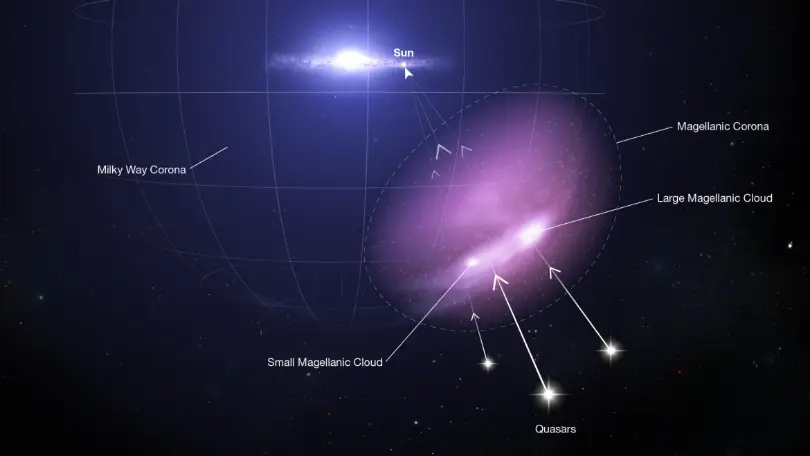
Researchers discover galactic shield of gas surrounding the Magellanic Cloud galaxies
The largest satellite galaxies of the Milky Way — the Large and Small Magellanic Clouds — have been undergoing a treacherous interaction for billions of years. As the galactic pair are pulled toward the Milky Way, they are constantly orbiting each other and unraveling themselves, creating massive trails of gaseous debris. Yet, the galaxies have…