
Tag: Galaxies
-
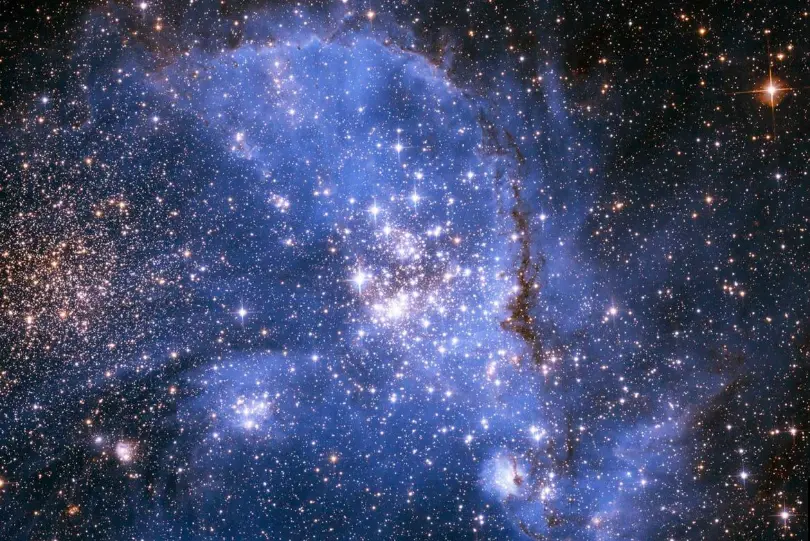
Hubble and VLT discover spiraling structure of young stars, hints at star formation in early universe
In a recently released study, data from the joint NASA/European Space Agency (ESA) Hubble Space Telescope and the European Space Observatory’s (ESO) ground-based Very Large Telescope (VLT) has been used to discover young stars spiraling into the center of a star cluster within the Small Magellanic Cloud, a small satellite galaxy of the Milky Way.…
-
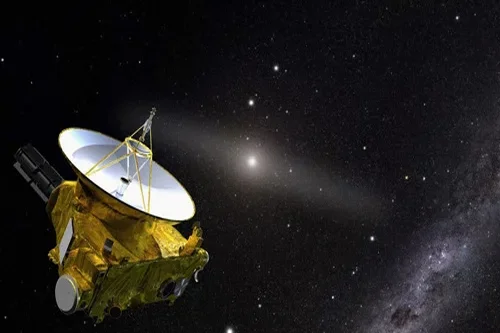
Data from ESA’s Gaia mission reveals our Sun’s future and past
On June 13, the third major data release from the European Space Agency’s (ESA) Gaia mission revealed details about the past and future of our solar system’s star, the Sun, by using data collected by Gaia on stars of similar mass and composition to our Sun. Gaia is a star mapping mission and collects massive…
-
NASA, ESA, CSA release historic first images from the James Webb Space Telescope
NASA, the European Space Agency (ESA), and the Canadian Space Agency (CSA) have released the first set of full-color images taken by the James Webb Space Telescope — the world’s newest, most powerful, and largest space telescope. A total of five images were released, with the first image being unveiled by United States President Joe…
-

NASA uplinks final command to deactivate Spitzer telescope
Artist’s concept of the Spitzer Space Telescope seen against the infrared sky. Credit: NASA/JPL-Caltech/R. Hurt (SSC) NASA declared the Spitzer Space Telescope’s 16-year mission complete Thursday after sending final commands for the spacecraft to enter hibernation as it drifts farther from Earth. The Spitzer Space Telescope, one of NASA’s original four “Great Observatories,” studied the…
-

NASA prepares to shut down one of its ‘Great Observatories’
Artist’s concept of NASA’s Spitzer Space Telescope, backdropped by an image of the infrared sky. Credit: NASA/JPL-Caltech NASA will say goodbye to the Spitzer Space Telescope this week after more than 16 years observing the most distant galaxies ever detected, planets orbiting other stars, and star-forming clouds of dust and gas. Spitzer, one of NASA’s four…
-
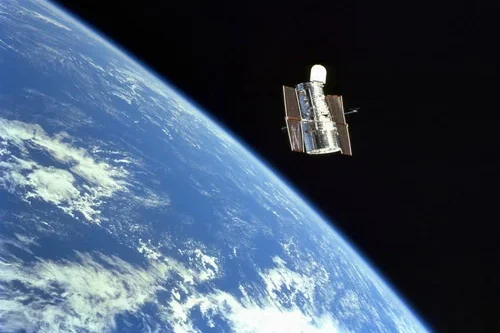
Happy Halloween from Hubble Telescope: Otherworldly ‘eyes’ glow in ghostly galaxy
This Hubble image of the merged galaxy known as AM 2026-424 was taken on June 19 in visible light by the Advanced Camera for Surveys. The system resides 704 million light-years from Earth. (NASA / ESA / UW / Dalcanton, Williams and Durbin) Now here’s something really scary for Halloween: Imagine two galaxies slamming into…
-
Russia launches international X-ray astronomy mission
A Proton rocket and Block DM upper stage climbed into space Saturday from the Baikonur Cosmodrome in Kazakhstan with Spektr-RG, an astronomical observatory with dual X-ray telescopes developed by Russian and German scientists on the hunt for the signature of dark energy. The new observatory will detect X-ray emissions from across the sky, including those…
-
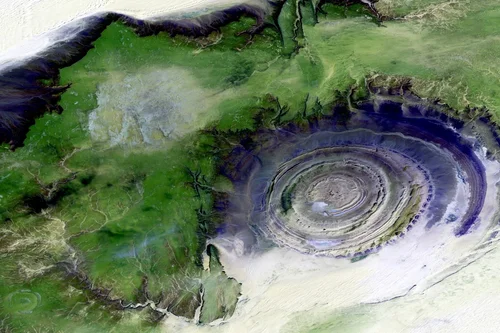
Live coverage: Proton rocket lifts off with X-ray astronomy observatory
Live coverage of the countdown and launch of a Proton rocket with the Spektr-RG X-ray astronomy mission. Text updates will appear automatically below; there is no need to reload the page. Follow us on Twitter. The live video webcast from Roscosmos will begin at approximately 1130 GMT (7:30 a.m. EDT) on launch day, and will be available…
-

Proton launch delayed to Saturday
The Proton rocket stands on its launch pad at the Baikonur Cosmodrome in Kazakhstan, awaiting liftoff with the Spektr-RG X-ray astronomy mission. Credit: Roscosmos Russian officials have delayed until Saturday the launch of a Proton rocket from Kazakhstan with the Spektr-RG X-ray astronomy observatory, an ambitious mission jointly developed with Germany to probe dark energy.…
-
Proton rocket and astronomy satellite back on the launch pad after battery replacement
Poised to loft a Russian-German X-ray astronomy observatory into space Friday, a Proton rocket returned to its launch pad Tuesday at the Baikonur Cosmodrome in Kazakhstan after a three-week delay to replace a drained battery on the vehicle. The Proton rocket departed its assembly building at Baikonur early Tuesday and rode a specialized rail car…