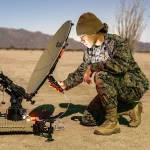

Manpack Satellite Terminals are portable communication devices that are designed to establish satellite connections in remote environments. They are compact, lightweight, and ruggedized, making them suitable for deployment in harsh conditions encountered in military operations, emergency response, disaster recovery, and exploration missions. Manpack satellite communication terminals enable the formation of a comprehensive tactical picture, offering crucial situational awareness in dynamic operational environments, and are specifically designed for rapid deployment by a single operator in a faster time. It also provides uninterrupted satellite communication across a wide range of covert operations and environmental conditions. These terminals are compatible with satellites operating within relevant frequency bands, ensuring flexibility and adaptability to diverse mission requirements. They provide a reliable communication environment with high data rates between tactical units and operation/command centers, ensuring strong coordination and decision-making. These systems establish a robust communication infrastructure that integrates tactical elements with strategic networks, facilitating efficient information exchange and command control.
Core Components of a Manpack Satellite Terminal
Manpack Satellite Terminal is an advanced piece of technology composed of several integrated components, each engineered for rugged field use and optimal performance in austere conditions. These systems are purpose-built for tactical satellite communications, and their modular, field-deployable design ensures both versatility and reliability in real-world operations.

- Antenna System: The antenna system is the heart of any manpack satellite terminal, responsible for establishing the crucial radio link with orbiting satellites. Most systems employ collapsible parabolic reflectors, flat-panel antennas, or foldable offset dishes that can be quickly deployed in the field. Sizes typically range from 45 cm to 1 meter in diameter, balancing portability with signal strength and gain performance. Many modern systems are equipped with auto-acquire or auto-pointing antennas, which dramatically reduce setup time by automatically aligning with the appropriate satellite. This is especially vital in combat or disaster zones where rapid deployment and minimal user intervention are required. These intelligent antennas improve operational efficiency and reduce the need for trained technical personnel on-site.
- RF Module (Radio Frequency Unit): The RF Module, often integrated into the antenna or housed in a compact enclosure, comprises essential components such as the Block Up Converter (BUC) and the Low-Noise Block Downconverter (LNB). These units handle the uplink and downlink signal conversion, enabling seamless two-way satellite communication. Each RF unit is calibrated to match the system’s operating frequency band, which could include X-band, Ku-band, Ka-band, L-band, or S-band, depending on mission requirements. This modularity ensures compatibility with both commercial and military satellite constellations, making the system highly adaptable across various operational theaters.
- Modem & Baseband Processing Unit: At the core of data handling is the modem and baseband processing unit, which performs modulation/demodulation, error correction, compression, and packet processing for all incoming and outgoing data streams. This unit interfaces with end-user devices such as laptops, radios, and VoIP phones to enable real-time, secure, and encrypted communication. These units are often compatible with advanced communication protocols like DVB-S2/S2X, iDirect Evolution or Velocity, UHF, and military waveforms (e.g., MIL-STD-188-165A). This wide compatibility ensures the backpack SATCOM system integrates seamlessly with existing defense or emergency communication networks.
- Power Supply System: Powering the lightweight SATCOM terminal is a critical consideration, especially in field operations where infrastructure is unavailable. These systems typically run on lithium-ion batteries, rechargeable power packs, AC/DC adapters, or even portable solar panels, providing flexible options to suit different environments. Designed for energy efficiency, these systems consume minimal power while offering extended operational endurance. Advanced models feature smart battery monitoring, hot-swappable batteries, and low-power standby modes, ensuring mission-critical operations can continue uninterrupted.
- Ruggedized Enclosure: To thrive in extreme field conditions, the entire manpack satellite terminal is housed in a ruggedized enclosure that offers weatherproofing, impact resistance, and electromagnetic shielding (EMI protection). These enclosures are engineered to meet rigorous military and industrial standards, such as MIL-STD-810G/H for environmental durability and IP65/IP67 ratings for water and dust ingress protection. This tough outer shell ensures the equipment can withstand high altitudes, sandstorms, freezing temperatures, or heavy rains, making it ideal for military reconnaissance, remote broadcasting, and humanitarian operations alike. Each of these core components works in harmony to deliver high-performance, mobile satellite communications in the harshest and most unpredictable scenarios. By combining compactness, modularity, and durability, manpack satellite terminals are redefining the standards for portable SATCOM systems in the modern era.
Properties of Manpack Satellite Terminals

- Portability: Manpack Satellite Terminals are engineered to be highly portable, allowing for easy transportation by an individual or within a backpack. They are designed to be carried by an individual or transported in a backpack, enabling rapid deployment and setup in the field. Their compact size and lightweight design enable personnel to carry them during missions or deployments without impeding mobility.
- Compact Design: Manpack Satellite Terminals are engineered with a compact form factor, to be space-efficient without compromising on performance. Their compact form factor allows for easy transportation and storage in limited spaces, such as vehicles, aircraft, or remote outposts making them ideal for mobile operations.
- Rugged Construction: MSTs are built to withstand harsh environmental conditions encountered in field operations, including extreme temperatures, moisture, dust, and physical shocks. They are constructed using durable materials such as ruggedized enclosures, reinforced connectors, and impact-resistant components to ensure reliability in challenging situations.
- Ease of Deployment: Manpack Satellite Terminals are designed for quick and straightforward setup, requiring minimal training for operation. This enables personnel with limited technical expertise to establish satellite communication links rapidly. They feature intuitive interfaces and simplified procedures, allowing users to establish satellite communication links rapidly in the field.
- Versatility in Terrain: MSTs are compatible with various satellite networks and can support different communication protocols, including voice, data, and video transmission. This versatility allows them to adapt to a wide range of operational requirements and scenarios. They are compatible with different satellite constellations and frequency bands, providing flexibility to adapt to diverse operational requirements and scenarios. Their adaptability ensures reliable communication connectivity regardless of geographical challenges or obstacles, making MSTs suitable for deployment in various scenarios ranging from dense forests to barren deserts.
- Power Efficiency: Recognizing the importance of power conservation in field operations, Manpack Satellite Terminals are engineered to be energy-efficient. They incorporate power-saving features such as sleep modes, automatic shut-off, and voltage regulation to maximize battery life and reduce the need for frequent recharging to reduce energy consumption.
- Security Features: Security is a primary concern in communication systems, particularly in military and government applications. MSTs incorporate robust encryption algorithms and authentication mechanisms to secure and safeguard sensitive protocols with data and prevent unauthorized access. The advanced security features of MSTs protect communication channels from interception and unauthorized access, ensuring confidentiality and integrity of information.
Features of Manpack Satellite Terminals

- Mobility: Compared to fixed satellite terminals, Manpack Satellite Terminals offer unparalleled mobility, allowing users to maintain communication capabilities while on the move. This mobility supports dynamic operational environments where rapid deployment and repositioning are essential for mission success.
- Adaptability: Manpack Satellite Terminals are designed to operate in diverse terrain and environmental conditions, from dense forests to deserts. Their adaptability ensures reliable communication connectivity regardless of geographical challenges or obstacles.
- Interoperability: Manpack Satellite Terminals are designed to seamlessly integrate with existing communication networks and infrastructure, ensuring interoperability with other terminals and systems. This interoperability enhances coordination and collaboration among different units and agencies operating in the field, promoting synergy and efficiency in multi-agency operations or joint missions.
- Self-Contained Systems: MSTs are self-contained communication systems, integrating satellite modem, antenna, and power supply into a single unit. This self-sufficiency reduces reliance on external infrastructure and simplifies logistics for deployment making MSTs suitable for operations in remote areas where access to power and support facilities may be limited.
- Scalability: Manpack Satellite Terminals are available in various configurations to accommodate different operational requirements and user preferences. They can be scaled up or down in terms of capabilities and capacity, making them suitable for small teams conducting reconnaissance missions or large-scale deployments involving multiple units. Manpack Satellite Terminals can be scaled accordingly to meet the demands of the mission, providing flexibility and versatility in deployment.
- Quick Deployment: With simplified setup procedures and intuitive user interfaces, MSTs enable users to establish satellite links within minutes, facilitating swift communication establishment in critical situations.
- IP-Based Communication: Supporting both secure and non-secure voice, data, video teleconferencing, and fax communication, these terminals leverage Internet Protocol (IP) for efficient and versatile connectivity.
- Quality of Service (QoS) Management: Prioritizing services such as voice, data, and video teleconferencing, QoS management ensures optimal performance tailored to specific user requirements. Voice and data rates are configurable to accommodate varying operational needs.
- Compatibility with Cryptographic Devices: With a system architecture designed for seamless integration with both National and NATO cryptographic devices, Manpack Satellite Communication Terminals offer robust encryption and security for sensitive communications, ensuring confidentiality and integrity.
Applications of Manpack Satellite Terminals

Manpack satellite terminals have revolutionized how mission-critical communications are delivered in the most remote, hostile, or infrastructure-deprived areas. With their lightweight form factor, robust design, and multi-band connectivity, these portable SATCOM systems are being deployed across a diverse range of sectors from defense to disaster recovery.
Military and Defense Communication: In the defense sector, manpack satellite terminals are indispensable for enabling tactical satellite communications in austere environments where traditional networks are non-existent or vulnerable. These field-deployable systems support:
- Tactical command and control (C2) operations, ensuring military units in the field maintain uninterrupted communication with headquarters.
- Real-time ISR (Intelligence, Surveillance, Reconnaissance) data transmission, facilitating live video, drone feeds, and geospatial intelligence for faster decision-making.
- Joint and multinational operations, where interoperability across different defense forces requires a unified, secure, and mobile communication system.
Because these systems can be deployed quickly and easily carried by soldiers or mounted on vehicles, they are critical for mobile ground forces, reconnaissance teams, and special operations units operating beyond line-of-sight (BLOS).
Disaster Relief and Humanitarian Missions: In the aftermath of natural calamities like earthquakes, floods, wildfires, and hurricanes, terrestrial communication infrastructures are often severely damaged or completely wiped out. Manpack satellite terminals serve as a lifesaving communication bridge in these scenarios by:
- Enabling rapid deployment of emergency communication hubs for coordination among relief agencies, governments, and NGOs.
- Providing reliable SATCOM links for the transfer of real-time situational data, resource tracking, and victim updates to command centers.
- Supporting voice, video, and data transmission where no other connectivity options exist.
Because of their portability and quick setup, these mobile satellite ground terminals are crucial for first responders and humanitarian relief teams operating in remote or disconnected zones.
Broadcast Journalism: For media outlets and reporters working in remote, politically sensitive, or conflict-prone regions, manpack satellite terminals offer a game-changing communication solution. These systems empower field journalists to:
- Broadcast live video feeds in HD directly from the field to broadcasting centers with low latency and high reliability.
- Transfer high-volume files such as interviews, drone footage, and field reports in real time.
- Operate independently from local infrastructure, ensuring freedom of movement and continuous reporting, even during blackouts or unrest.
With lightweight design and self-contained setup, manpack terminals are ideal for live coverage in war zones, natural disasters, and international sporting or cultural events held in remote locations.
Oil & Gas, Mining, and Maritime: In sectors like energy, mining, and maritime operations, field teams often work in harsh and isolated environments where terrestrial communication is either unavailable or impractical. Manpack SATCOM terminals are deployed for:
- Connecting offshore oil rigs and remote mining camps to central control facilities for real-time status updates and voice/video calls.
- Supporting SCADA (Supervisory Control and Data Acquisition) systems for automation and telemetry monitoring.
- Enabling emergency communication during equipment failures or adverse weather conditions on maritime vessels.
With their ruggedized design and weatherproof enclosures, these systems provide reliable, secure, and always-available connectivity in offshore and inland industrial deployments.
Border Surveillance & Law Enforcement: Border protection forces and law enforcement agencies increasingly rely on manpack satellite communication terminals to enhance real-time situational awareness and field coordination. These systems are essential for:
- Supporting mobile surveillance vehicles, drones, and temporary outposts in border areas or sensitive zones.
- Transmitting live feeds and intelligence data from field patrols to central command centers.
- Coordinating with national and international law enforcement agencies during cross-border operations or anti-terror activities.
The ease of mobility, robust security, and ability to function without fixed infrastructure make these tactical SATCOM systems a go-to solution for law enforcement operations in rural and rugged terrains.
Manpack satellite terminals have emerged as a vital tool across a wide spectrum of use cases, providing real-time, reliable, and secure communication when and where it’s needed the most. If in the middle of a battlefield, a disaster zone, a news front, or an offshore rig, these portable and tactical satellite communication systems ensure that no mission is left disconnected.
Leading Manufacturers and Manpack SATCOM Solutions
The global demand for lightweight, field-deployable satellite communication terminals has spurred a range of innovative solutions from defense contractors and SATCOM technology providers. Several industry leaders are delivering high-performance manpack SATCOM terminals tailored to mission-critical environments, offering portability, secure communication, and multi-band support.
- L3Harris Technologies: L3Harris Technologies, a defense communication giant, is a front-runner in developing tactical satellite communication systems for the military and allied forces. One of their most advanced offerings is the Falcon III AN/PRC-163 Multi-Channel Handheld Radio, which supports SATCOM-on-the-move (SOTM) capabilities. This rugged terminal allows simultaneous voice, video, and data exchange over multiple satellite bands, enhancing situational awareness and real-time command coordination in complex battlefield scenarios. It’s highly modular and interoperable with a wide range of networks, making it a go-to choice for multi-domain operations.
- Hughes Network Systems: Hughes Network Systems, a global leader in broadband satellite technologies, delivers highly reliable manpack terminals for emergency services, NGOs, and defense. The Hughes 9202 BGAN (Broadband Global Area Network) Terminal is one of the most compact Class 2 portable satellite terminals on the market. Despite its small form factor, the terminal offers high-speed data transmission and secure voice services via the Inmarsat satellite network. Designed for rapid deployment and minimal setup, it’s ideal for disaster recovery teams, remote field workers, and mobile journalism units needing dependable, low-latency connectivity in austere environments.
- Get SAT: Get SAT, an Israeli-based satellite communication firm, is widely recognized for its Micron Series, a line of SATCOM-on-the-move and on-the-pause manpack terminals. The Micron manpacks are notable for integrating flat-panel, electronically steered antennas that allow users to maintain satellite link while in motion. Supporting Ku- and Ka-band frequencies, these compact systems are optimized for mobile ground units, UAV command centers, and expeditionary forces. Their innovative design minimizes size, weight, and power (SWaP), making them one of the most agile SATCOM solutions in the current market.
- Norsat International: Norsat International, a Canadian-based defense and communications manufacturer, provides MIL-STD-810-certified manpack SATCOM terminals engineered to withstand extreme field conditions. Their systems are frequently deployed by defense, law enforcement, and energy sector clients operating in remote and rugged geographies. Known for their durability and high-performance RF components, Norsat terminals offer multi-band support, integrated encryption modules, and long-lasting battery options. Their products are particularly valued in border surveillance, critical infrastructure protection, and Arctic operations.
- Paradigm Communication Systems: UK-based Paradigm Communication Systems specializes in compact, auto-acquire manpack terminals that simplify the deployment process in time-sensitive missions. Their flagship SWARM terminal is a highly portable SATCOM unit that automatically locks onto satellite signals without the need for skilled operators. Designed for Special Forces, humanitarian teams, and mobile command centers, the SWARM terminal supports a range of satellite constellations and operates across Ka, Ku, and X bands. Its tool-free setup, low power consumption, and robust construction make it especially suitable for high-tempo field missions where every second counts.
These leading manufacturers are at the forefront of portable SATCOM innovation, pushing the boundaries of connectivity, mobility, and resilience. Whether in conflict zones, disaster areas, or remote exploration sites, their manpack SATCOM solutions enable real-time, secure communication that’s vital for mission success.
Manpack Satellite Terminals are revolutionizing communication marked by rapidly evolving technological demands, these portable satellite terminals have become indispensable tools for enhancing tactical mobility and ensuring uninterrupted connectivity in remote and high-risk areas. The primary appeal of manpack satellite terminals lies in their lightweight and compact design, which allows individual operators to easily carry, set up, and deploy the system in minutes. Despite their small form factor, these systems provide high-performance satellite connectivity that supports voice, data, and video communications, ensuring that teams on the ground can stay connected with command centers, relay critical information, and make real-time decisions even in the most isolated or hostile environments. The ability to establish Beyond-Line-of-Sight (BLOS) communication is particularly valuable for military operations, where secure communication can be the difference between success and failure.

In addition to their role in defense and emergency response, manpack satellite terminals have applications across a wide range of industries. Broadcast journalists covering breaking news from conflict zones or remote regions rely on these systems to deliver live reports with high-definition video and reliable data transfers. Similarly, industries like oil & gas, mining, and maritime operations benefit from field-deployable SATCOM solutions to maintain continuous communication for mission-critical tasks such as monitoring infrastructure or coordinating remote activities. The integration with Low Earth Orbit (LEO) satellite constellations such as Starlink and OneWeb promises to reduce latency, improve throughput, and expand global coverage, ensuring that these terminals remain at the cutting edge of mobile satellite communication. As these technologies evolve, the next-generation manpack terminals will be more capable than ever before, offering faster deployment times, enhanced functionality, and greater flexibility to meet the unique communication needs of military, humanitarian, and commercial sectors. The future of mobile satellite communications is fast evolving and manpack terminals are well-positioned to lead the charge toward reliable, flexible, and scalable communication solutions for the most challenging missions around the world.
Satellite Terminal Manufacturers (View All)
-

Norsat
-

DataPath
-

Cobham Satcom
-

ReQuTech AB
-

Profen
-

Collins Aerospace
-

ND SatCom GmbH
-

Kymeta