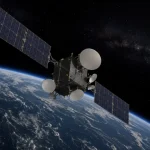
Capella Space has successfully validated its first optical communications terminal (OCT) aboard the Acadia-10 synthetic aperture radar (SAR) satellite, marking the company’s first deployment of laser communications technology in orbit.
The milestone follows the launch of Acadia-10 in March and coincides with the release of the satellite’s first SAR imagery.
Faster Data Transmission
Capella said onboard testing has demonstrated data transfer speeds of up to 2.5 gigabits per second using the Mynaric optical communications terminal.
The company said the technology enables satellite data to be transmitted through optical links rather than waiting for contact with a ground station, reducing the time required to deliver imagery.
“This near-real-time handoff bypasses the multi-hour ground station wait. The impact is profound; task-to-delivery timelines compress from hours down to minutes, fundamentally changing how organizations operationalize SAR data,” Capella said in a company blog post.
Preparing for Future Optical Networks
Capella first announced plans to integrate Mynaric optical terminals into its satellites in 2021. The company said future Acadia satellites will instead be equipped with optical communications terminals developed by Skyloom beginning in 2027.
Both Capella Space and Skyloom are now owned by quantum computing company IonQ, which has been expanding its capabilities in quantum networking and space communications.
The optical terminal installed on Acadia-10 is compatible with the Space Development Agency’s (SDA) optical communications standard, allowing it to communicate with the agency’s proliferated low Earth orbit satellite network.
Supporting Defense Missions
Capella has collaborated with the Space Development Agency since 2021. Earlier this year, the agency selected the company under its HALO Europa Track 1 program to develop two satellites demonstrating advanced tactical waveform performance, adaptive beamforming and secure tactical communications in low Earth orbit.
Capella said additional details regarding testing under the HALO program will be announced at a later date.
Integrating Laser Communications
According to the company, incorporating an optical communications terminal required significant engineering because of the size and power requirements of its SAR satellites, which weigh between 175 kilograms and 195 kilograms and generate approximately 700 watts of solar power.
Capella said engineers redesigned spacecraft accommodation, pointing systems and mission scheduling to integrate the laser communications payload alongside the existing X-band communications system.