Optera has secured £3 million ($4 million) in fresh funding to support its relocation from Australia to the United Kingdom, strengthening its position in the growing market for space domain awareness (SDA) and dual-use sensing technologies.
The funding round was led by the UK Innovation & Science Seed Fund (UKI2S), with participation from Blackfinch Ventures, Foresight Group, the National Security Strategic Investment Fund and Empirical Ventures.
The investment will help the company expand its engineering capabilities in the UK, advance sensor development programmes and accelerate the deployment of its space-based intelligence technologies.
Advancing Neuromorphic Sensing
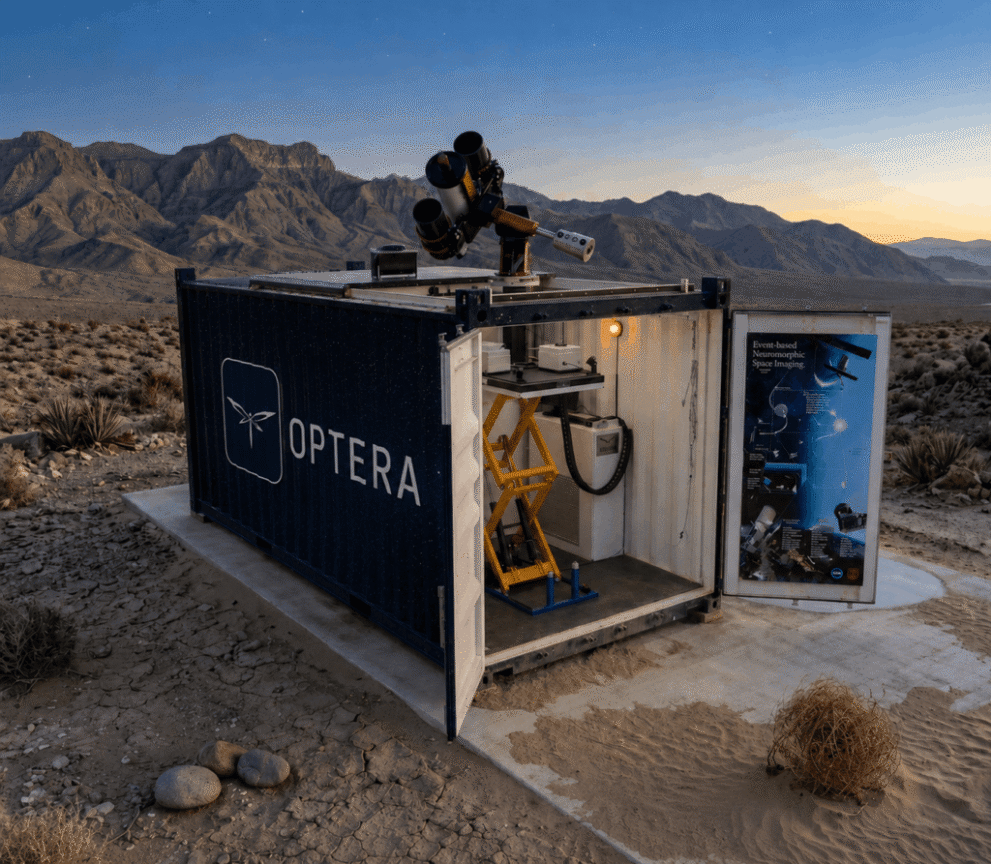
Founded as a spinout from Western Sydney University’s International Centre for Neuromorphic Systems in 2024, Optera specializes in neuromorphic sensors designed to mimic aspects of human vision.
Unlike conventional imaging systems that continuously collect large volumes of visual data for later analysis, neuromorphic sensors focus on detecting movement and changes within a scene as they occur.
This event-based approach significantly reduces data volumes, lowers power consumption and enables faster identification of anomalies and moving objects.
The technology has attracted interest for applications where real-time monitoring and efficient processing are critical, including space surveillance and national security operations.
Supporting Space Domain Awareness
Optera’s sensing systems are particularly suited to space domain awareness missions, where operators must detect, track and characterize objects in increasingly congested orbital environments.
By concentrating on changes rather than capturing full-frame imagery, the sensors can identify unusual activity while minimizing the computational resources required to process data.
The company has already demonstrated its technology in orbit and is exploring future applications that include both satellite-based and ground-based monitoring systems.
These capabilities could support efforts to improve tracking of satellites, debris and other objects operating within Earth’s orbital environment.
Expanding in the United Kingdom
The funding comes as the UK government continues to increase support for domestic space and defence technology development.
Optera said the investment will allow the company to grow its UK engineering team and accelerate the development of on-orbit processing capabilities, enabling more intelligence to be generated directly at the edge rather than relying on ground-based analysis.
Chief Executive Officer Jonathon Wolfe said the new capital will support the next phase of the company’s growth.
“This funding enables us to expand our UK engineering team, deliver key SDA and dual-use sensing programmes, and accelerate on-orbit processing so more intelligence can be generated at the edge.”
Growing UK Support for Deep Technology
The investment also reflects broader efforts by the UK government to strengthen sovereign technology capabilities in strategically important sectors.
Recent commitments by the UK Space Agency, the Ministry of Defence and the UK Atomic Energy Authority have increased funding available through UKI2S to support emerging deep-tech companies operating in areas such as space, defence and advanced engineering.
Alexander Leigh, Investment Director at UKI2S, said Optera’s decision to establish operations in the UK demonstrates the country’s growing appeal as a destination for innovative dual-use technology companies.
“Optera’s decision to relocate from Australia underlines the UK’s pull as the place for dual-use innovators to scale—and sets a clear signal for others to do the same.”
“Optera shows how research excellence can translate into deployable capabilities, export potential, and resilience across our defence and space ecosystem.”
With fresh funding secured and expansion plans underway, Optera aims to further develop its neuromorphic sensing technology while strengthening its presence within Europe’s rapidly evolving space and defence markets.