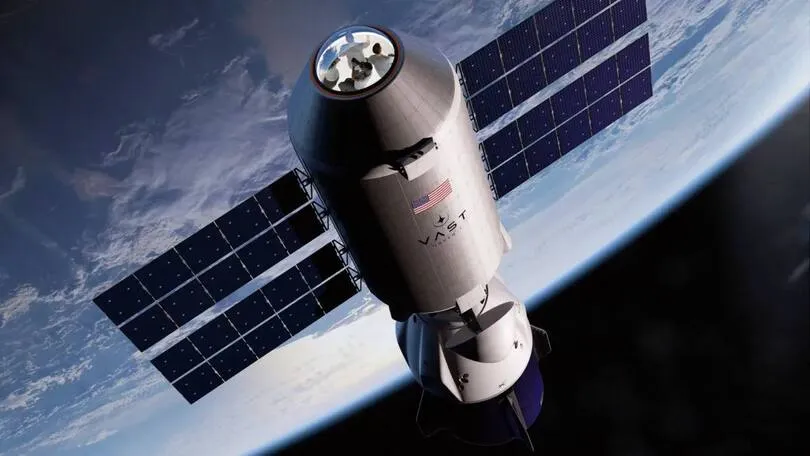
Haven-1 is what Vast describes as a minimum viable product, demonstrating the technology needed for the company’s planned multi-modular Haven-2 station. Vast and companies including Axiom Space and Blue Origin are competing for NASA funding under the Commercial low-Earth orbit Destinations program, which will fund one or more stations as a successor to the ISS. Following industry uncertainty over the program’s timeline raised during NASA’s Ignition event, the agency reaffirmed its commitment to the commercial low-Earth orbit transition.
The station will provide 45 cubic meters of habitable volume, 85 cubic meters pressurized, and is designed to support four astronaut missions, each lasting up to two weeks. Weighing 14,000 kg, it features a 1.1-meter domed window, Starlink connectivity, and the Haven Lab for microgravity research. In June, Vast installed thermal control system trays on the Haven-1 flight article, modular panels that integrate control valves, sensors, and hardware to regulate temperature.
A 10-kW Hall thruster developed by Vast recently underwent vacuum-chamber testing, demonstrating a specific impulse of more than 3,000 seconds. The in-house electric propulsion system builds on NASA Jet Propulsion Laboratory’s H10 thruster and will form part of a larger Reaction Control System alongside Impulse Space’s Saiph chemical thruster and six internal Control Moment Gyroscopes for attitude control. The station will launch atop a SpaceX Falcon 9, with its first four-person crew arriving via a Crew Dragon capsule on the Vast-1 mission. Haven-1 will rely on the docked Crew Dragon for critical life-support functions, including supplemental carbon dioxide scrubbing.
To prove out its hardware, Vast launched Haven Demo in November 2025 aboard SpaceX’s Bandwagon-4 rideshare mission. The 500 kg testbed verified non-human systems including solar panel array deployment and Guidance, Navigation, and Control functions before being deorbited in February 2026. Following that mission, Vast announced plans to build high-power satellite buses leveraging its in-house systems. Its first product, a 15-kW-class bus, is expected to begin launching in 2027, with an undisclosed customer having purchased four spacecraft and options for up to 200 more. CEO Max Haot said Vast is “uniquely positioned to compete in the high-power satellite market through the combination of our world-class engineering team, large-scale manufacturing capabilities, and the on-orbit success of Haven Demo.”
Vast has signed agreements with European countries to support astronaut missions. European Space Agency reserve astronaut Arnaud Prost is set to serve as flight engineer on Vast-1, while the UK Space Agency signed a Memorandum of Understanding to explore sending ESA astronaut John McFall to Haven-1, potentially making the former Paralympian the first person with a physical disability to live in orbit. Agreements with the Czech Republic and France will send Czech astronaut Aleš Svoboda and French astronaut Thomas Pesquet, as commander, on a Private Astronaut Mission to the ISS in 2027.
Vast hopes that by sending a smaller, simpler station ahead of competitors, it can demonstrate crucial capabilities to NASA and win funding as the ISS approaches decommissioning. The company says Haven-1 marks only the beginning, with plans for more advanced stations and an ultimate goal of building the first station with artificial gravity.