A doctor who has assisted in mass casualty events, served overseas, and has assisted both NASA and SpaceX crews with their health is now getting his chance to go to space. Dr. Anil Menon will launch to the International Space Station (ISS) onboard a Soyuz rocket no earlier than July 14 on the MS-29 mission. He will then spend eight months living on the station as part of Expeditions 74 and 75.
Prior to his flight, Menon spoke with NASASpaceflight.com to profile his upcoming mission and his journey to space.
See Also
- Soyuz MS-29 Updates
- Expedition 75 Updates
- NSF Store
- Click Here to Join L2
This mission will mark the return of crewed Soyuz launches following an incident during the MS-28 launch on Nov. 27 when a mobile service platform located underneath the launch pad came loose during launch, damaging Site 31/6 at the Baikonour Cosmodrome in Kazakhstan.
Spaceflight history books
(adsbygoogle = window.adsbygoogle || []).push({});
The pad’s first launch since the issue was the Soyuz MS-33 ISS resupply mission in March, which was successful.
“Then I knew the launchpad was working and functional after the issues they had before,” Menon said. “That’s when I felt like I was at the peak of the roller coaster, and you’re just tipping over, and it was that moment of like excitement and thrill that it was coming no matter what.”

Anil Menon of NASA, left, Petr Dubrov, and Anna Kikina of Roscosmos stand in front of the Soyuz which launched the MS-28 mission in Nov. 2025. Credit: NASA)
Menon started at a young age wanting to get involved in spaceflight, but also had a passion for helping people, which would later shape his career choices.
“I got into it when I saw my mom hurt, and I also had like some broken arms, and someone helped me, and I just knew that medicine was what I wanted to go into,” Menon remembered.
He would go on to get his bachelor’s degree in Neurobiology from Harvard before completing his master’s and doctorate degrees at Stanford University. Menon was deployed with the United States Air Force to Afghanistan. He also assisted in caring for climbers who needed rescuing from Mount Everest.
In fact, he would volunteer in multiple emergency field situations, including the 2010 earthquake in Haiti, a plane crash at the 2011 Reno Air Show, and the 2015 earthquake in Nepal, something he believes will help him during his long-duration mission.
“These rare things do happen, and if you’re ready for them you can have a huge larger benefit to them,” Menon said.
Another key takeaway from those experiences?
“Improvisation, so there’s a lot of things you can’t predict or prepare for. And in that case, you kind of lean back into trying to just do the right thing, and using your intuition in those circumstances usually works out.”

Dr. Anil Menon escorts Demo-2 astronauts Doug Hurley and Bob Behnken following the successful splashdown of Crew Dragon. (Credit: NASA)
Menon began his career at NASA in 2014 as a flight surgeon, supporting multiple ISS expeditions. He would then move on to work at SpaceX in 2018 as the company’s first ever flight surgeon. He supported four crewed Dragon missions, including America’s return to human spaceflight from US soil following the end of the space shuttle program, Demo-2 back in 2020.
“We were just so focused on it, and it was so important to us that we all had this shared vision of executing on it, which would open the doors for more people to fly to space,” Menon remembered. “So it was just something that we all went through together, and that was so powerful as an individual.”
He noted how it took him time to reflect on the magnitude of the mission.
“The biggest thing I learned was really executing on it,” Menon said. “It’s easy to be a doctor, go into a place and give your medical opinion and focus on just the medicine. But the great thing that was culturally a part of SpaceX that I learned about medicine was as a doctor you could actually do everything from start to finish.
“So if I’m going to put a medical cabin on the recovery ship, like, I’m going to start with the preliminary design review on the actual review process, then go through how it will be implemented, and then organize the engineers to give me feedback, and then do a critical design review, and then actually buy the materials and get them in there so I understand the costs and difficulties of transporting them and then map out the whole training program for everyone who uses it.”
Menon was officially selected as an astronaut as part of the class of 2021. However, if the last name sounds familiar to one in the most recent NASA astronaut class, you aren’t mistaken.
Dr. Menon is married to Anna Menon, who, following a stint at NASA as a biomedical flight controller and as a space operations engineer at SpaceX, would fly aboard the Polaris Dawn mission to space.
The private mission, funded and commanded by Jared Isaacman prior to his assignment as NASA administrator, included the first commercial spacewalk. NASASpaceflight.com spoke with her shortly after her announcement as an astronaut candidate.

Dr. Anil Menon with his wife, SpaceX astronaut and now NASA astronaut candidate Anna Menon at a Starship launch in Texas. (Credit: Anil Menon)
When asked if she had any pointers for his upcoming flight, Dr. Menon said she’s been a wealth of information.
“She had medical tips for me about just how to navigate some of the nausea that happens to a lot of people there with space motion sickness and treat it and be aware of it,” Menon said. “Then she’s very organized, and so she had a clear plan of how to take pictures and utilize that precious time that she has up there to maximize it.”
In terms of what experiments he’s looking forward to most, he says anything related to emergency medicine excites him.
“Some of those things are being able to do autonomous ultrasounds, and there’s experiments that we’ll work on that…and then there’s a way to create IV fluids in space…so I’m excited to do that because it’s just demonstrating that we can do these things and that will enable us to land on the Moon,” Menon said. “It also helps people on the ground as well, which is super interesting because in some of these remote environments you can’t do that either, so they’re good capabilities to have.”
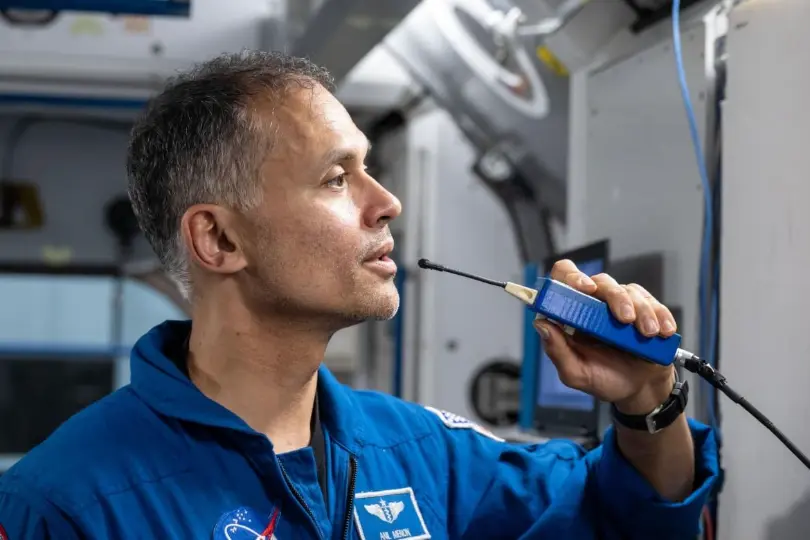
Lead image: (Dr. Anil Menon training in Houston ahead of his first ISS mission. Credit: NASA)