
The U.S. National Reconnaissance Office’s decision to move HawkEye 360 from experimental evaluation into an operational commercial radio-frequency intelligence role marks a significant step in the evolution of the commercial space-based intelligence market.
The development is important not simply because HawkEye 360 has won another government contract. The larger change is institutional: the U.S. intelligence community is moving toward treating commercially collected RF data as an operational intelligence resource rather than an experimental supplement to government-owned systems.
That distinction could have lasting consequences for how governments acquire signals intelligence, how satellite constellations are designed, and how commercial space companies compete in the defense market.
What Happened
On August 17, 2026, the National Reconnaissance Office announced an operational Commercial Radio Frequency Capabilities Augmentation, or CRFCA, contract with HawkEye 360.
The contract follows the NRO’s Commercial Radio Frequency Capabilities effort, which began in 2022. Under that earlier program, the agency awarded study contracts to six companies: Aurora Insight, HawkEye 360, Kleos Space, PredaSAR, Spire Global and Umbra.
The objective was to determine whether commercially operated RF sensing systems could provide useful intelligence capabilities alongside government systems.
The evaluation progressed from modeling and simulation to on-orbit demonstrations. HawkEye 360’s performance during those trials was sufficient for the NRO to conclude that its system was mission-ready.
The new CRFCA contract is structured differently from a conventional technology demonstration. Instead of being primarily designed to test whether a capability works, it provides a mechanism for the NRO to purchase and scale commercial RF collections as operational requirements change.
The financial value of the award has not been disclosed.
For HawkEye 360, the development also comes at a significant point in its corporate expansion. The company became publicly traded in 2026 and has been expanding beyond the U.S. government market, including international defense and maritime customers.
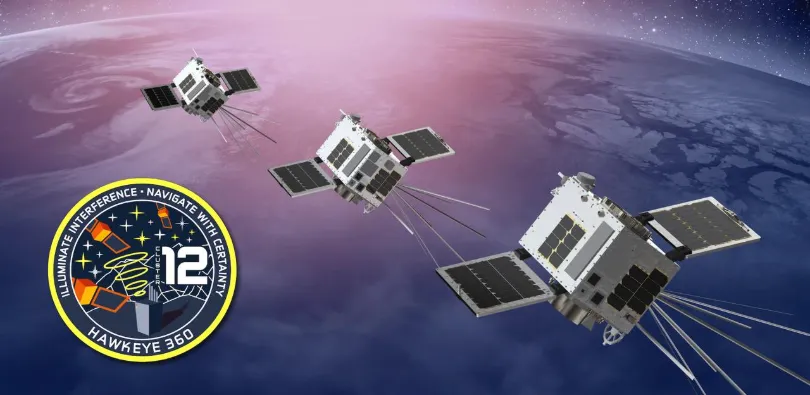
Its constellation now consists of more than 30 satellites in low Earth orbit, generally organized into three-satellite formations. The company is also pursuing higher collection capacity, faster data delivery and lower latency.
The significance of the NRO award therefore extends beyond one contract: it provides evidence that commercial RF sensing is progressing from a niche satellite-data business toward an operational component of national-security architectures.
Historical Background and Timeline
The commercial RF intelligence market developed later than commercial optical Earth observation because RF collection involves a different technical and regulatory problem.
Optical satellites produce images that can be inspected visually or processed using relatively mature computer-vision techniques. RF satellites instead collect electromagnetic emissions. Turning those measurements into useful intelligence requires sophisticated signal processing, geolocation algorithms, emitter libraries and knowledge of how individual transmitters behave.
HawkEye 360 was established around this opportunity.
2015 – HawkEye 360 is founded, with a business model centered on detecting and locating RF emissions from space.
2018 – The company launches its first Pathfinder cluster, demonstrating the use of multiple small satellites flying in formation to collect RF measurements.
2019 – The NRO awards HawkEye 360 a commercial integration study contract, beginning a formal effort to understand how commercial RF data could fit into the U.S. intelligence architecture.
2021 – The National Geospatial-Intelligence Agency awards HawkEye 360 an RF mapping contract, expanding the role of commercial RF data in government geospatial intelligence.
2022 – The NRO launches a broader commercial RF evaluation program, awarding study contracts to six companies covering different approaches to space-based RF sensing.
2025 – HawkEye 360 continues expanding its constellation, while Cluster 12 reaches full operational capability. The company also receives additional NRO funding and expands international activity.
2026 – The NRO awards HawkEye 360 the operational CRFCA contract, moving the relationship beyond experimentation toward recurring operational procurement.
The progression is revealing. Government agencies did not immediately treat commercial RF satellites as substitutes for classified intelligence systems. Instead, the technology was introduced through a sequence of demonstrations, studies, pilot programs and increasingly operational contracts.
That acquisition pathway resembles the broader evolution of commercial satellite imagery, in which governments gradually moved from buying experimental datasets to incorporating commercial imagery into routine intelligence workflows.
Technology Explained
RF intelligence is fundamentally different from conventional satellite imagery.
A camera observes reflected or emitted electromagnetic radiation and creates an image. An RF satellite instead listens for transmissions produced by radars, communications equipment, navigation systems, satellite terminals, maritime systems and other electronic devices.
The important information may include the frequency of a signal, its timing, waveform characteristics, strength, direction and changes over time.
A single satellite can detect an emission, but determining its precise location can be much more difficult.
This is why HawkEye 360 uses three-satellite formations.
When multiple satellites simultaneously observe the same emitter, differences in the arrival time and frequency of the signal at each spacecraft can be used to estimate the transmitter’s location. The technique relies on measurements commonly associated with time-difference-of-arrival and frequency-difference-of-arrival geolocation.
The satellites therefore function less like three independent cameras and more like a distributed sensor system.
The raw measurements are only the beginning. Signal-processing software must distinguish useful emissions from noise and interference, classify the emitter and compare the observed characteristics with previously collected signals.
Over time, the resulting database becomes an important competitive asset.
This is one reason commercial RF intelligence may be more difficult to commoditize than conventional satellite imagery. Two companies can theoretically operate satellites with similar size and sensor hardware, but their analytical performance can still differ substantially because of signal-processing algorithms, accumulated observations, emitter libraries and operational experience.
HawkEye 360’s current system covers a broad range of frequencies and uses software-based processing to detect, characterize and geolocate different types of emitters.
The company’s next challenge is latency.
A satellite intelligence product that arrives hours after collection can be useful for strategic analysis. A product delivered within minutes can support tactical decision-making.
HawkEye 360 has therefore been pursuing shorter revisit intervals, faster processing and eventually much lower end-to-end latency. Achieving that goal will require more satellites, improved ground infrastructure and potentially hosted payloads, onboard processing and faster satellite-to-ground communications.
Why It Matters
The most important change is the transition from commercial data as an experiment to commercial data as infrastructure.
Government intelligence agencies historically relied heavily on satellites that they owned, controlled and operated themselves. Those systems remain essential for highly sensitive missions, but they can be expensive, slow to develop and difficult to scale.
Commercial constellations offer a different model.
Instead of buying an entire satellite architecture, a government customer can purchase access to data generated by an existing constellation.
That changes the economics of intelligence collection.
A commercial provider can spread the cost of its satellites across multiple customers. A government can potentially obtain global coverage without deploying a dedicated sensor for every mission.
Commercial data can also be shared more easily among partners when its classification and ownership structure permit it.
For the NRO, this makes RF sensing particularly attractive because the commercial sector can add another layer to the agency’s existing intelligence architecture.
RF data also complements rather than replaces optical and radar imagery.
An optical satellite might show a ship in a harbor. An RF constellation could identify radio activity associated with that ship or detect electronic emissions in an area even when optical imaging is obstructed by clouds or darkness.
Synthetic-aperture radar can provide another layer of information, particularly for vessels and infrastructure that are difficult to observe optically.
The future intelligence architecture is therefore increasingly likely to combine multiple sensing modalities rather than depend on a single satellite type.
Industry Comparison
HawkEye 360 is not alone in commercial RF intelligence.
France-based Unseenlabs has built a rapidly expanding RF constellation, initially focused heavily on maritime surveillance. By 2026, its constellation had reached more than 20 satellites, while its next-generation systems were being designed to expand into terrestrial and space-domain RF monitoring.
The two companies illustrate different approaches to the same market.
HawkEye 360 has emphasized formation flying with multiple satellites working together, broad RF coverage and integration with defense and intelligence customers.
Unseenlabs has developed a different architecture in which individual satellites can perform RF geolocation, reducing dependence on multi-satellite formations for some missions.
Spire Global has also demonstrated RF geolocation capabilities, particularly through its broader LEO sensing infrastructure.
The competitive question is therefore no longer simply who can detect an RF signal.
The more important questions are:
- How quickly can the signal be detected?
- How accurately can it be located?
- Can the emitter be identified?
- Can its behavior be tracked over time?
- Can the data be fused with imagery, AIS, navigation and other intelligence?
- Can the provider deliver the result directly into an operational workflow?
This favors companies with both satellites and sophisticated software infrastructure.
It also creates a barrier to entry. Launching a few RF satellites does not automatically create a useful intelligence business. The value increasingly lies in the accumulated dataset and processing ecosystem surrounding the constellation.
Market and Industry Impact
The NRO’s decision could accelerate the development of the commercial RF intelligence market in several ways.
First, it provides stronger validation for investors and other government customers. A government intelligence agency moving from trials to operational procurement demonstrates that the technology has passed an important credibility threshold.
Second, it could encourage more specialized RF satellite constellations.
The commercial Earth-observation industry has already demonstrated how government demand can support large constellations whose data is subsequently sold to commercial customers. RF intelligence could follow a similar path.
Third, it may accelerate the shift from satellite hardware procurement toward Data-as-a-Service.
A government that purchases RF intelligence does not necessarily need to own the spacecraft. Instead, it can purchase access to a sensor network and integrate the resulting information into its own systems.
This model is particularly attractive for countries that do not have the financial or technical resources to build a sovereign RF satellite constellation.
The market could also expand beyond military intelligence.
RF monitoring has applications in maritime surveillance, illegal fishing detection, GNSS interference monitoring, border security, disaster response, spectrum management and infrastructure protection.
As satellite revisit rates improve, the distinction between strategic intelligence and operational monitoring could become increasingly blurred.
China Space Perspective
China has substantial experience with space-based RF sensing, but its development model differs from the U.S. commercial approach.
Chinese military and government satellite programs have included spacecraft associated with RF detection and geolocation missions. The Yaogan-31 series, for example, has been widely assessed by external analysts as having an RF intelligence or electronic intelligence role.
The important distinction is that these capabilities are primarily associated with government and state-linked space programs rather than a transparent commercial RF-data market comparable to HawkEye 360 or Unseenlabs.
China’s commercial satellite industry has instead developed much more visibly around optical remote sensing.
Companies operating Jilin-1, SuperView and other commercial constellations have built large Earth-observation networks and commercial data businesses. This provides China with a substantial foundation in satellite-based geospatial intelligence, but RF intelligence requires a different combination of payload technology, signal-processing expertise and long-term emitter data accumulation.
That does not mean China lacks the underlying technical capability.
China has strong capabilities in communications satellites, electronic warfare, signal processing, remote sensing and large-scale constellation deployment. The more significant question is whether those capabilities will increasingly be packaged into commercially accessible RF intelligence services.
If that happens, the Chinese commercial space sector could eventually develop an RF data market serving maritime monitoring, spectrum management, navigation-interference detection and security applications.
For Chinese commercial space companies, the HawkEye 360 model is therefore relevant less as a direct competitor and more as an example of how a specialized satellite sensor can evolve into a data and intelligence business.
The commercial opportunity is potentially broader than simply selling satellite observations. A successful RF company can combine spacecraft, signal processing, analytics, geolocation and customer-specific intelligence products into a vertically integrated service.
Long-Term Implications
The next three to ten years will determine whether commercial RF intelligence becomes a major segment of the space economy or remains a specialized defense market.
The strongest indicator will be the speed at which commercial providers can reduce latency.
A constellation delivering RF data every few hours has strategic value. A network capable of detecting, locating and characterizing an emitter within minutes has substantially greater tactical value.
That transition will require more than additional satellites. It will require onboard processing, faster communications, automated signal classification, cross-satellite coordination and integration with other intelligence sources.
The eventual objective is not simply a larger RF constellation. It is a persistent intelligence layer capable of automatically correlating RF activity with imagery, radar, maritime tracking and other data.
That could fundamentally change the role of commercial satellite operators.
Instead of selling individual satellite observations, companies could increasingly sell continuously updated representations of activity on Earth.
For defense customers, this would support faster detection and decision-making. For commercial customers, it could provide new tools for maritime security, infrastructure monitoring and spectrum awareness.
The NRO’s move with HawkEye 360 is therefore best understood as part of a larger transformation in satellite intelligence procurement.
The United States is not abandoning government-owned intelligence satellites. Rather, it is building a layered architecture in which government systems and commercial constellations perform complementary roles.
If HawkEye 360 can deliver the lower latency and higher persistence it is targeting, RF intelligence could become one of the clearest examples of how commercial small-satellite constellations are moving from technology demonstrations into operational national-security infrastructure.
The broader lesson for the satellite industry is equally important: the competitive advantage is shifting away from simply putting sensors in orbit. Increasingly, the value lies in turning persistent streams of space-based measurements into timely, reliable and operationally useful intelligence.