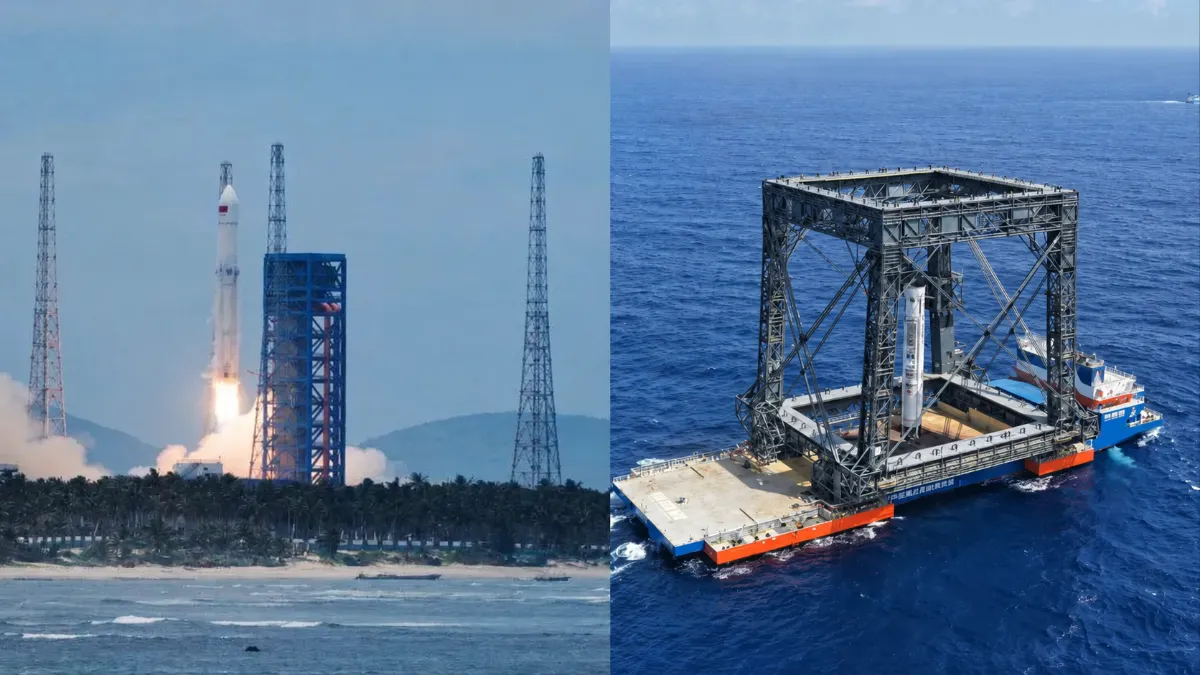
China’s reusable-rocket race has reached a turning point. With the Long March-10B completing an offshore net-capture recovery and Zhuque-3 Y2 landing its first stage on deployable legs, the country has demonstrated that it can recover intact boosters from orbital-class missions. But landing a rocket is not the same as reusing it—and reuse does not automatically make launches cheaper. The real test now is whether recovered stages can be inspected, refurbished and flown again safely, quickly and economically. These six metrics offer a practical framework for assessing when China’s reusable rockets move from headline-making demonstrations to routine commercial operations.
First, whether the same first stage has flown again. This is the clearest evidence that recovery has progressed to actual reuse. The stage must also complete an orbital launch mission, rather than merely perform a low-altitude takeoff-and-landing test.
Second, what must be inspected and replaced after recovery. If the stage requires only visual inspections, data analysis and replacement of a few consumable components, it may have strong turnaround potential. If every flight requires extensive disassembly and refurbishment, much of the cost advantage will disappear.
Third, how long it takes for a recovered stage to become flight-ready again. Calendar turnaround time should be distinguished from actual labor hours, while non-technical delays such as mission scheduling and launch-site availability should be excluded.
Fourth, whether reliability remains stable over multiple flight cycles. Assessments should cover not only engine and structural life but also frequently overlooked components such as valves, connectors, avionics, thermal protection and landing systems.
Fifth, payload capacity and pricing in reusable mode. Flight count, payload penalties, recovery infrastructure and refurbishment expenses must all be included in the same cost model. It is not enough to calculate how much was saved by avoiding the manufacture of a new first stage.
Sixth, whether launch demand can support the fleet. High-frequency reuse requires a steady order book, satellites produced at scale, sufficient launch-pad capacity, launch and test crews, and a reliable recovery support system. Without enough missions, even a rocket capable of rapid turnaround may remain idle for long periods.
Recovery Does Not Automatically Make a Rocket Cheaper—Here Is How the Economics Work
An expendable rocket must absorb the manufacturing cost of a new first stage on every flight. A reusable rocket seeks to spread the first stage’s manufacturing and initial qualification costs across all the flights it performs during its service life.
However, expendable hardware such as the upper stage must still be included in the mission cost. Reusability also introduces additional expenses, including return propellant, recovery hardware, reduced payload capacity, recovery pads or vessels, transportation, inspection, maintenance and reflight certification.
Amortized first-stage manufacturing cost ≈ First-stage manufacturing and initial qualification cost ÷ Actual lifetime flight count
Total cost per mission ≈ Manufacturing amortization + Expendable hardware such as the upper stage + Recovery and transportation + Inspection and refurbishment + Launch operations + Risk and idle-capacity allocation
Cost per unit of payload ≈ Total mission cost ÷ Actual payload mass delivered to orbit
The “actual lifetime flight count” includes both the first flight and all subsequent reflights. It should not be confused with the number of times a stage has been reused.
If a first stage is designed for 20 flights but retires after only two missions because of insufficient demand, an abnormal condition or a vehicle upgrade, its manufacturing cost cannot be spread effectively across its intended service life.
These equations are intended only to illustrate the underlying cost structure; they are not corporate accounting formulas. Actual economics must also account for depreciation methods, financing costs, insurance, taxes, mission configuration and fleet utilization.
The payload penalty associated with recovery must also be considered. A first stage needs to reserve propellant for its return and landing, while carrying additional equipment such as grid fins, attitude-control systems, capture mechanisms or landing legs. Consequently, the same rocket will generally carry less payload in reusable mode than in expendable mode.
Customers are therefore not purchasing the recovery maneuver itself. They are purchasing a combination of price per unit of payload, mission reliability, launch-window availability and delivery speed.
The operational lessons of the Space Shuttle are relevant, but they cannot be applied directly to modern vertically returning rocket stages. The Shuttle consisted of a winged orbiter, recoverable solid rocket boosters and an expendable external tank. Its mission profile, reentry environment, thermal-protection area and ground-support system were fundamentally different from those of a vertically returning first stage.
What the Shuttle demonstrated is that reusable hardware does not automatically deliver lower operating costs. Inspections, maintenance, thermal-protection repairs and responses to unplanned faults may still consume substantial turnaround resources. NASA’s reviews of reusable and expendable launch-vehicle operations have highlighted many of the same constraints.
Whether the commercial model works ultimately depends on two factors: whether the vehicle was designed from the outset to minimize maintenance requirements, and whether the market can provide enough missions to sustain frequent flights.
Conclusion
The Long March-10B and Zhuque-3 Y2 have now completed offshore net-capture recovery and land-based recovery using landing legs, respectively. Together, these achievements have advanced China’s orbital-class rockets from merely attempting controlled returns to successfully recovering intact first-stage hardware.
The next milestone will attract less attention, but it will matter more to the industry: safely handling the recovered stage, thoroughly inspecting it, assessing its remaining service life, completing limited repairs, clearing it for flight and then launching it again with an operational payload.
The industry must subsequently repeat that process across more first stages, more missions and more reuse cycles.
China’s reusable rockets will have truly entered the operational era when recovery is no longer an experiment watched with bated breath across the industry, but a stable and predictable part of routine launch-site operations—and when reflight counts, turnaround times and cost per unit of payload can be verified consistently.
Related Article: Decoding the Six Reusable Rockets Successfully Recovered Worldwide