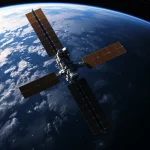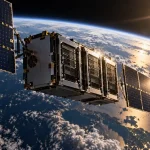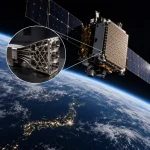
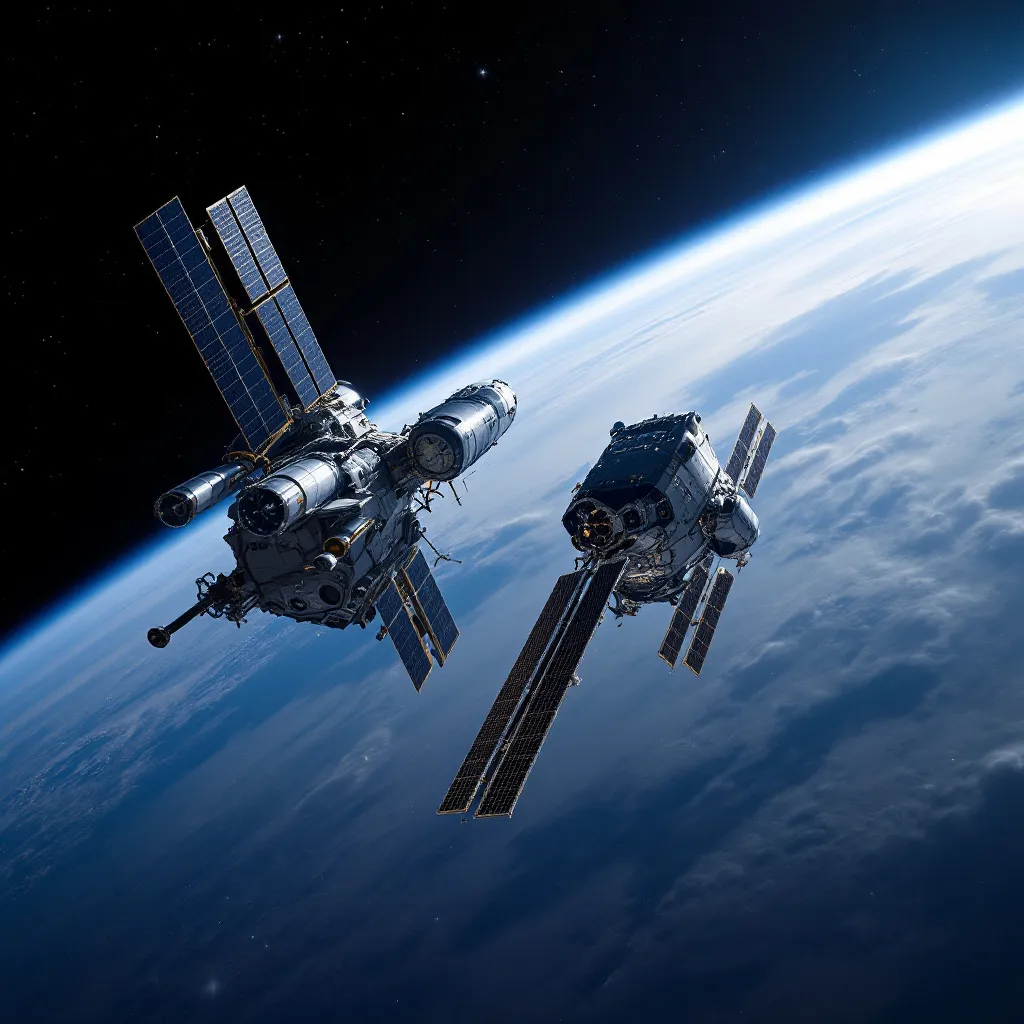
Two Impulse Space Mira orbital transfer vehicles approached within approximately 200 meters of each other in low Earth orbit during a July 2026 rendezvous and proximity operations demonstration, the California-based company announced September 8. The maneuver involved spacecraft launched on the LEO Express 2 and LEO Express 3 missions and demonstrated controlled orbit matching, close approaches and mutual imaging between two independently operated vehicles.
The operation began in February, when the LEO Express 2 Mira performed an extended engine burn to reduce its separation from the LEO Express 3 spacecraft. A series of smaller burns during the spring and summer gradually aligned the vehicles’ orbits.
In July, LEO Express 2 conducted multiple close approaches, initially passing within about 820 meters of LEO Express 3 before reducing the distance to approximately 200 meters, or 650 feet. Cameras aboard both spacecraft photographed the other vehicle during the operation, providing visual data from different ranges and viewing geometries.
Starfish Space and non-Earth imaging specialist HEO supported the demonstration. Impulse did not disclose whether the final approach was conducted autonomously or under ground-commanded guidance, nor did it report an attempted docking or physical capture. The test therefore demonstrated proximity flight, maneuvering and inspection-related capabilities rather than the complete sequence required for satellite servicing.
“These types of dynamic, agile maneuvers are how we unlock full access to space after launch and create new mission possibilities,” Impulse Space founder and CEO Tom Mueller said. Mueller founded Impulse in 2021 after serving as SpaceX’s first propulsion employee and leading development of the company’s Merlin rocket engine family.
The two spacecraft reached orbit on separate SpaceX rideshare launches from Vandenberg Space Force Base in California. LEO Express 2 launched aboard Transporter-12 on January 14, 2025, while LEO Express 3 flew on Transporter-15 on November 29, 2025.
LEO Express 3 was the first flight of an upgraded Mira design incorporating deployable gimbaled solar arrays, reaction wheels, enhanced propulsion systems and avionics intended to establish flight heritage for Impulse’s larger Helios kick stage. Its mission also included CubeSat deployment and hosted payload operations for multiple customers.
Mira is a compact, high-thrust spacecraft designed for payload hosting, deployment and orbital transfer missions. The current configuration can carry as much as 300 kilograms of payload in more than one cubic meter of available volume. Depending on payload mass, Impulse lists a total velocity-change capability ranging from 550 meters per second with a 300-kilogram payload to 850 meters per second with a 100-kilogram payload.
The vehicle uses eight Saiph bipropellant thrusters burning nitrous oxide and ethane. Each engine produces about 26 newtons of thrust, providing a combined available thrust of 208 newtons on the upgraded vehicle. Reaction wheels and 20 cold-gas thrusters provide six-degree-of-freedom attitude control, supporting the pointing and translation maneuvers needed for payload deployment, imaging and proximity operations.
The July flyby was Impulse’s second disclosed close-approach demonstration involving Mira. During the Remora mission in late 2025, LEO Express 2 approached the first Mira, launched on LEO Express 1 in November 2023, to within approximately 1,250 meters.
For Remora, Starfish’s Cetacean computer-vision software processed images from a single lightweight camera to estimate the target’s relative position. Those estimates fed the company’s Cephalopod guidance, navigation and control software, which calculated trajectories and issued thruster commands in a closed loop. The mission demonstrated an autonomous rendezvous architecture using a hosted camera and peripheral flight computer rather than a larger suite of dedicated sensors.
The reduction in minimum separation from 1,250 meters during Remora to about 200 meters in the latest operation extends Mira’s demonstrated proximity-flight envelope. Repeated close approaches are relevant to commercial inspection, satellite life extension, orbital debris removal and repositioning missions, as well as government space-domain awareness and responsive-space operations. Such missions require accurate relative navigation, sufficient propulsion authority and carefully managed trajectories to prevent collision with the target.
Impulse said it plans to continue demonstrating mission profiles suited to Mira’s high-thrust propulsion and maneuverability. Future tests will need to address progressively closer operations and, where required by a customer mission, terminal approach, station-keeping and docking or capture.