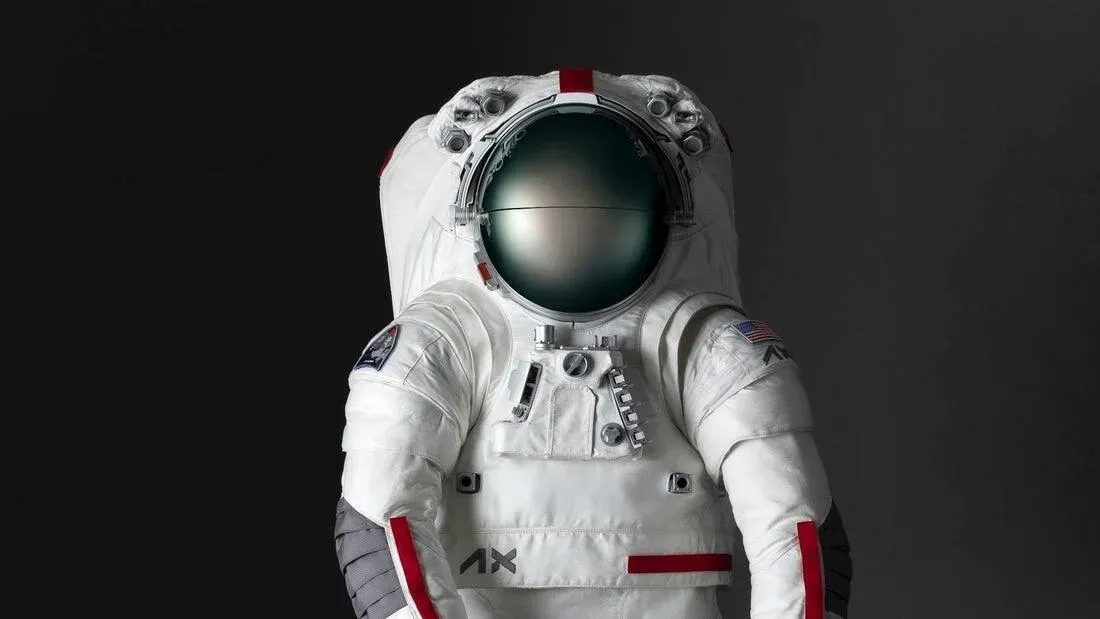
NASA is developing a simplified version of Axiom Space’s lunar spacesuit to reduce schedule risk ahead of the first Artemis crewed landing, now planned for early 2028. Reportedly known internally as the “sortie suit,” the configuration would remove or defer some of the mass, complexity and long-duration capabilities included in the original Axiom Extravehicular Mobility Unit, while retaining the systems needed to keep astronauts safe and operational during the initial lunar missions.
The effort addresses growing concern over the readiness of a mission-critical system. NASA has not publicly announced the sortie configuration or identified which AxEMU requirements could be modified. However, an April 2026 report by NASA’s Office of Inspector General found that the suit development schedule had little to no margin remaining.
As of January, Axiom was working toward a late-2027 demonstration of the suit, leaving limited time to complete testing, qualification, lander integration and certification before the planned Artemis 4 landing. A delay in any of those activities could affect the broader mission schedule even if the Space Launch System rocket, Orion spacecraft and lunar lander are ready.
The original AxEMU requirements were written to support more demanding operations than astronauts may conduct during the first Artemis landing. The suit was expected to support up to six extravehicular activities during a 6.5-day surface mission and remain capable of performing additional EVAs after as many as 210 days in dormant storage.
NASA also required the system to support excursions into permanently shadowed regions near the lunar south pole. Those environments can be substantially colder than sunlit terrain and require more demanding thermal protection, power management and life-support performance.
A sortie-focused configuration would prioritize the capabilities required for an initial, relatively short lunar expedition. More demanding functions could then be introduced as Artemis missions progress toward longer surface stays, wider travel distances and operations in extreme thermal environments.
The approach would represent a phased development strategy rather than the abandonment of NASA’s longer-term spacesuit requirements. It could allow Axiom to qualify a minimum operational configuration for the first landing while continuing to mature the full AxEMU architecture for later missions.
NASA has given no indication that it plans to relax fundamental crew-safety standards. The distinction is between life-critical requirements and operational capabilities intended for missions that the first flight article may not be required to perform.
AxEMU has already completed substantial development and testing. NASA reported in late 2025 that the program had exceeded 700 hours of crewed pressurized testing and completed its first two-suit test in the Neutral Buoyancy Laboratory. The underwater facility allows astronauts and engineers to evaluate mobility, procedures, tools and suit interfaces under conditions that approximate some aspects of working in reduced gravity.
The suit is designed to provide greater mobility than the Apollo-era lunar suits, including improved bending and movement for geological sampling and surface equipment operations. It must also accommodate a wider range of astronaut body sizes and integrate life support, thermal control, communications, displays, gloves, boots and protection against abrasive lunar dust.
The development program has become more consequential since Collins Aerospace withdrew from its next-generation spacesuit work. NASA selected Axiom and Collins in 2022 under the Exploration Extravehicular Activity Services contract, known as xEVAS. The agency and Collins subsequently agreed to remove the company’s task orders, leaving Axiom as NASA’s only active provider for its immediate lunar and microgravity spacesuit requirements.
AxEMU must also interface with two independently developed human landing systems. SpaceX is building a lunar version of Starship, while Blue Origin is developing its Blue Moon Mark 2 lander. The suit must function not only on the lunar surface but also as part of each lander’s broader architecture, including stowage, servicing, communications and the physical interfaces used as astronauts move between the crew compartment and the surface.
Reducing the complexity of those interfaces is reportedly one objective of the sortie-suit effort. Common or simplified procedures could lower integration and training demands, although the suit will still need to accommodate differences between the SpaceX and Blue Origin vehicles.
The spacesuit work is unfolding alongside NASA’s revised Artemis mission sequence. Artemis 3, scheduled for 2027, is now planned as a crewed demonstration in low Earth orbit rather than a lunar landing. The mission is intended to test rendezvous and docking between Orion and commercial lunar-lander hardware before astronauts attempt a descent to the Moon.
NASA is also evaluating whether Artemis 3 could be used to test interfaces between AxEMU and the landers. Such testing would provide operational data before Artemis 4, which is targeted to return astronauts to the lunar surface near the south pole in early 2028.
If the simplified configuration can be completed and qualified on time, NASA would gain additional schedule flexibility without giving up the more capable suit required for sustained lunar exploration. The immediate challenge is to finalize the reduced requirement set, complete integrated testing with the lander systems and demonstrate that the flight configuration is ready before Artemis 4 enters its final launch preparations.