LEIDEN, Netherlands — Astrophysicist Dr. Kelly Holley-Bockelmann has joined the Netherlands Institute for Space Research (SRON) to lead multi-messenger astrophysics research and data modeling for the Laser
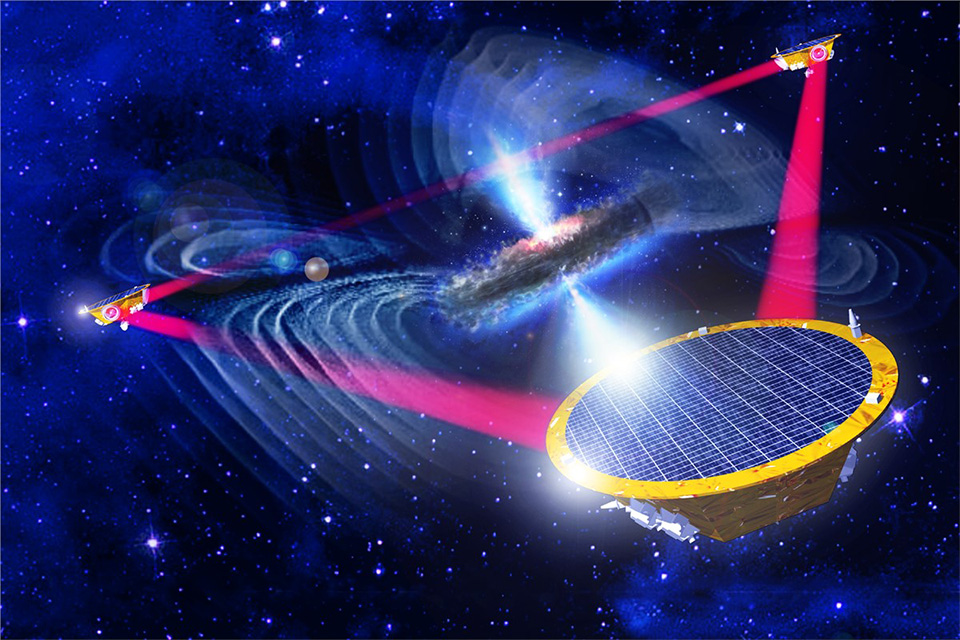
Interferometer Space Antenna (LISA) satellite constellation, the institute confirmed on Sunday, Nov. 8, 2026. Holley-Bockelmann, who chairs NASA’s LISA Study Team and previously chaired the agency’s Astrophysics Advisory Committee (APAC), will guide the development of orbital extraction algorithms required to interpret gravitational wave signals collected across the three-spacecraft formation.
Low-Frequency Gravitational Waves and Space-Based Interferometry Rationale

While ground-based interferometers such as the Laser Interferometer Gravitational-Wave Observatory (LIGO) detect high-frequency gravitational ripples produced by stellar-mass black hole collisions, terrestrial seismic noise blinds surface detectors to lower frequency bands. LISA circumvents these limits by deploying an orbital interferometer into deep space, targeting millihertz frequencies to observe supermassive black hole mergers, extreme mass-ratio inspirals, and primordial cosmological fluctuations. Holley-Bockelmann’s computational frameworks translate these complex multi-satellite laser interference patterns into observable astrophysical data.
LISA Constellation Geometry and Optoelectronic Specifications
Holley-Bockelmann’s scientific work centers on the ESA-led LISA mission, an international gravitational wave space observatory developed in partnership with NASA. The orbital observatory features an unprecedented scale:
- Constellation Baseline: The three spacecraft form an equilateral triangle with laser arm lengths extending 2.5 million kilometers, exchanging continuous infrared laser beams to measure path-length variations with picometer-scale precision.
- Optical Assemblies: Each spacecraft carries two optical benches coupled to six ultra-stable Zerodur telescopes engineered by Thales Alenia Space to transmit and collect 1,064-nanometer laser light across deep space.
- Inertial Sensing and Pointing: Gold-platinum test masses float free from non-gravitational forces inside gravitational reference sensors, while Teledyne Space Imaging’s Constellation Acquisition Sensor ensures sub-micro-arcsecond inter-satellite optical alignment.
Industrial Integration and 2035 Launch Roadmap
Following formal mission adoption by ESA and prime industrial contracts led by OHB SE, flight hardware testing is progressing through optical testbeds and hardware-in-the-loop simulators. The LISA observatory is scheduled to launch in 2035 aboard an Ariane 6 rocket from Europe’s Spaceport in Kourou, French Guiana, initiating an initial 4.5-year operational science campaign.