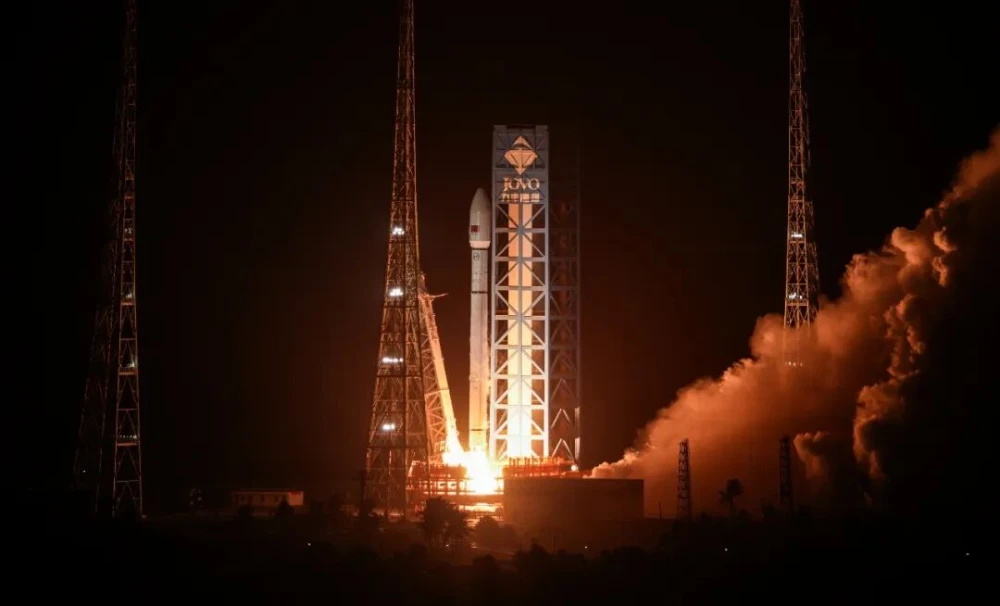
China launched Satellite Internet Low-Orbit Group 29 aboard a Long March 12 rocket at 4:24 a.m. Beijing time on November 9, or 20:24 UTC on November 8, from the Hainan Commercial Space Launch Site near Wenchang. The satellites entered their planned orbit, continuing the rapid deployment of the country’s low-Earth-orbit communications infrastructure.
“Group 29” is the mission’s official batch designation and does not mean the rocket carried 29 spacecraft. The China Aerospace Science and Technology Corporation said its Fifth Academy, also known as the China Academy of Space Technology, led development of the satellite group. CASC’s commercial-rocket subsidiary led the launch-vehicle program, with the Shanghai Academy of Spaceflight Technology responsible for developing the Long March 12.
China’s Ministry of Industry and Information Technology said it had completed domestic frequency coordination for the satellites before launch. The ministry also issued space-radio-station licenses and radio-frequency-use permits in batches, providing the regulatory approvals needed to operate the satellite communications system.
Long March 12 supports batch constellation deployment
The Long March 12 is a two-stage, liquid-oxygen and kerosene rocket about 62 meters tall. It is China’s first four-meter-class, single-core launch vehicle and is designed for both individual spacecraft and multi-satellite deployment missions.
Its first stage uses four liquid-oxygen and kerosene engines, each producing 1,250 kilonewtons of thrust. CASC rates the rocket to carry at least 12 metric tons to low Earth orbit and at least 6 metric tons to a 700-kilometer sun-synchronous orbit.
The vehicle can use either a 4.2-meter- or 5.2-meter-diameter payload fairing, allowing it to accommodate different satellite arrangements. It also uses horizontal assembly, horizontal testing and horizontal transport before being erected at the pad, a processing model intended to shorten launch preparations and support a higher flight rate.
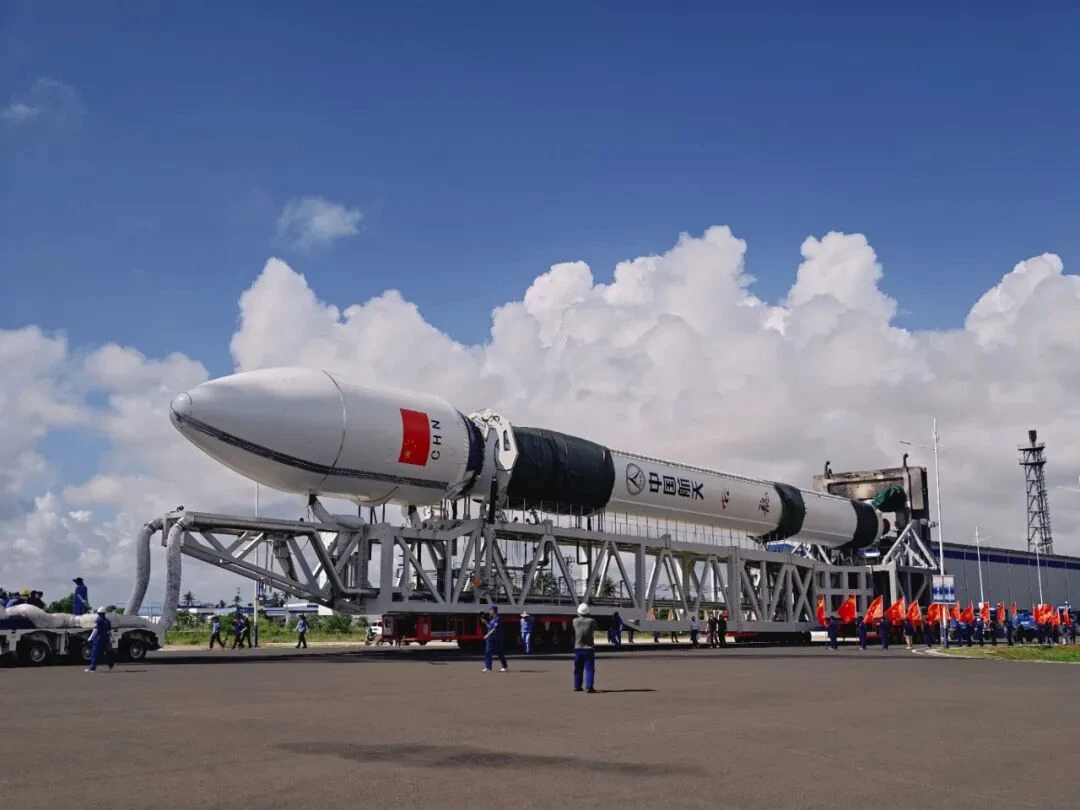
Long March 12 Rocket During Horizontal Transport
Long March 12 made its debut on November 30, 2024, simultaneously conducting the first launch from the Hainan Commercial Space Launch Site. The spaceport’s second launch position is China’s first general-purpose medium-lift pad for liquid-propellant rockets and can accommodate launch vehicles with core diameters ranging from 3.35 to 5 meters.
The Group 29 mission was the 10th Long March 12 flight and its sixth launch of 2026. It was also the 676th launch of the broader Long March rocket family.
Deployment cadence reaches 15-day intervals
The latest mission followed the launch of Satellite Internet Low-Orbit Group 28 aboard a Long March 8A from Hainan on October 25. Group 27 flew on another Long March 12 on October 10, placing the three most recent deployments at 15-day intervals.
Groups 25 and 26 were launched on September 17 and September 23, respectively. China therefore deployed five consecutive satellite internet groups from Hainan in 53 days, using both the Long March 12 and Long March 8A. The use of two medium-lift vehicles provides parallel launch capacity for the constellation campaign.
Although the Group 29 announcement did not identify an operator, Chinese government material has associated the numbered low-orbit deployments with the state-backed GW satellite internet system managed by China Satellite Network Group. The deployment campaign began with Group 01 in December 2024.
CASC has separately described GW as a planned 12,992-satellite network. Current program targets call for approximately 1,300 spacecraft to be deployed by the end of 2029 and for the constellation to be completed by 2035. Chinese authorities have not announced a launch date for the next numbered group.
As satellite manufacturing capacity expands and constellation deployment accelerates, operators have access to a broader range of cost-competitive mission options. STARPATH GLOBAL provides customized satellites, payloads and AIT equipment, and organizations planning a demonstration spacecraft or constellation can discuss your technical and delivery requirements with the STARPATH GLOBAL team to identify a configuration aligned with their objectives, schedule and budget.