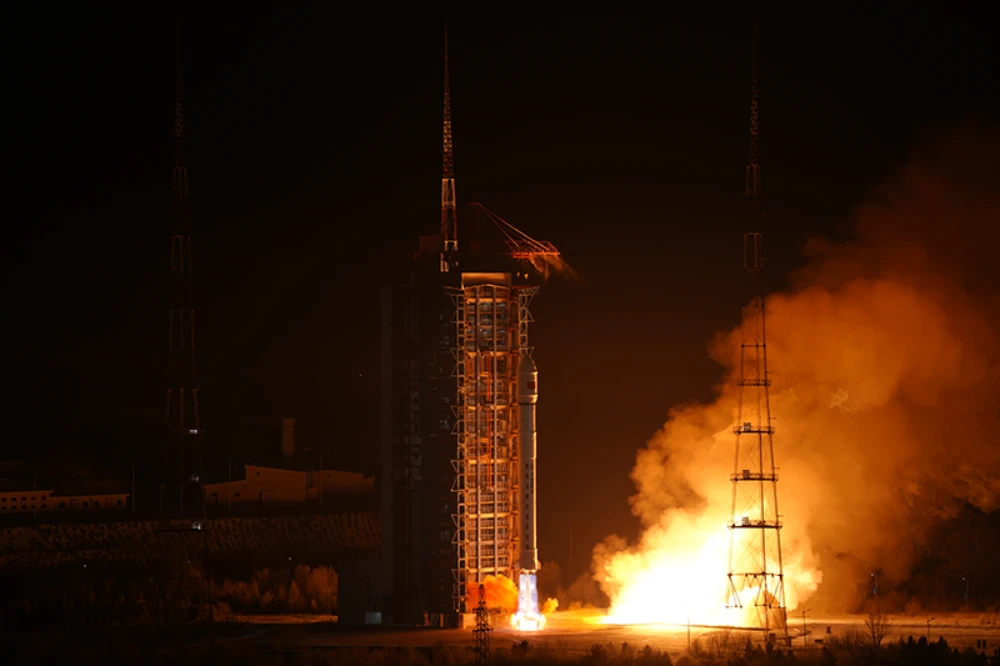
China launched the Shijian-24 satellite aboard a Long March 2D rocket from the Taiyuan Satellite Launch Center at 6:51 a.m. Beijing time on Nov. 19, 2026, equivalent to 22:51 UTC on Nov. 18. The spacecraft entered its planned orbit, marking the 678th flight of the Long March launch vehicle family.
The Shijian series dates to Shijian-1, launched in March 1971 as China’s first scientific experimental satellite. Spacecraft carrying the Shijian designation have since supported a broad range of space-science investigations and in-orbit technology experiments. That program history does not establish Shijian-24’s specific role, however, because individual satellites in the series have been developed for different objectives.
The Long March 2D is a two-stage, storable-liquid launch vehicle developed by the Shanghai Academy of Spaceflight Technology under the China Aerospace Science and Technology Corporation. It can conduct single- and multi-satellite missions to different orbits and has a published capacity of 1.3 metric tons to a 700-kilometer circular sun-synchronous orbit. That performance figure describes the rocket’s general capability and does not confirm Shijian-24’s destination orbit.
Taiyuan, located in Shanxi province, routinely supports missions to polar and sun-synchronous trajectories. The launch center’s inland location and available flight paths make it one of China’s primary facilities for deploying remote-sensing, scientific and experimental spacecraft.
The Shijian-24 mission followed another Long March 2D launch eight days earlier. On Nov. 11, the vehicle launched the Tanyuan program Pathfinder satellite from the Jiuquan Satellite Launch Center in the 677th Long March flight, demonstrating the rocket’s use across multiple launch sites within a short operational interval.
As satellite programs move from technology development to launch and in-orbit validation, STARPATH GLOBAL helps international customers access cost-competitive complete satellites, payloads, and assembly, integration and testing (AIT) solutions. Organizations planning new satellite missions can contact STARPATH GLOBAL to identify configurations aligned with their technical requirements, budgets and delivery schedules, with support extending from initial mission definition through final delivery.